


On this page
- A pipe wrench is an adjustable tool with toothed jaws that tighten as you pull, made for round pipe.
- Most homes need a 10-inch and a 14-inch straight wrench.
- Use it on GI and steel pipe. Its teeth mark chrome, brass, CPVC and PVC.
- Pull the handle towards the open side of the hook jaw, and never use a cheater bar.
- Buy forged steel with sharp teeth and a smooth adjusting nut.
A pipe wrench is an adjustable plumbing tool with toothed jaws that grips and turns round pipes and pipe fittings. Its jaws tighten their grip as you pull the handle, which is why plumbers use it on threaded GI and steel pipe. In India it is often called a "pipe pana".
What Is a Pipe Wrench and How Does It Grip?
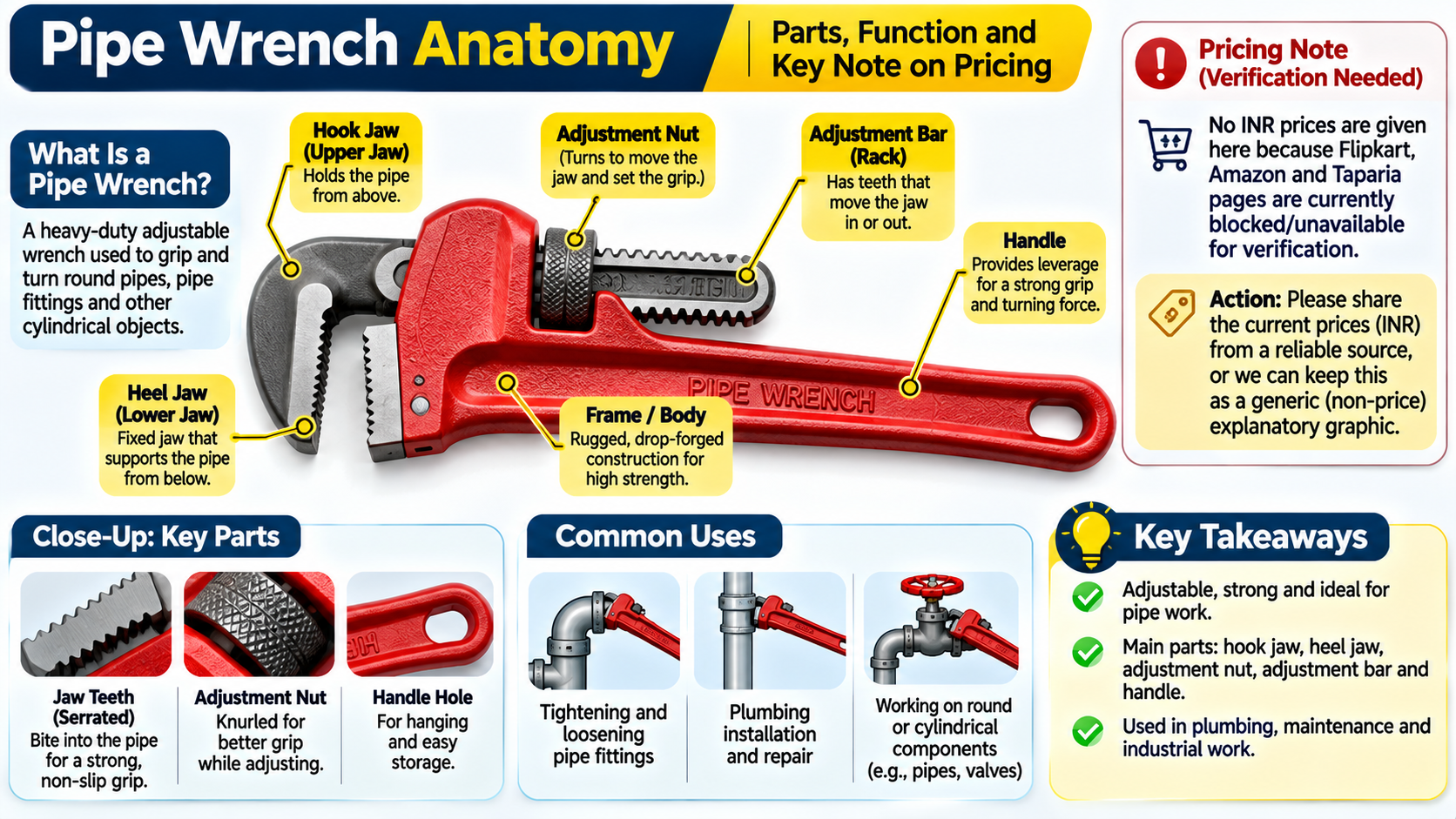
A pipe wrench grips because its hook jaw tilts slightly under load, so pulling the handle presses the teeth harder into the pipe. The design comes from Daniel C. Stillson, a mechanic at the Walworth Company in Massachusetts, which is why it is also called a Stillson wrench.
A pipe wrench has four main parts:
- Hook jaw: the movable upper jaw with hardened teeth.
- Heel jaw: the fixed lower jaw, also toothed.
- Adjusting nut: a knurled nut that sets the jaw opening.
- Handle: the length that gives leverage and names the size.
Which Type of Pipe Wrench Do You Need?
Most homes need a straight pipe wrench. The other types solve specific problems:
- Straight (Stillson) wrench: the everyday default for bathroom, kitchen and tank pipework.
- Offset wrench: angled jaws reach pipes close to walls and behind fittings.
- Chain wrench: a chain wraps large or awkward pipes, such as borewell lines.
- Compound-leverage wrench: extra linkage multiplies force on seized joints.
How Do You Choose the Right Pipe Wrench Size?
Choose a pipe wrench by matching its jaw capacity to your largest pipe. Pipe wrenches are sized by overall length, and a longer wrench opens wider.
Pipe wrench size and pipe capacity
RIDGID heavy-duty straight wrenches| Wrench length | Max pipe capacity | Typical home use |
|---|---|---|
| 8 in (200 mm) | 25 mm | Taps, ½–¾ in fittings |
| 10 in (250 mm) Default pick | 40 mm | Bathroom and kitchen lines |
| 14 in (350 mm) | 50 mm | Main lines, tank outlets |
| 18 in (450 mm) | 65 mm | Larger GI and pump lines |
| 24 in (600 mm) | 80 mm | Borewell and heavy pipework |
A 10-inch and a 14-inch wrench cover almost every household job. An oversized wrench on a small fitting applies too much force and can crack it.
How Do You Use a Pipe Wrench Correctly?
Use a pipe wrench by setting the jaws snug, facing the hook jaw in the turning direction, and pulling the handle smoothly.
- Open the jaws so the pipe sits deep in the hook jaw, with a small gap at the back.
- Face the jaw opening in the direction you want to turn.
- Pull, don't push. Pull the handle towards you so a slip doesn't throw your hand forward.
- Hold the fitting with a second wrench turned the other way, so you don't twist the joint behind it.
- For a seized joint, apply penetrating oil, wait, then use steady force.
Do not slide a pipe over the handle as a "cheater bar"; it can bend the handle or snap the jaw. Never work on a pressurised water line or any gas line. Wear gloves and eye protection.
Can You Use a Pipe Wrench on Every Pipe Material?
No, a pipe wrench suits GI and steel pipe but damages softer materials. The teeth mark brass, copper, chrome, CPVC and PVC.
Which wrench to reach for
By job| Job | Best tool |
|---|---|
| GI or steel threaded pipe | Pipe wrench |
| Chrome taps and brass fittings | Strap wrench, or a pipe wrench over a thick cloth |
| CPVC and PVC pipe | Strap wrench or hand-tight; never toothed jaws |
| Hex nuts and bolts | Spanner or adjustable (monkey) wrench |
| Large or rough pipe | Chain wrench |
A pipe wrench rounds off the corners of hex nuts, so use it on a nut only when the nut is already stripped and will be replaced.
What Should You Look For When Buying a Pipe Wrench?
Look for a forged steel body, hardened teeth, a smooth-turning adjusting nut and the brand's name stamped on the tool. Price depends on size, material and brand.
- Forged steel or chrome-vanadium: strong and affordable; heavier to carry
- Aluminium handle: lighter to carry; costs more
- Sharp, even teeth on both jaws, with no casting marks
- Adjusting nut that turns smoothly without wobble
- Replaceable jaws on larger professional wrenches
Common brands in Indian shops include Taparia, Stanley, Groz, Ingco and Eastman. Compare current prices for the same size and material before buying.
How Do You Maintain a Pipe Wrench?
Maintain a pipe wrench by cleaning the teeth, oiling the adjusting nut and storing it dry. Replace the hook jaw, or the wrench, when the teeth are rounded and the grip slips.
Plumbing tools and fittings
Hand tools, pipes and fittings from trusted brands, delivered across Bengaluru. Genuine stock, GST invoice.