On this page
- What Is a Water Valve and What Does It Do?
- What Are the Common Types of Water Valves in Indian Homes?
- Which Specialty Valves Are Used in Water Systems?
- Where Does Each Valve Go in a House?
- Which Valve Material Suits Indian Water Conditions?
- How Do You Choose the Right Type of Water Valve?
- How Do You Install a Water Valve?
- How Do You Maintain Water Valves So They Last?
- The common types of water valves are ball, gate, globe, check and butterfly valves.
- Homes also use angle valves at fixtures and float valves to stop tanks overflowing.
- Use shut-off valves (ball, gate) for on/off and a globe valve when you need to throttle flow.
- Pick the body material for your water: brass or CPVC for hot lines, uPVC for cold lines only.
- Fit valves with the flow arrow pointing the right way and keep every valve reachable.
The main types of water valves are ball, gate, globe, check and butterfly valves. Each one either shuts water off, controls how much flows, or stops it flowing backwards.
Indian homes add a few more: angle valves under basins, float valves in tanks and diverters in showers. This guide explains what each valve does, where it goes and how to fit it.
What Is a Water Valve and What Does It Do?
A water valve is a fitting that opens, closes or partly blocks a pipe to control water flow and pressure. It sits in the line and moves a ball, gate, disc or plug across the water path.
Valves in a house do four jobs:
- Isolate: shut one bathroom or fixture for repairs.
- Regulate: hold flow at a set rate.
- Prevent backflow: stop water draining back when the pump stops.
- Protect: release or reduce excess pressure.
A stop valve can block flow in both directions; a check valve only lets water go one way. A pressure relief valve dumps water when pressure gets too high, while a pressure reducing valve keeps pressure steady at a lower level.
What Are the Common Types of Water Valves in Indian Homes?
The common types of water valves in Indian plumbing are ball, gate, globe, check, butterfly, angle and float valves. IS 778, the Bureau of Indian Standards (BIS) specification for copper alloy gate, globe and check valves for waterworks, covers three of them.
Types of water valves used in water supply systems
How they work and where they fit| Valve | How it works | Best for |
|---|---|---|
| Ball valve Default shut-off | Quarter turn rotates a drilled ball | Main lines, bathroom inlets, tank outlets |
| Gate valve | Several turns lift a wedge out of the bore | Fully open or fully shut lines, larger pipes |
| Globe valve | A disc presses down onto a fixed seat | Throttling flow, garden and geyser lines |
| Check valve | Swing flap or lift disc closes on reverse flow | Pump outlets, borewell and pressure pump lines |
| Butterfly valve | A disc in the pipe turns 90° | Large pipes in pump rooms and mains |
| Angle valve At fixtures | Stop valve with outlet at 90° to inlet | Basins, WC cisterns, sinks, purifiers |
| Float valve | A float shuts the inlet as water rises | Sumps, overhead tanks, cisterns |
Ball valves are the everyday shut-off in Indian homes because one quarter turn opens or closes them fully. Our ball valve guide covers their parts, variants and sizes in detail.
In showers, a diverter valve sends water to the spout, hand shower or overhead shower. See our guide to diverter valve types.
Which Specialty Valves Are Used in Water Systems?
Specialty valves handle jobs the basic types cannot, such as cutting pressure or metering tiny flows. They are more common in pump rooms, treatment plants and mains than in houses.
- Pressure reducing valve (PRV): holds downstream pressure at a set level. Indian water utilities fit PRVs at zone boundaries, typically set to 20–50 m of water column, according to the CPHEEO water supply manual.
- Pressure relief valve: opens and releases water when pressure passes a set limit. Storage geysers and pressure pump tanks carry one as a safety device.
- Plug valve: a quarter-turn valve with a cylindrical or tapered plug in place of a ball.
- Pinch valve: squeezes a rubber sleeve shut, which suits slurries and water with suspended solids.
- Needle valve: a slim, pointed plunger for very fine control of small flows, such as dosing lines.
- Diaphragm valve: a flexible diaphragm presses onto a seat and keeps the water away from the moving parts.
Most sump and overhead tank homes do not, because gravity pressure is low. Lower floors of tall buildings and homes on a pressure pump often do.
Where Does Each Valve Go in a House?
Each valve in a house sits at a point where you need to stop, control or protect the flow. In a typical Bengaluru home, water runs from the BWSSB (Bangalore Water Supply and Sewerage Board) meter to a sump, then a pump lifts it to the overhead tank.
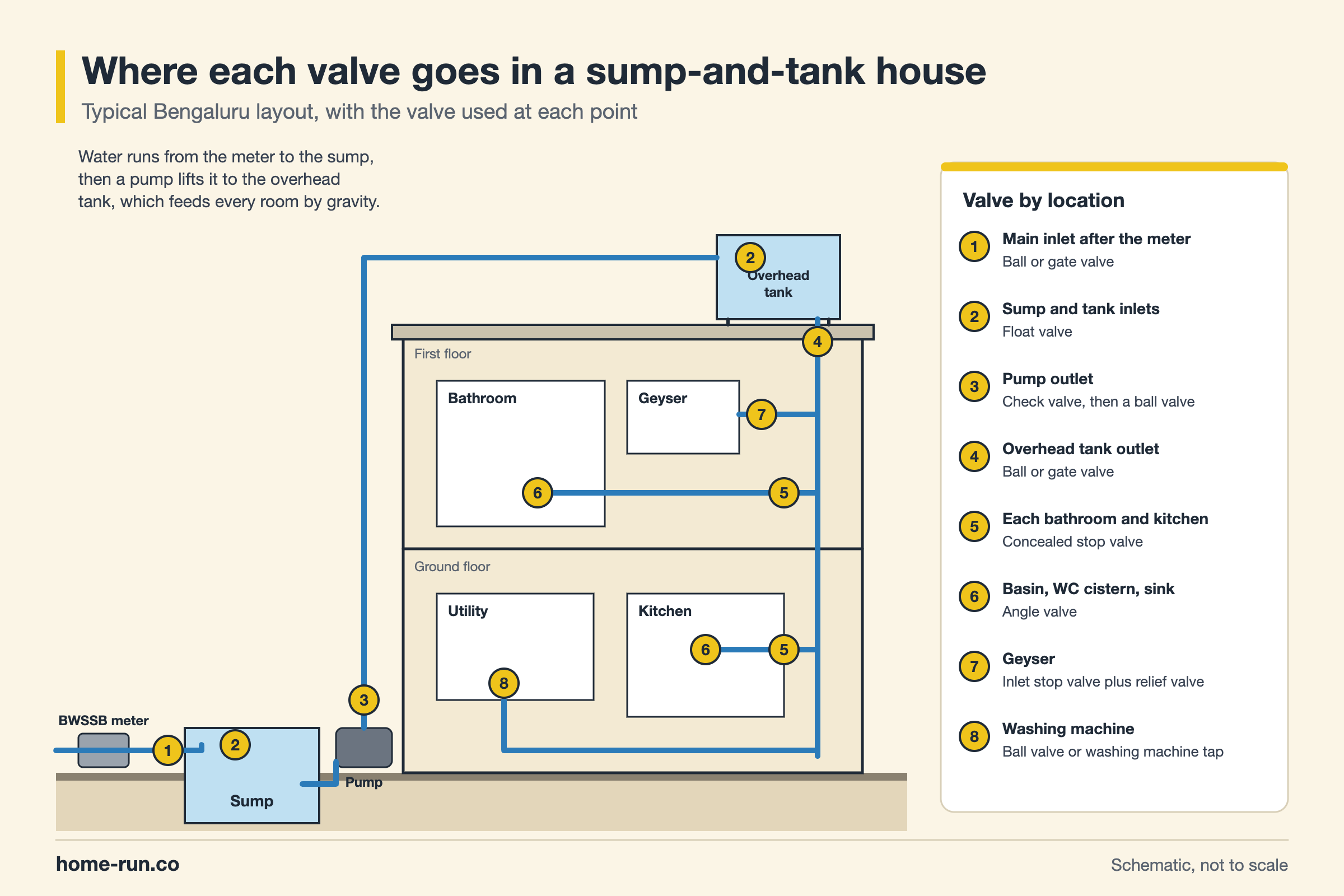
Types of water shut-off valves and where they go
Typical sump and overhead tank house| Location | Valve to use | Why |
|---|---|---|
| Main inlet after the meter | Ball or gate valve | Shuts the whole house supply |
| Sump and tank inlets | Float valve | Stops overflow when the tank is full |
| Pump outlet | Check valve, then a ball valve | Holds the column of water when the pump stops |
| Overhead tank outlet | Ball or gate valve | Isolates the house without draining the tank |
| Each bathroom and kitchen | Concealed stop valve | Lets you work on one room at a time |
| Basin, WC cistern, sink | Angle valve | Shuts one fixture for washer or hose changes |
| Geyser | Inlet stop valve plus relief valve | Isolation and over-pressure safety |
| Washing machine | Ball valve or washing machine tap | Close it when not in use to protect the hose |
Planning the full layout? Our bathroom plumbing guide shows how supply and drain lines run inside a bathroom.
Which Valve Material Suits Indian Water Conditions?
The right valve material depends on water temperature, water quality and the pipe it joins. Forged brass suits most home lines, CPVC suits CPVC hot and cold systems, and uPVC suits cold water only.
Valve materials compared
Home and building water lines| Material | Hot water | Best for | Watch for |
|---|---|---|---|
| Brass Default pick | Yes | Ball, angle and gate valves in most homes | Dezincification in hard or salty water |
| Gunmetal / bronze | Yes | Main lines, pump outlets, check valves | Higher price, heavier |
| CPVC | Yes, up to 93°C | Solvent-joined CPVC hot and cold systems | Cracks if over-tightened or hit |
| uPVC Cold only | No, up to 60°C | Tanks, garden lines, cold supply | Sunlight and heat soften cheap grades |
| Stainless steel | Yes | Aggressive or treated water, purifier lines | Costs the most |
Water quality matters in Bengaluru, where many homes mix BWSSB supply with borewell water. A 2018 BRITA study of 1,423 city homes, reported by Deccan Chronicle, found higher hardness in about 24% of samples, with borewells the largest share.
Dezincification is the slow loss of zinc from brass, which leaves a weak, porous copper shell. DZR (dezincification-resistant) brass limits it by controlling the alloy mix.
Match the valve to the pipe: brass or CPVC valves on hot lines, uPVC only on cold lines. On borewell water, choose DZR brass or a CPVC body over plain brass.
How Do You Choose the Right Type of Water Valve?
Choose a water valve by asking what it must do first: shut off, control flow, or stop backflow. Then match size, pressure rating and material to the line.
Shut-off (on/off)
Most home pointsPoint
- Use a ball valve, or a gate valve on large pipes
- Run it fully open or fully shut, never half
- Low pressure loss when open
- Main inlet, tank outlet, bathroom and fixture points
Flow control (throttling)
Special pointsPoint
- Use a globe valve, or a needle valve for tiny flows
- Designed to sit part open without wear
- Higher pressure loss when open
- Garden lines, geyser inlets, dosing and balancing
- Size: match the pipe. Fixture points are usually 15 mm (½ in); risers and mains are larger.
- Pressure: IS 778 Class 1 valves work up to 1.0 MPa and Class 2 up to 1.6 MPa (cold water, no shock). Class 1 covers normal home pressure.
Replacing valves this week?
Valves, pipes and fittings delivered across Bengaluru.
How Do You Install a Water Valve?
You install a threaded water valve by shutting and draining the line, sealing the threads with PTFE tape and tightening the valve with its flow arrow pointing downstream. Solvent-joint CPVC and uPVC valves are glued in like any other fitting.
Step-by-step installation
- Shut off and drain. Close the upstream valve and open a tap below the work point until flow stops.
- Clean the threads. Remove old tape and dirt so the new seal sits on clean metal or plastic.
- Wrap the male thread. Wind PTFE tape in the direction the fitting tightens, so it does not unwind.
- Check the arrow. Globe and check valves only work one way; point the arrow in the direction of flow.
- Tighten with two spanners. Hold the pipe fitting with one spanner and turn the valve's hex with the other. Stop once snug; plastic threads split if forced.
- For solvent joints, follow the cure time. Leave CPVC and uPVC joints for the time the pipe maker states before you turn water on.
- Open slowly and check. Restore supply gradually, then wipe the joint dry and check it again after a few hours.
Never tile over a stop valve you may need in an emergency.
How Do You Maintain Water Valves So They Last?
Water valves last longest when you operate them now and then, keep strainers clean and fix small leaks early. A valve left untouched for years can seize open just when you need to close it.
- Close and reopen every shut-off valve a couple of times a year so it does not seize.
- Clean float valves and any Y-strainer (mesh filter) that collects sand from borewell water.
- Tighten the gland nut on gate and globe valves if water seeps around the spindle.
- Test the geyser relief valve as the geyser maker's manual describes.
Signs of a faulty water valve
- Drips at the handle or spindle: the gland seal or O-ring has worn.
- Handle stiff or spinning freely: scale has built up, or the stem has broken inside.
- Green or white crust on the body: corrosion or dezincification from hard water.
- Weak flow when fully open: a blocked bore, a loose gate or a failed cartridge.
- Banging when the pump stops: a check valve that slams or no longer seals.
Need a full shopping list for a new line? See our plumbing materials list.