On this page
- What Is a Diverter Valve and How Does It Work?
- How Many Types of Diverter Valves Are There?
- What Is the Difference Between 2-Way, 3-Way and 4-Way Diverters?
- Concealed vs Exposed Diverter: Which Suits Your Bathroom?
- What Other Bathroom Diverter Formats Will You See?
- What Are the Benefits of a Diverter Valve?
- Which Diverter Valve Is Best for Your Bathroom?
- What About Industrial Diverter Valves?
- What Are the Signs Your Diverter Valve Is Failing?
- A diverter valve routes water to one chosen outlet, such as the overhead shower, hand shower or spout.
- Diverter valve types are grouped by number of outlets (2-way, 3-way, 4-way) and by mounting (concealed, exposed, spout).
- Some 3-way diverters run two outlets together; many run only one at a time. Check the spec sheet.
- A concealed diverter looks cleaner but must be fitted before tiling and is harder to repair.
A diverter valve is a bathroom fitting that takes water from one supply and sends it to the outlet you choose. Turn the handle, and the flow moves from the tap spout to the overhead shower or the hand shower. This guide explains the diverter valve types sold in India and how to choose one.
What Is a Diverter Valve and How Does It Work?
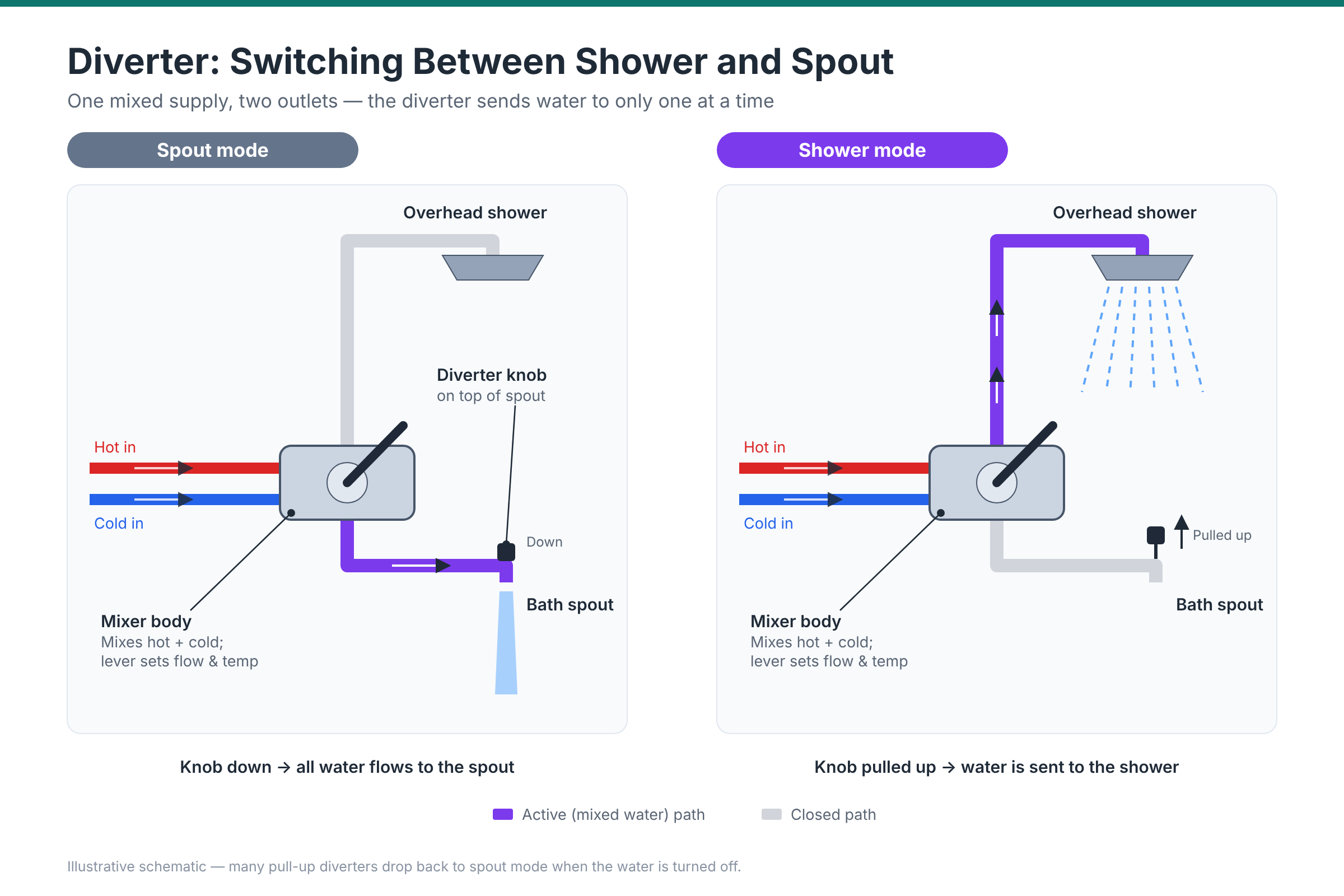
A diverter valve works by moving an internal part that opens one water path and closes the others. That moving part can be a plug, a stem, ceramic discs or a replaceable cartridge.
A cartridge is the removable inner unit that does the switching. When the cartridge wears out, water leaks or comes out of two outlets at once.
A mixer blends hot and cold water to set the temperature. A diverter only chooses where that water goes. Many Indian listings combine both, so read what is included.
How Many Types of Diverter Valves Are There?
There is no single fixed count of diverter valve types. Bathroom diverters are sorted by how many outlets they control and how they are mounted. Industrial diverters form a separate group.
Bathroom diverter valve types at a glance
Qualitative comparison| Type | Where it sits | Typical use | Ease of repair |
|---|---|---|---|
| 2-way concealed Default pick | Body inside the wall | Overhead plus hand shower | Cartridge from the front; body needs tile work |
| 3-way concealed | Body inside the wall | Overhead, hand shower and spout | As above |
| 4-way or more | Body inside the wall | Rain head, body jets and more | Specialist plumber |
| Exposed wall-mounted Retrofit | On the wall surface | Existing tiled bathrooms | Easy, everything is reachable |
| Spout diverter | Built into the bath spout | Bathtub with shower | Replace the spout |
What Is the Difference Between 2-Way, 3-Way and 4-Way Diverters?
The number in a diverter's name is the number of outlets it can send water to, not the number of handles.
- 2-way diverter: switches between two outlets, usually the overhead shower and the hand shower or spout.
- 3-way (3-function) diverter: adds a third outlet, such as overhead shower, hand shower and spout.
- 4-way diverter: serves larger setups with a rain head, body jets or a second hand shower.
Some 3-way valves have a shared position. The HammerHead 3-way valve, for example, has a third position that runs both outlets at the same time. Others do not: Kohler states that its MasterShower K-737-K outlets "can only be operated individually".
Buy a diverter with one position for every outlet you plan to use. If you want two outlets running together, confirm a shared position on the spec sheet.
Concealed vs Exposed Diverter: Which Suits Your Bathroom?
A concealed diverter suits a new bathroom or a full renovation, while an exposed diverter suits a bathroom that is already tiled.
Concealed diverter
New buildBody inside the wall, only the trim plate and handle show.
- Clean, minimal look
- Body fixed during plumbing, before tiling
- Body and trim kit often sold separately
- Body repair may mean breaking tiles
Exposed diverter
RetrofitBody and pipework mounted on the wall surface.
- Visible fitting and pipes
- Fits onto existing wall points
- Usually sold as one complete unit
- Every part reachable for repair
Jaquar and other brands list the concealed body and the exposed part kit as separate products. A low-priced listing may be only one half. Ask for both before the plumber arrives.
What Other Bathroom Diverter Formats Will You See?
Besides wall diverters, you will see spout diverters, pull-down diverters and diverter mixers in Indian shops.
- Spout (tub spout) diverter: a knob on the bath spout that you lift to send water up to the shower. It is part of the spout.
- Pull-down diverter: a knob you pull to switch outlets, often on wall mixers for a bucket tap and shower.
- Diverter mixer: one fitting that sets temperature and picks the outlet, sold as a "set" or "full set".
Bathtubs are less common in Indian homes, so most buyers need a wall diverter for an overhead and hand shower.
What Are the Benefits of a Diverter Valve?
The main benefit of a diverter valve is that one handle controls several outlets from a single water supply.
- Fewer valves and wall points: one diverter replaces a separate tap for each outlet.
- Same temperature at every outlet: with a mixer, you set warm water once and switch outlets.
- Less wasted water: only the outlet you are using runs.
Diverters are also used outside the bathroom. Rainwater systems use a first-flush diverter to send the dirty first rain away, as covered in our guide to rainwater harvesting.
Which Diverter Valve Is Best for Your Bathroom?
The best diverter valve is the one that matches your number of outlets, your wall and your water pressure. No single type is best for every bathroom.
- Outlets: match positions to how you shower, and confirm shared or one-at-a-time flow.
- Body and cartridge: check the listing for a brass body and ceramic cartridge; chrome plating can sit on plastic too.
- Pressure: an overhead tank gives about 0.1 bar for every metre of height. Ashirvad lists 0.2 bar as the minimum for its concealed diverters; a top-floor rain shower may still need a pressure pump.
- Hard water: borewell water in many parts of Bengaluru is hard, and scale stiffens cartridges. Pick a brand that stocks spare cartridges.
- Standards: look for the ISI mark. IS 8931 is the BIS (Bureau of Indian Standards) code for copper alloy fancy taps, combination tap assemblies and stop valves for water services.
- Fit: confirm the inlet size, usually 15 mm (1/2 inch) in homes, and the wall depth for a concealed body.
Bathroom fittings and plumbing, delivered
Order bathroom fittings, pipes and hardware with a GST invoice and delivery across Bengaluru.
What About Industrial Diverter Valves?
Industrial diverter valves route powders, granules and pellets in conveying lines, and they are a different product from bathroom fittings.
Common designs include blade, spherical, flapper (conveying), plug and gravity diverters. The FAQ below compares the main ones.
Industrial diverters are chosen on material, pressure, temperature and cycle frequency. Follow the supplier's datasheet and your plant's standards.
What Are the Signs Your Diverter Valve Is Failing?
A failing diverter valve usually shows water coming from two outlets at once, weak flow, a stiff handle or a damp wall.
- Water drips from the shower while the spout or hand shower runs
- Flow at the selected outlet drops suddenly
- The handle is stiff, loose or will not stop in position
- Wet patches or swelling on the wall around the trim plate
Check before you call a plumber:
- Run each outlet in turn and note where water escapes.
- Check the aerator and shower head for scale; a blocked head feels like a weak diverter.
- Shut the supply valve, remove the trim and look for white scale or a torn O-ring.
On most modern fittings, the fix is a cartridge or seal swap from the front. A failed concealed body may need tiles opened. Damp from a hidden leak also ruins paint, as our guide to fixing damp patches on walls explains. For exposed fittings, a pipe wrench helps free tight union nuts.