On this page
- Why Does a Building Need Waterproofing?
- How Many Types of Waterproofing Are There?
- What Is Cementitious Waterproofing?
- Which Liquid Membranes Are Used: PU, Acrylic or Bituminous?
- What Are Sheet Membranes, Crystalline and Injection Grouting?
- How Do the Types of Waterproofing Compare?
- Which Type of Waterproofing Suits Each Part of the House?
- How Is a Terrace Waterproofed, Stage by Stage?
- How Much Waterproofing Material Do You Need?
- How Do You Choose the Right Waterproofing Type?
- What Should You Do Before Getting a Quote?
- There is no official count of waterproofing types.
- Cementitious coatings are low-cost, but rigid grades crack on moving surfaces.
- Exposed terraces need a flexible, UV-stable system or a protective layer.
- Crystalline and integral treatments work inside concrete, suiting basements and tanks.
- Prep, coat thickness, curing and a ponding test matter more than the brand.
The types of waterproofing used in construction fall into three families: surface coatings, membranes, and treatments that work inside concrete. Each stops water differently, so the right choice depends on where water attacks your building.
Why Does a Building Need Waterproofing?
Waterproofing stops water before it enters slabs, walls and foundations. The benefits are:
- Steel reinforcement inside RCC slabs stays dry and rust-free
- No damp patches, peeling paint or efflorescence (white salt deposits)
- Less mould and fewer repairs under finished tiles
Bengaluru's wettest season runs from September to November, after the monsoon. Learn the early signs in our guide to water seepage causes and solutions.
How Many Types of Waterproofing Are There?
There is no official number of waterproofing types. Sources group methods by material, application or location, so published lists run from three to ten. This guide uses three families:
- Coatings: cementitious, acrylic, polyurethane and bituminous.
- Sheet membranes: modified bitumen, PVC or EPDM rubber, sealed at the joints.
- Integral and specialist: admixtures, crystalline treatments and injection grouting.
Waterproofing stops liquid water even under pressure, as on a flooded terrace. Damp-proofing only resists moisture seeping slowly through walls, and will not hold standing water.
Older terraces use brick bat coba: broken bricks in lime or cement mortar, laid to a slope. It drains water but is not a true membrane.
What Is Cementitious Waterproofing?
Cementitious waterproofing is a coating of cement, fine sand and additives, mixed with water or a liquid polymer and brushed onto concrete. It is the most common type of waterproofing in Indian homes because it is low-cost and bonds well to concrete.
- Single-component: powder plus water. The cured coat is rigid, so use it on surfaces that do not move.
- Two-component (2K): powder plus a liquid acrylic polymer, flexible enough to bridge hairline cracks.
For example, Dr. Fixit Pidifin 2K mixes 1 part polymer to 2 parts powder and goes on in two coats 6–8 hours apart. Its datasheet lists bathrooms, balconies, roofs and domestic water tanks. Fosroc and Sika sell similar 2K coatings.
Buried, internal or tiled over? Use cementitious or crystalline. Facing sun, movement or foot traffic? Use a flexible, UV-stable system, or protect the coat with screed or tiles.
Planning a waterproofing job?
Waterproofing chemicals, cement and tiles delivered across Bengaluru.
Which Liquid Membranes Are Used: PU, Acrylic or Bituminous?
A liquid membrane is a coating that cures into a continuous, rubbery skin with no joints. The common types of liquid waterproofing membrane are:
- Polyurethane (PU): highly elastic, for terraces, balconies and wet areas. Standard aromatic PU yellows in sun, so exposed areas need aliphatic (UV-stable) PU or a UV top coat.
- Acrylic: water-based and easy to roll on, for roofs and external walls. Check its foot-traffic rating before terrace use.
- Bituminous coating: black, tar-based paint for foundations. Bitumen ages in sunlight, so keep it buried or covered.
Every liquid system needs a clean, sound, primed surface. PU in particular fails on damp or freshly cast concrete.
Liquid-applied coating
Most homesPoint
- No seams to leak
- Wraps pipes and corners easily
- Thickness depends on coats applied
Sheet membrane
Large roofsPoint
- Laps can leak if poorly sealed
- Harder to detail around pipes
- Uniform factory thickness
What Are Sheet Membranes, Crystalline and Injection Grouting?
These specialist types of waterproofing suit large roofs, basements, tanks or active leaks.
- Modified bitumen sheets: bitumen improved with plastic (APP, atactic polypropylene) or rubber (SBS, styrene-butadiene-styrene). Baumerk rates APP's heat resistance at 120°C or more, against 100–110°C for SBS, so APP suits sunny roofs and SBS suits basements.
- PVC and EPDM sheets: plastic or rubber sheets welded or glued at joints, mostly on commercial roofs.
- Crystalline: a powder that grows crystals inside concrete pores. JSW Krysta Leakproof, dosed at 1% of cement weight, claims to self-seal cracks up to 0.5 mm.
- Integral compounds: admixtures added at mixing, covered by IS 2645:2003, the Indian Standard for integral cement waterproofing compounds. They do not seal joints or later cracks.
- Injection grouting: PU or epoxy resin pumped into leaking cracks. It is a repair, not a preventive coat.
See our leaking roof repair guide to trace and fix active leaks.
How Do the Types of Waterproofing Compare?
2K cementitious coatings suit wet areas; flexible membranes suit exposed terraces.
Types of waterproofing at a glance
General ratings; the datasheet is final| Type | Flexibility | Best areas | Direct sun | Relative cost |
|---|---|---|---|---|
| Basic cementitious | Low | Internal walls | Cracks with movement | Low |
| 2K cementitious Default pick | Medium | Bathrooms, balconies, tanks | Protect under traffic | Low to medium |
| Polyurethane (PU) Terraces | High | Terraces, wet areas | Aliphatic or top coat | Medium to high |
| Acrylic | Medium | Roofs, external walls | Check datasheet | Low to medium |
| Bituminous coating Not in sun | Medium | Foundations | Poor unless covered | Low |
| APP or SBS sheet | Medium to high | Large roofs, basements | APP good | Medium to high |
| Crystalline | Low | Basements, tanks | Inside concrete | Medium |
Which Type of Waterproofing Suits Each Part of the House?
The right type for each area depends on sun exposure, standing water and movement.
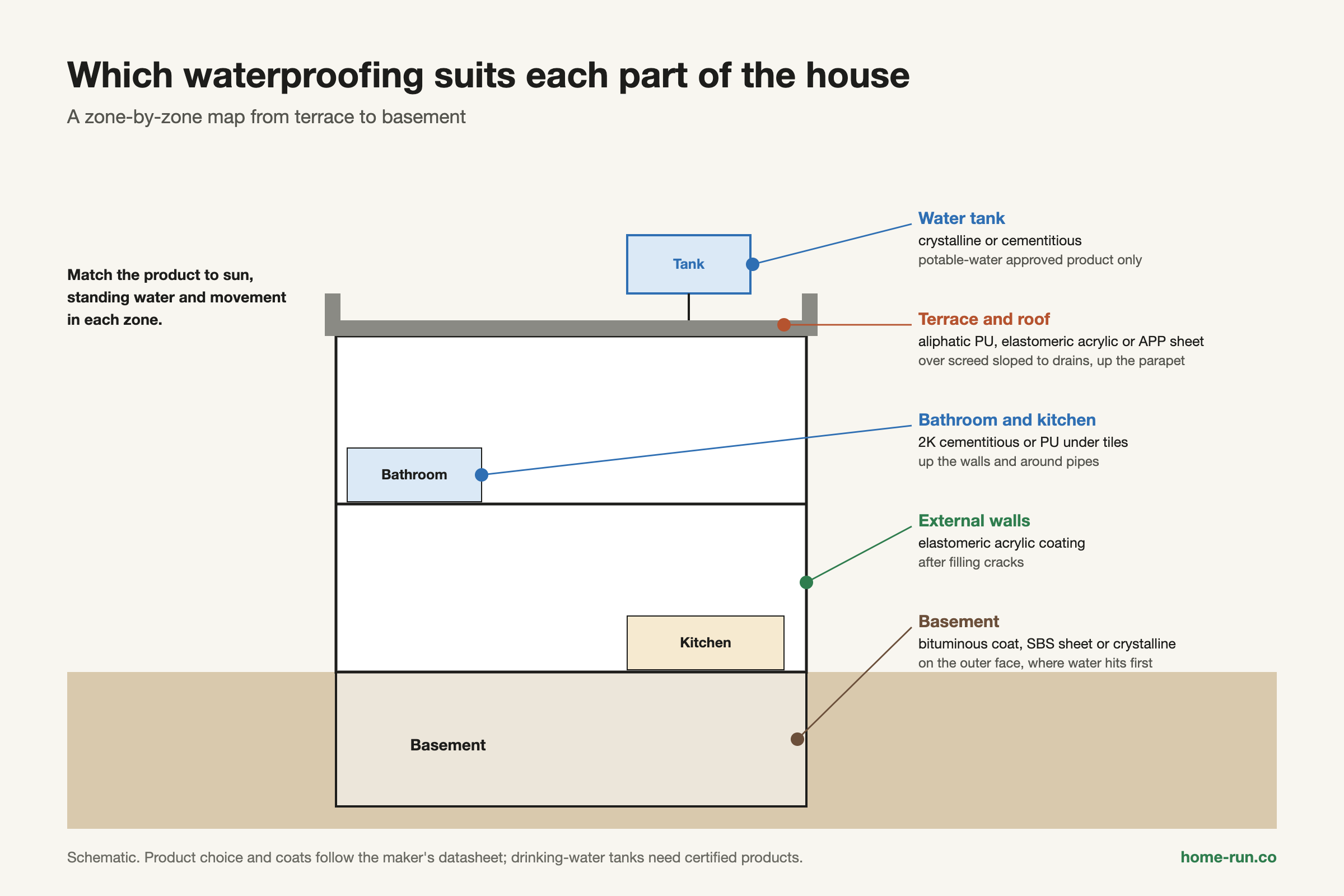
- Terrace and roof: aliphatic PU, elastomeric acrylic or APP sheet over a screed sloped to drains, carried up the parapet.
- Bathrooms and kitchens: 2K cementitious or PU under tiles, up the walls and around pipes. See our bathroom waterproofing guide.
- Basements: positive-side treatment (on the outer face, where water hits first), such as bituminous coat, SBS sheet or crystalline. Inner-face coats are a repair.
- External walls: elastomeric acrylic coating, after filling cracks.
- Water tanks: crystalline or cementitious products approved for drinking water.
Use only a product whose datasheet states potable-water approval, and ask the dealer for the certificate.
How Is a Terrace Waterproofed, Stage by Stage?
A terrace job takes six stages. Coat and curing waits follow the Dr. Fixit Pidifin 2K datasheet.
Prepare
Remove loose screed, fill cracks, clean, and fix the slope to drains.
First coat
Detail corners and drain outlets, then coat evenly up the parapet.
Second coat
Apply at right angles to the first.
Cure
Air-cure under moist hessian in sun; do not flood.
Ponding test
Flood the terrace and check the ceiling below.
Protect
Lay screed or tiles over the membrane.
How Much Waterproofing Material Do You Need?
Material needed equals area times the datasheet consumption rate, plus wastage.
In the shower zone, take the upturn to shower-head height. Cementitious coats usually cost least; PU and sheets cost more.
How Do You Choose the Right Waterproofing Type?
Match water, movement and sun exposure to a system, then check the datasheet.
- Name the water source: rain, standing water or ground water.
- Check movement and sun: both rule out unprotected rigid coats.
- Shortlist from the comparison table.
- Read the datasheet: coats, curing, UV and potable ratings.
- Confirm the warranty: most brands honour it only for their stated method.
- Coating on a dusty or wet surface
- No upturn at walls or parapet
- One thin coat instead of two
- Curing or ponding test skipped
For recurring wall damp, read about the causes of wall dampness.
What Should You Do Before Getting a Quote?
- Photograph the damp area and the ceiling below it
- Measure the area in sq ft and note sun exposure
- Ask for an itemised quote naming product, coats and test
- Afterwards, keep drains clear and avoid drilling treated surfaces