On this page
- What Is Terrace Waterproofing and Why Does It Matter?
- What Factors Affect Terrace Waterproofing Cost?
- How Do Waterproofing Methods Compare on Cost per Sq Ft?
- How Does Terrace Waterproofing Cost Vary by City in India?
- How Do You Estimate Terrace Waterproofing Cost per Sq Ft for Your Home?
- Can You Waterproof a Terrace Yourself, Step by Step?
- How Do You Choose the Right Terrace Waterproofing Solution?
- How Do You Maintain Terrace Waterproofing So It Lasts?
- How Do You Get a Fair Terrace Waterproofing Quote?
- Terrace waterproofing cost in India runs about ₹60–250 per sq ft applied; basic coatings start near ₹25.
- The method sets the base rate: coatings are cheapest, APP membranes sit in the middle, PU costs the most.
- Cracks, ponding, old layers and broken tiles can add 20–40% to a quote.
- Measure the parapet upturns too, then add a 10–15% contingency and check GST.
- A cheap coat over a badly sloped or cracked terrace fails early, so fix slope and cracks first.
Terrace waterproofing cost in India is about ₹60–250 per sq ft with material and labour, according to Asian Paints' 2026 cost guide. Simple acrylic coatings can cost as little as ₹25–45 per sq ft, while two-component PU systems reach ₹300.
The rate you pay depends on the method, the state of your terrace, its size and your city. This guide breaks down each factor so you can read a quote line by line.
What Is Terrace Waterproofing and Why Does It Matter?
Terrace waterproofing is a continuous barrier laid on a flat roof so rainwater runs off instead of soaking into the RCC (reinforced cement concrete) slab. The barrier can be a coating, a liquid membrane or a sheet membrane.
An unprotected terrace lets water reach the slab steel. The steel rusts, expands and cracks the concrete from inside.
- Ceiling damp and peeling paint in the top-floor rooms
- Rusting reinforcement and spalling concrete under the slab
- Leaks at joints where the slab meets the parapet, pipes and outlets
- Repair bills that cost more than the original waterproofing
A terrace faces direct sun, heat cycles and standing rain, so it needs UV-stable, flexible products. Bathroom waterproofing sits under tiles and never sees sunlight. For a method-by-method explainer, read our guide to types of waterproofing.
What Factors Affect Terrace Waterproofing Cost?
Terrace waterproofing cost depends mainly on the method, the surface condition, the area and local labour rates. Use this checklist before you call for quotes.
- Method and layers: a two-coat acrylic costs far less than a primed, mesh-reinforced PU system. Terraces usually get 2–3 layers.
- Surface condition: cracks, hollow plaster, ponding and leaks raise the cost by 20–40% on badly damaged surfaces.
- Old waterproofing or tiles: removing failed layers or dismantling terrace tiles adds labour and debris disposal.
- Terrace size: large areas get a lower rate per sq ft. Very small terraces often attract a minimum charge.
- Upturns and details: parapet upturns, outlets, pipe sleeves and water tank bases all add area and labour.
- Labour and location: labour alone is ₹20–35 per sq ft in metros such as Bengaluru and Mumbai.
- Access: high-rise terraces and tight staircases raise handling cost.
- Use of the terrace: a terrace garden or heavy foot traffic needs a protective screed or tiles on top, which adds cost.
Two things lower the bill: a sound surface and waterproofing done during construction, before tiles and fittings go on.
How Do Waterproofing Methods Compare on Cost per Sq Ft?
Coatings are the cheapest terrace waterproofing method, APP membranes cost about two to three times more, and PU systems cost the most. Published 2026 rates for each method differ by source, so the table shows both.
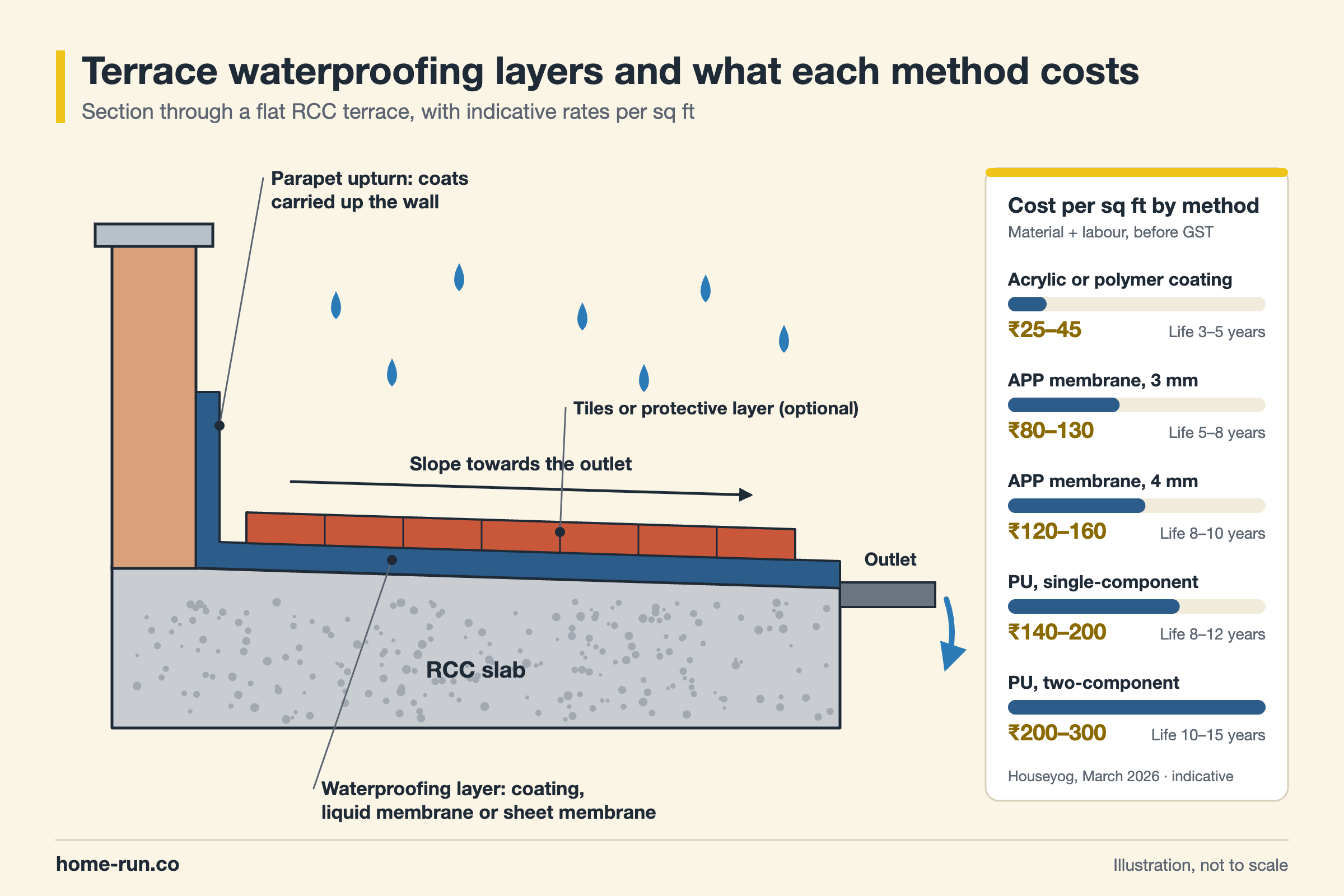
Terrace waterproofing cost per sq ft by method
Material + labour, before GST| Method | Houseyog (Mar 2026) | Asian Paints (2026) | Stated life (Houseyog) |
|---|---|---|---|
| Acrylic or polymer coating Budget | ₹25–45 | ₹35–90 (cementitious) | 3–5 years |
| Fibre-reinforced coating | ₹40–60 | Not listed | 4–6 years |
| APP membrane, 3 mm | ₹80–130 | ₹80–180 (bituminous) | 5–8 years |
| APP membrane, 4 mm | ₹120–160 | ₹80–180 (bituminous) | 8–10 years |
| Liquid membrane | Not listed | ₹90–220 | Not stated |
| PU, single-component | ₹140–200 | ₹150–250 | 8–12 years |
| PU, two-component Exposed terraces | ₹200–300 | ₹150–250 | 10–15 years |
Asian Paints also groups terrace jobs into three tiers: basic coatings at ₹60–100, mid-range membranes at ₹100–180 and premium PU systems at ₹180–250 per sq ft.
Cementitious waterproofing is a cement-based coating mixed with polymers and brushed on in coats. Membrane waterproofing is a continuous sheet (such as APP, atactic polypropylene modified bitumen) or a liquid that cures into a rubbery film.
Cementitious coating
Lower costPoint
- Lowest rate per sq ft, often under ₹90
- Easy to apply by brush; good under tiles
- Limited flexibility, so slab cracks can reopen
- Shorter stated life on exposed terraces
Membrane (sheet or liquid)
Exposed terracePoint
- Higher rate, about ₹80–300 per sq ft
- Bridges hairline cracks and moves with the slab
- Needs a dry, primed surface and skilled laying
- Longer stated life, especially PU and 4 mm APP
Over 10 years, a coating redone two or three times can cost about as much as one 4 mm APP job, and each redo means fresh preparation. Compare cost per year of stated life rather than the rate per sq ft alone.
How Does Terrace Waterproofing Cost Vary by City in India?
Terrace waterproofing cost varies by city mostly through labour rates and climate, not material prices. Brand-name materials sell at similar MRPs across India.
City-wise cost drivers
Trends, not fixed prices| City group | Labour per sq ft | Climate pressure | Usual system |
|---|---|---|---|
| Mumbai, Delhi, Bengaluru | ₹20–35 | Mumbai: heavy monsoon; Bengaluru: wettest Sep–Nov | Membrane or PU in Mumbai; coating or membrane in Bengaluru |
| Pune, Kolkata, Chennai | ₹15–25 | Chennai: coastal, humid, most rain in Oct–Dec | PU or membrane for coastal humidity |
| Tier-2 and tier-3 cities | ₹10–20 | Varies by region | Coatings on new, sound terraces |
Bengaluru gets about 1,077 mm of rain a year on the IMD (India Meteorological Department) long-period average, and September to November is the wettest season. Plan terrace work for the drier months, December to March.
Homeowners on NoBroker's Bengaluru forum reported paying about ₹70–80 per sq ft for standard terrace jobs between 2024 and 2026, with budget options near ₹40–50. Treat these as user reports, not quotes.
Waterproofing your terrace?
Waterproofing chemicals, cement and tools delivered across Bengaluru.
How Do You Estimate Terrace Waterproofing Cost per Sq Ft for Your Home?
Estimate terrace waterproofing cost by multiplying the total treated area, including parapet upturns, by the quoted rate, then adding repairs and a 10–15% contingency.
The ₹100 rate is an example at the low end of Asian Paints' mid-range membrane band. Swap in your own quote; at ₹180 the same terrace costs about ₹2,10,870 with contingency.
A quick material check helps you read the quote. Dr. Fixit Roofseal Classic, an acrylic liquid membrane, covers 1.0–1.1 sq m per litre for its full three-coat system, per the manufacturer.
- Area: 1,065 sq ft ÷ 10.764 = 98.94 sq m
- Litres: 98.94 ÷ 1.1 to 98.94 ÷ 1.0 = about 90–99 litres
- Packs: five 20-litre packs at ₹7,355 MRP each = ₹36,775
The rest of the quote covers crack sealant, surface preparation, labour and the contractor's margin.
Inspect and clean
Remove loose plaster, moss and dust; open blocked outlets.
Treat cracks
Groove and seal cracks; let the sealant cure per its datasheet.
Prime and coat
Primer coat, then two coats 4–6 hours apart.
Cure
About 7 days of air curing, kept dry.
Ponding test
Hold about 50 mm of water for 24 hours and check the ceiling below.
Plan for about 12 dry days for a liquid membrane job. Rain during curing means a restart.
Can You Waterproof a Terrace Yourself, Step by Step?
Yes, a small, sound terrace with only hairline cracks can take a DIY liquid membrane coating. Follow the product datasheet; the steps below follow Dr. Fixit's Roofseal Classic data sheet.
- Check the slope. Water should run to the outlets. A fall of at least 1 in 100 (10 mm per metre) is the usual minimum.
- Clean the surface. Scrape off loose material, algae and old flaking coatings, then wash and let the slab dry fully.
- Fill cracks. Cut cracks wider than 0.5 mm into a V-groove of about 10 × 6 mm and fill with the recommended sealant. Let it cure for 72 hours.
- Prime. Apply the first coat diluted as the datasheet says (50% for Roofseal Classic) and let it dry 2–3 hours.
- Apply two full coats. Brush or roll each coat 4–6 hours apart, crossing the direction of the previous coat. Carry the coats up the parapet.
- Cure and test. Air-cure for 7 days, then pond about 50 mm of water for 24 hours.
- Water ponds in large patches after rain, so the slope needs correcting
- Cracks are wide, keep moving, or show rust stains
- The ceiling below already leaks or has spalling concrete
- The parapet is lower than waist height and you have no safety harness
Wear gloves and eye protection, and never coat a damp slab or work with rain forecast.
How Do You Choose the Right Terrace Waterproofing Solution?
Choose terrace waterproofing by climate first, then terrace use, then budget per year of life.
- Climate: coastal, humid cities such as Mumbai, Kochi and Goa usually need PU or membranes. Drier inland cities can manage with good coatings on a sound slab.
- Exposure: an open terrace in full sun needs a UV-stable product. Under tiles, a cementitious coat works well.
- Use: regular foot traffic, a terrace garden or a solar frame needs a tougher system plus a protective layer.
- Budget: divide the rate by the stated life. A ₹40 coating lasting 4 years works out to ₹10 per sq ft per year; a ₹200 PU lasting 12 years, about ₹17. The coating wins on paper, but every recoat adds preparation, disruption and leak risk.
Exposed terrace, heavy rain or old cracks: pick a membrane or PU system. New, sound slab under tiles: a polymer-modified cementitious coat is usually enough.
Already fighting leaks? Read our guide to a permanent solution for roof leakage before you choose.
How Do You Maintain Terrace Waterproofing So It Lasts?
Terrace waterproofing lasts longest when outlets stay clear, water never stands, and small damage gets sealed the same season.
- Before the rains: clear leaves and silt from outlets and gutters. In Bengaluru, do this by August, before the September to November peak.
- After heavy rain: check for puddles an hour later. Standing water points to a blocked outlet or a low spot.
- Twice a year: walk the terrace and look for blisters, peeling, cracks at the parapet joint and gaps around pipes.
- When fixing anything: seal around new bolts for solar frames, dish antennas or water tanks before rain.
- Keep it clean: sweep off moss and debris; avoid dragging heavy objects across an exposed coating.
- Recoat on time: follow the product's recoat interval rather than waiting for a leak.
If water is already coming through, start with our step-by-step leaking roof repair guide.
How Do You Get a Fair Terrace Waterproofing Quote?
A fair terrace waterproofing quote names the product, the number of coats, the area measured and the warranty in writing. Ask at least two or three contractors to inspect the terrace before they price it.
- A BOQ (bill of quantities) with material brand, product name and litres or rolls
- Crack treatment, priming and upturn work listed as separate lines
- A ponding test included before handover
- A written warranty of at least 2–5 years, with what it covers
- GST shown clearly, plus the charge for any extra repairs found on site
Professional applicators bring moisture checks, thickness control and post-work inspection. Those steps decide whether the coating lasts its stated life.
Manufacturer pages can state different warranty terms for the same product. Ask the applicator for the warranty card and register it with the manufacturer.