On this page
- What Is Cement Flooring, and How Is It Different From Concrete?
- What Are the Main Types of Cement Flooring Designs?
- Which Cement Floor Design Ideas Suit Indian Homes?
- Traditional vs Modern Cement Flooring: Which Style Fits?
- How Durable Are Cement Floors?
- How Much Do Cement Flooring Designs Cost?
- How Do You Maintain a Cement Floor?
- Are Cement Floors an Eco-Conscious Choice?
- How Do You Choose the Right Cement Flooring Design?
- Cement flooring designs come from one base, a cement topping, finished in different ways: plain, oxide, polished, stained, stamped or patterned.
- Plain IPS is the cheapest at about ₹40–120 per sq ft; microcement sits at the top at about ₹250–500 per sq ft (2026 guides).
- Durability depends on the mix, small panels and curing. IS 2571 asks for at least 15 days of moist curing.
- Choose a matte or textured finish for bathrooms, balconies and outdoor areas; gloss turns slippery when wet.
- Clean with water or a pH-neutral cleaner; acids and bleach etch cement and lift colour.
Cement flooring designs are the finishes, colours and patterns you can give a floor made from a cement topping laid on site. The same grey base can become a red oxide verandah, a polished concrete living room or a stamped driveway.
This page compares the designs side by side. Each finish has its own HomeRun deep-dive, linked in the tables below.
What Is Cement Flooring, and How Is It Different From Concrete?
Cement flooring is a floor whose top layer is a cement-rich mix trowelled smooth on site and then finished. Cement is the binder. Concrete is the mix of cement, sand, stone aggregate and water.
So most "cement floors" in India are really cement concrete floors. The structural slab is concrete, and the visible finish is a thin cement topping over it.
IS 2571:1970, the Bureau of Indian Standards code of practice for laying in-situ cement concrete flooring, covers these floors in homes and light industrial buildings. "In-situ" means cast in place, not laid as factory tiles.
A cement floor has no grout lines to clean. It stays cool underfoot in warm weather and can be repolished instead of replaced. UltraTech Cement says a well-laid concrete floor can last 50 years or more.
What Are the Main Types of Cement Flooring Designs?
The main cement flooring types in Indian homes are plain IPS, oxide, polished concrete, stained concrete, stamped concrete, microcement, terrazzo-style mosaic, Athangudi cement tiles and trimix.
Cement flooring types at a glance
Look, best use and where to read more| Finish | What it is | Look | Best for |
|---|---|---|---|
| Plain IPS Budget | Indian Patent Stone: a 20–40 mm cement concrete topping, trowelled and panelled | Grey, matte or smooth | Utility rooms, stores, rentals, base for later tiling |
| Oxide and red oxide | Cement topping coloured with mineral oxide pigment, hand-polished. See oxide flooring colours and pros and cons | Red, yellow, black, green; soft sheen | Living rooms, verandahs, heritage-style homes |
| Polished concrete | Slab or topping ground, densified and polished by machine | Matte, satin or mirror gloss | Modern living areas, studios, shops |
| Stained or dyed concrete | Acid- or water-based stain or dye on a cured floor | Mottled, earthy, marble-like | Feature floors, cafés, lofts |
| Stamped concrete | Fresh concrete pressed with pattern mats. See how stamped concrete is laid | Stone, brick, slate or wood texture | Driveways, patios, pool decks |
| Microcement Overlay | 2–3 mm cement-polymer coat over an existing floor. See microcement cost and care | Jointless, smooth, any colour | Renovations, bathrooms, walls and counters |
| Terrazzo-style mosaic | Marble chips in cement, cast on site, ground and polished. See mosaic flooring types | Speckled chips in a cement matrix | Living rooms, staircases, lobbies |
| Athangudi cement tiles | Handmade, unfired cement tiles from Chettinad, Tamil Nadu | Floral and geometric patterns, natural gloss | Patterned rugs, borders, courtyards |
| Trimix (VDF) Heavy duty | Vacuum-dewatered, power-trowelled slab. See trimix flooring | Plain grey, dense surface | Parking, basements, warehouses |
Red oxide is the best-known oxide colour. Our red oxide flooring guide covers its laying process step by step.
Which Cement Floor Design Ideas Suit Indian Homes?
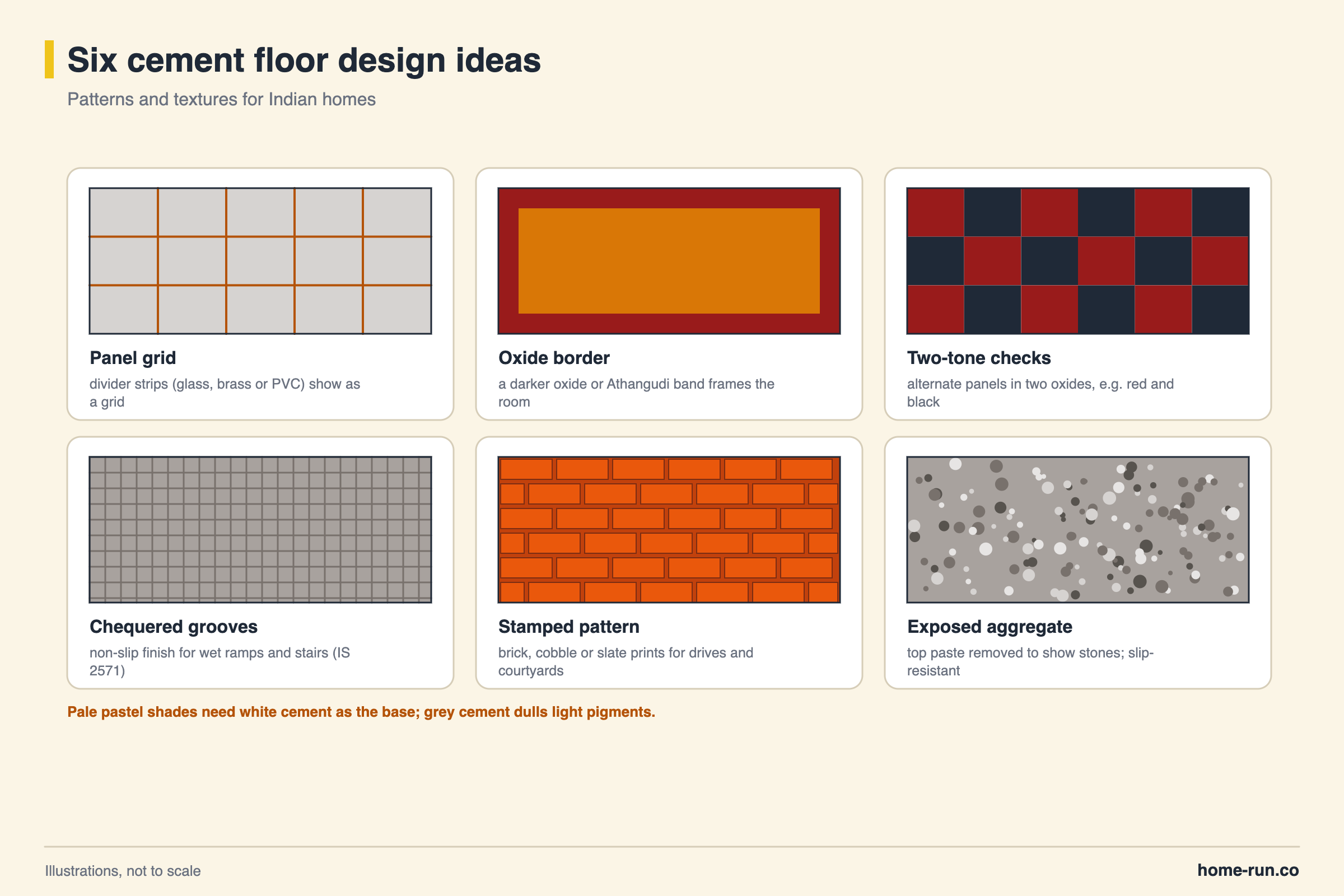
The best cement floor design ideas in Indian homes play with three things: panel patterns, colour and texture. Each one changes the look without changing the base material.
Patterns and layouts
- Panel grids: IS 2571 lays cement floors in panels anyway. Glass, brass or PVC divider strips turn the joints into a visible grid.
- Borders: a band of a darker oxide or an Athangudi tile row frames a room like a rug.
- Two-tone checks: alternate panels in two oxides, such as red and black, for a traditional chessboard look.
- Chequered grooves: IS 2571 asks for a chequered finish on ramps and stairs that may get wet, so they stay non-slip.
- Stamped patterns: brick, cobble or slate prints for driveways and courtyards.
Colour choices
Colour sets the mood of a cement floor more than any other choice. Grey reads cool and modern. Red, terracotta and yellow oxides feel warm and traditional.
Black and charcoal floors look rich but show dust and footprints. Pale pastel shades need white cement as the base, because grey cement dulls light pigments.
Textures
- Mirror polish: bright and reflective, best in dry living areas.
- Matte or honed: calm, hides marks, safer when damp.
- Broom or brush finish: ridged grip for outdoor paths and car porches.
- Exposed aggregate: top paste removed to show stones, slip-resistant for walkways.
Traditional vs Modern Cement Flooring: Which Style Fits?
Traditional cement floors use oxide colour, hand polish and handmade tiles, while modern cement floors use machine polish, thin overlays and large jointless areas.
Traditional cement floors
Heritage look- Red, yellow or black oxide, hand-polished
- Athangudi tile rugs and borders
- Site-cast marble-chip mosaic
- Refreshed with oil or wax and buffing
Modern cement floors
Minimal look- Grey polished or honed concrete
- Microcement over old tiles, no demolition
- Stained or dyed feature areas
- Sealed once, then damp-mopped
You can mix both. A grey polished hall with an Athangudi rug at the entrance, or a red oxide verandah next to a modern kitchen, keeps one material through the house.
Gloss for dry rooms, matte for damp rooms, texture for outdoors. If you are unsure, choose a satin or honed polish: it shows less wear and grips better than a mirror finish.
How Durable Are Cement Floors?
Cement floors last for decades when the mix, panel size and curing are right. Most failures trace back to the laying, not the material.
- Panels: IS 2571 limits panel sides to 4 m when the topping is laid with the base, and 2 m when laid on a hardened base.
- Curing: keep the surface continuously moist for at least 15 days and allow regular traffic only after 28 days, per IS 2571.
- Hardeners: IS 2571 allows surface treatments such as sodium silicate or silicofluorides, renewed about once a year.
- Base: a level, sound base matters. Our concrete screed guide covers mixes and thickness.
Fine hairline cracks along panel edges are normal over time. Wide or spreading cracks usually point to poor curing or a weak base.
- Dry cement sprinkled on wet topping to speed up finishing. IS 2571 does not allow it, and the surface can dust or craze later.
- One large pour with no joints or panels bigger than 4 m.
- Curing for only 2–3 days instead of 15.
- Mirror gloss in bathrooms, balconies or on stairs.
- Old or lumpy cement bags on site; buy fresh stock close to the pour.
How Much Do Cement Flooring Designs Cost?
Cement flooring designs cost about ₹40 to ₹500 per sq ft in India in 2026, from plain IPS at the low end to microcement at the top. Rates below are indicative and exclude 18% GST.
Cement flooring cost per sq ft
Indicative India ranges, 2026| Finish | ₹ per sq ft | Source and date |
|---|---|---|
| Plain grey IPS, sealed Budget | 40–80 | Studio Matrx, June 2026 |
| Pigmented IPS | 60–120 | Studio Matrx, June 2026 |
| Red oxide, standard | 60–110 | Studio Matrx, June 2026 |
| Red oxide, premium multi-layer | 100–150 | Studio Matrx, June 2026 |
| Polished concrete, matte to mirror | 100–400 | Studio Matrx, June 2026 |
| Dye layer on polished concrete | +30–100 | Studio Matrx, June 2026 |
| Stamped concrete | 50–176 | IndiaMART quotes, Nov 2026 |
| Trimix (VDF), plain | 60–110 | HomeRun trimix guide, June 2026 |
| Athangudi tiles, material only | 80–250 | Studio Matrx, June 2026 |
| Microcement Premium | 250–500 | HomeRun microcement guide, 2026 |
How Do You Maintain a Cement Floor?
You maintain a cement floor by sweeping daily, mopping with water or a pH-neutral cleaner and renewing the sealer, oil or wax when the sheen fades.
- Sweep or vacuum grit daily; sand scratches polish.
- Mop with plain water or a mild pH-neutral cleaner.
- Avoid acids, bleach and strong descalers; cement is alkaline and etches.
- Wipe oil, turmeric and lime juice spills quickly.
- Put felt pads under furniture and mats at entrances.
- Re-oil or wax oxide floors every few months to once a year, then buff.
- Reseal Athangudi tiles every 1–2 years, more often in busy or wet areas.
In Bengaluru's monsoon months, dry wet patches near doors and balconies quickly. Damp, shaded floors can grow mould and lose their shine faster.
Are Cement Floors an Eco-Conscious Choice?
Cement floors can be a lower-impact choice when you reuse the slab as the finish and pick blended cement. Cement itself has a high carbon footprint, so use less of it, not more.
- Fly ash cement: Portland pozzolana cement (PPC) to IS 1489 (Part 1) contains 15–35% fly ash by mass, which replaces some clinker.
- No kiln: Athangudi tiles are sun-dried and water-cured, not fired.
- No extra layer: polished concrete turns the slab into the finished floor, so no tiles are added.
- No demolition: microcement goes over existing floors, cutting rubble.
Ask your contractor which cement and sealer they plan to use. Water-based, low-odour sealers are easier to live with indoors than solvent-based ones.
How Do You Choose the Right Cement Flooring Design?
Choose a cement flooring design by matching the finish to the room, checking the base and getting a written quote that names the mix, panel size and curing days.
- List the rooms and mark which are wet, outdoor or heavy-traffic.
- Pick a finish per room from the types table: gloss for dry rooms, matte or textured for damp ones.
- Check the base slab for level, cracks and damp before any topping goes down.
- Get two or three written quotes that state thickness, mix, divider strips, sealer and GST.
- Plan the time: 15 days of moist curing and no regular traffic until day 28.
- Ask for a sample panel to see the real colour and sheen before the full floor.
For which cement to use, OPC (ordinary Portland cement) and PPC from a BIS-certified brand both work for toppings. White cement gives cleaner pastel and bright oxide colours.
Laying a cement floor?
Cement, white cement, sand and waterproofing delivered across Bengaluru.