On this page
- What Is the Difference Between White Cement and Grey Cement?
- How Is Grey Cement Made?
- How Is White Cement Made?
- White Cement vs Grey Cement: Side-by-Side Comparison
- Which Is Stronger, White Cement or Grey Cement?
- Where Does Each Cement Work Best?
- How Much Do White and Grey Cement Cost?
- Is White Cement Waterproof?
- Which Cement Has the Bigger Environmental Footprint?
- How Do You Choose Between White Cement and Grey Cement?
- Both are Portland cement; white cement leaves out the iron and manganese that turn grey cement grey.
- Grey cement (OPC or PPC) is the structural binder for foundations, slabs, columns, plaster and masonry.
- White cement is a finishing material for tile joints, cement wash, terrazzo and decorative work.
- White cement costs about ₹25 per kg against ₹8–9 per kg for grey OPC in Bengaluru.
White cement vs grey cement comes down to colour, cost and job: both are Portland cement, but white cement is made from iron-free raw materials for a clean white finish, while grey cement is the cheaper, everyday binder for structure.
For white cement alone, see white cement composition and properties and white cement uses.
What Is the Difference Between White Cement and Grey Cement?
The difference between white cement and grey cement is the iron and manganese content of the raw materials. Grey cement uses ordinary limestone and clay, which carry iron oxide. White cement uses pure limestone and kaolin, a white china clay.
White clinker keeps iron oxide (Fe₂O₃) below 0.35% and manganese oxide below 0.03%. Even traces of these metals tint the powder.
"Grey cement" covers OPC (Ordinary Portland Cement), PPC (Portland Pozzolana Cement) and slag cement. White cement is not putty, a separate wall-levelling material.
How Is Grey Cement Made?
Grey cement is made by burning crushed limestone and clay in a rotary kiln at about 1,450 °C to form clinker. The clinker is ground with gypsum, which controls setting.
- OPC is clinker plus gypsum, sold in 33, 43 and 53 grades under IS 269:2015, the Indian standard for Ordinary Portland Cement.
- PPC replaces 15–35% of the clinker with fly ash, under IS 1489 (Part 1).
How Is White Cement Made?
White cement is made the same way, with cleaner materials and a hotter kiln. Kaolin replaces ordinary clay, and fine silica sand tops up the silica.
- Iron-free raw materials: limestone under 0.1% iron oxide, plus kaolin.
- Hotter kiln: about 1,600–1,700 °C.
- Fast cooling and clean grinding to protect the colour.
White clinker needs 20–50% more fuel, and a kiln makes 20–50% less of it. India's main white cement plants are in Rajasthan, including Birla White at Kharia Khangar and JK White at Gotan.
White Cement vs Grey Cement: Side-by-Side Comparison
White and grey cement set in similar times but differ in cost, colour and use.
White cement vs grey cement at a glance
Standards, manufacturer data and HomeRun price list| Property | White cement | Grey cement (OPC) |
|---|---|---|
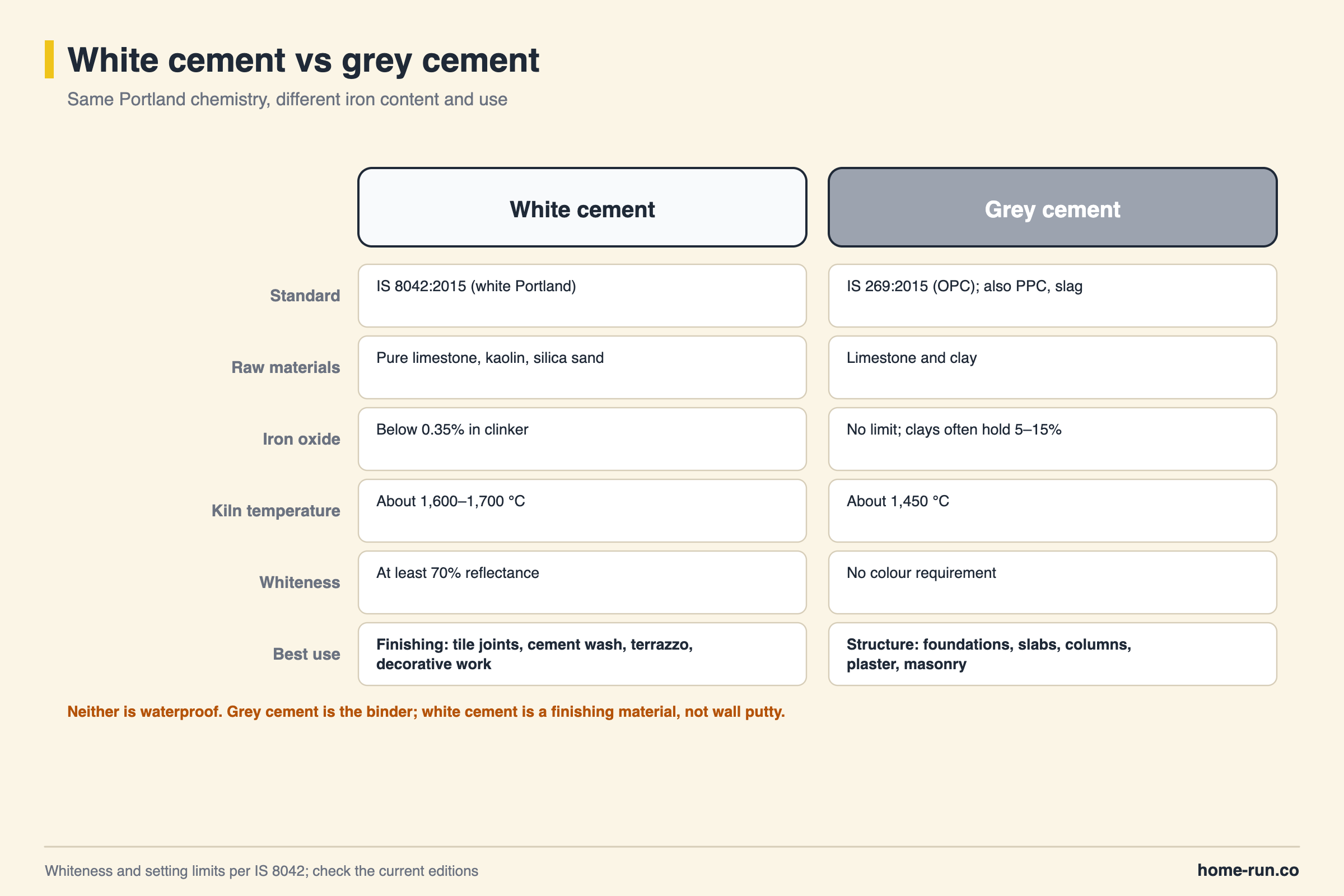
| Indian standard | IS 8042:2015, white Portland cement | IS 269:2015, Ordinary Portland Cement |
| Main raw materials | Pure limestone, kaolin, silica sand | Limestone and clay |
| Iron oxide limit | Below 0.35% in clinker | No limit; its clays often hold 5–15% |
| Kiln temperature | About 1,600–1,700 °C | About 1,450 °C |
| Whiteness | At least 70% reflectance (IS 8042); Birla White claims 89%+ Hunter | No colour requirement |
| Setting time | Initial at least 30 min, final at most 600 min | Initial at least 30 min, final at most 600 min |
| Typical use Key difference | Finishes, joints, decorative work | Concrete, plaster, masonry mortar |
| 50 kg bag, Bengaluru | ₹1,240 | ₹380–450 (OPC 53) |
Which Is Stronger, White Cement or Grey Cement?
Neither is inherently stronger: white and grey Portland cement develop strength in essentially the same way.
Grey OPC is graded by guaranteed 28-day strength of 33, 43 or 53 MPa under IS 269. White cement is bought for colour, and its price keeps it out of structural work. Use the grey grade your engineer specifies.
Where Does Each Cement Work Best?
Grey cement works best where strength matters; white cement works best where the cement stays visible.
White cement
Visible finishes- Tile and marble joint filling
- Cement wash on walls
- Terrazzo and mosaic floors
- Mouldings and coloured mixes
Grey cement
Structure- Footings, columns, beams, slabs
- Brick and block masonry mortar
- Internal and external plaster
- Floor screeds and bedding mortar
For wet-area tile joints, an epoxy or polymer grout outlasts plain white cement. For mixing and application steps, see how to apply white cement.
How Much Do White and Grey Cement Cost?
White cement costs about three times more than grey cement per kilogram. HomeRun's Bengaluru list prices a 50 kg bag of Birla White at ₹1,240 and OPC 53 grade at ₹380–450 (May 2026).
For small jobs, the same list has 1 kg at ₹40 and 5 kg at ₹140.
Is White Cement Waterproof?
No, white cement is not waterproof, and neither is grey cement. JK Cement states plainly that cement in itself is not waterproof.
Water resistance comes from waterproofing admixtures, a dense well-cured surface or a waterproof coating. Products sold as "waterproof" white cement or putty contain added chemicals; check what the pack claim covers.
Which Cement Has the Bigger Environmental Footprint?
White cement has the bigger footprint per tonne. Its kiln runs about 150–250 °C hotter and burns 20–50% more fuel, and the quenched clinker wastes heat that grey plants recover.
Homes use far less white cement than grey, and PPC lowers grey cement's footprint by using fly ash.
How Do You Choose Between White Cement and Grey Cement?
Choose by asking whether the cement will be seen. Use grey cement if it carries load or sits under plaster, tile or paint; use white cement if it forms the finished face.
- Follow the cement type and grade in your structural drawing.
- Look for the ISI mark with IS 8042 (white) or IS 269 / IS 1489 (grey).
- Buy white cement in packs sized to the job, from 1 kg up.
Reject a bag with any of these signs of poor quality:
- Hard lumps that do not crumble between your fingers.
- Yellow or grey tint in white cement against a known good sample.
- Old packing date: IS 269 asks for retesting of OPC more than three months after packing.
Need white or grey cement today?
White cement packs, OPC and PPC bags delivered across Bengaluru.