On this page
- What Are Ceramic Tiles Made Of?
- How Are Ceramic Tiles Different From Vitrified and Porcelain Tiles?
- What Types of Ceramic Tiles Are Available?
- What Are the Main Characteristics of Ceramic Tiles?
- Where Do Ceramic Tiles Suit Best in Your Home?
- How Much Do Ceramic Tiles Cost in Bengaluru?
- How Do You Choose the Right Ceramic Tiles?
- How Are Ceramic Tiles Installed and Maintained?
- Ceramic tiles are glazed clay tiles fired in a kiln.
- They are more porous than vitrified tiles.
- They suit walls and low-traffic floors; use vitrified for busy floors.
- Never lay a wall tile on a floor.
- Buy 10% extra, all from one batch.
Ceramic tiles are flat clay tiles that are shaped, glazed and fired in a kiln. The glaze gives the colour and pattern; the clay body underneath stays fairly porous.
What Are Ceramic Tiles Made Of?
Ceramic tiles are made of natural clay, pressed and fired, with a glassy glaze fused onto the face.
- Body (bisque): the fired clay base. It is usually red or white.
- Glaze: a thin glassy coat that carries the print.
- Firing: done at a lower temperature than vitrified tiles, so the body stays more porous.
In India, IS 15622:2017 is the Bureau of Indian Standards (BIS) specification for pressed ceramic tiles. It sorts tiles into groups by water absorption, following the international standard ISO 13006.
How Are Ceramic Tiles Different From Vitrified and Porcelain Tiles?
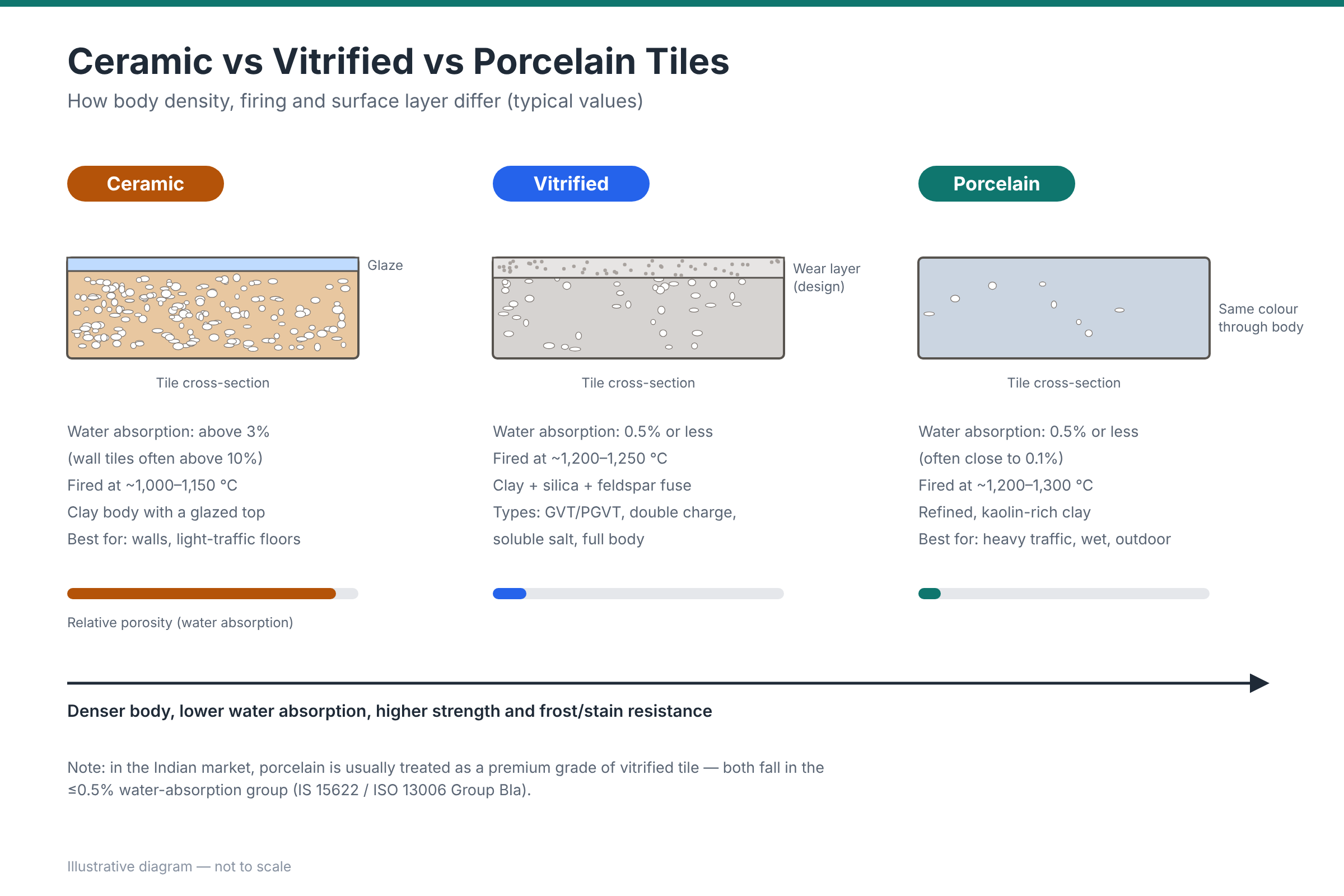
Ceramic tiles absorb more water than vitrified and porcelain tiles. Water absorption is the share of its weight a tile soaks up; lower means denser and stronger.
Ceramic, vitrified and porcelain tiles compared
Groups as defined in ISO 13006 / IS 15622| Tile type | Typical group | Water absorption | Best for |
|---|---|---|---|
| Ceramic wall tile | BIII | Over 10% | Walls only |
| Ceramic floor tile | BIIa–BIIb | 3–10% | Indoor, light-traffic floors |
| Vitrified tile Busy floors | BIa–BIb | Up to 3%, often ≤0.5% | Living rooms, halls, entrances |
| Porcelain / full-body tile | BIa | 0.5% or less | Wet areas, heavy traffic, outdoors |
Ceramic tiles
Walls, budgetGlazed clay body, lighter and easier to cut.
- Lower price per sq ft
- Wide range of wall designs
- Glaze can wear on busy floors
- Chips show the clay body below
Vitrified tiles
Main floorsClay, silica and feldspar fired until glass-like.
- Very low water absorption
- Harder and more scratch-resistant
- Large formats like 600x1200 mm
- Usually costs more per sq ft
What Types of Ceramic Tiles Are Available?
Ceramic tiles come as wall tiles and floor tiles, in glazed or unglazed forms and several finishes.
- Wall tiles: thinner and lighter, not built for foot traffic.
- Floor tiles: thicker and harder, made to resist wear.
- Glazed: design sits in a top coat. Most ceramic tiles are glazed.
- Unglazed: colour runs through the body.
- Finishes: glossy for walls, matt or satin for floors, anti-skid for wet areas.
A ceramic wall tile laid on a floor cracks and wears fast. Check the box says floor use.
What Are the Main Characteristics of Ceramic Tiles?
The main characteristics of ceramic tiles are moderate to high water absorption, a hard but thin glaze, and easy cutting.
- Easy to clean: the glaze resists stains and wipes clean.
- Affordable: usually cheaper than vitrified per sq ft.
- Easy to cut: lighter, so faster to fix on walls.
- PEI rating: a 0–5 scale for glaze wear. PEI 0 is walls only; PEI 3 suits all home floors.
- More porous, so not ideal for outdoor or frost-prone use
- Can chip or crack under heavy impact
- Glossy finishes are slippery when wet
Where Do Ceramic Tiles Suit Best in Your Home?
Ceramic tiles suit walls and low-traffic indoor floors best.
Ceramic tiles room by room
General guidance; confirm the rating on the box| Area | Ceramic suits? | What to pick |
|---|---|---|
| Bathroom walls Ideal | Yes | Glossy or satin wall tile |
| Bathroom floor | Yes, with care | Matt, anti-skid floor tile |
| Kitchen walls and backsplash Ideal | Yes | Glazed tile that wipes clean |
| Bedroom floor | Yes | Floor tile, PEI 2–3 |
| Living room and entrance Avoid | Better in vitrified | Vitrified or GVT |
| Balcony and terrace | Only outdoor-rated | Anti-skid, low-absorption tile |
Ceramic on the walls, vitrified underfoot in busy rooms. Bengaluru's monsoon soaks open balconies, so use anti-skid tiles there.
For driveways, paving blocks take vehicle loads better than tiles.
How Much Do Ceramic Tiles Cost in Bengaluru?
Ceramic wall tiles cost about ₹44–90 per sq ft in Bengaluru, with a typical rate near ₹67 (Infralens, August 2026). Orientbell lists its ceramic range at ₹34–356 per sq ft.
Price rises with size, print quality, finish, thickness and brand. Convert box prices to per sq ft before comparing, and budget for adhesive, grout and labour.
Check pieces per box on the label; 4 is illustrative.
How Do You Choose the Right Ceramic Tiles?
Choose ceramic tiles by matching the surface, wetness and foot traffic.
- Decide wall or floor, and buy the matching tile.
- For wet areas, pick a matt anti-skid finish.
- Pick a size that suits the room. Larger tiles mean fewer grout lines.
- Check the batch and shade number on every box.
- Calculate the quantity, add wastage, and keep one spare box.
How Are Ceramic Tiles Installed and Maintained?
Ceramic tiles are fixed with adhesive on a clean, level base, then grouted.
- Prep: level and clean the base. Hollow-sounding tiles usually mean poor prep.
- Spacing: use spacers; grout fills the joints.
- Curing: follow the adhesive maker's curing time before grouting and walking.
- Care: clean with a mild cleaner. Harsh acids dull the glaze and eat grout.
For jointless floors in garages and workshops, see epoxy flooring. Pale joints are often filled with white cement based grout.
Everything for your tiling job
Order tiles, adhesive and grout with a GST invoice and delivery across Bengaluru.