


On this page
- What Is Epoxy Flooring and How Does It Work?
- What Are the Types of Epoxy Flooring?
- What Are the Benefits and Disadvantages of Epoxy Flooring?
- How Much Does Epoxy Flooring Cost per Sq Ft in India?
- What Factors Change the Cost of Epoxy Flooring?
- Where Should You Use Epoxy Flooring: Homes, Garages or Commercial Spaces?
- Epoxy vs PU vs Tiles: Which Flooring Is Better?
- Can Epoxy Be Applied Over Existing Tiles or Concrete?
- How Is Epoxy Flooring Installed, Step by Step?
- How Long Does Epoxy Flooring Take to Cure?
- Why Do Epoxy Floors Fail, and How Do You Avoid It?
- How Do You Maintain and Repair an Epoxy Floor?
- How Do You Choose the Right Epoxy Flooring and Contractor?
- Epoxy flooring is a resin and hardener that cures into a hard, jointless layer bonded to concrete.
- Thin coatings cost about ₹30–80 per sq ft; self-levelling floors about ₹100–250; decorative and heavy-duty systems more.
- Surface preparation and a dry slab decide whether the floor lasts. Most peeling traces back to them.
- Standard epoxy yellows in sunlight. Use a PU or polyaspartic topcoat outdoors.
- Expect about 24 hours to foot traffic and about 7 days to full cure.
Epoxy flooring is a two-part resin and hardener, mixed on site and laid over concrete, that cures into a hard, jointless and chemical-resistant floor. It suits garages, showrooms, factories and modern homes, but only when the slab underneath is sound, dry and properly prepared.
This guide covers the types of epoxy flooring, what it costs per sq ft in India, how it is installed, how long it takes to cure, and why some floors fail.
What Is Epoxy Flooring and How Does It Work?
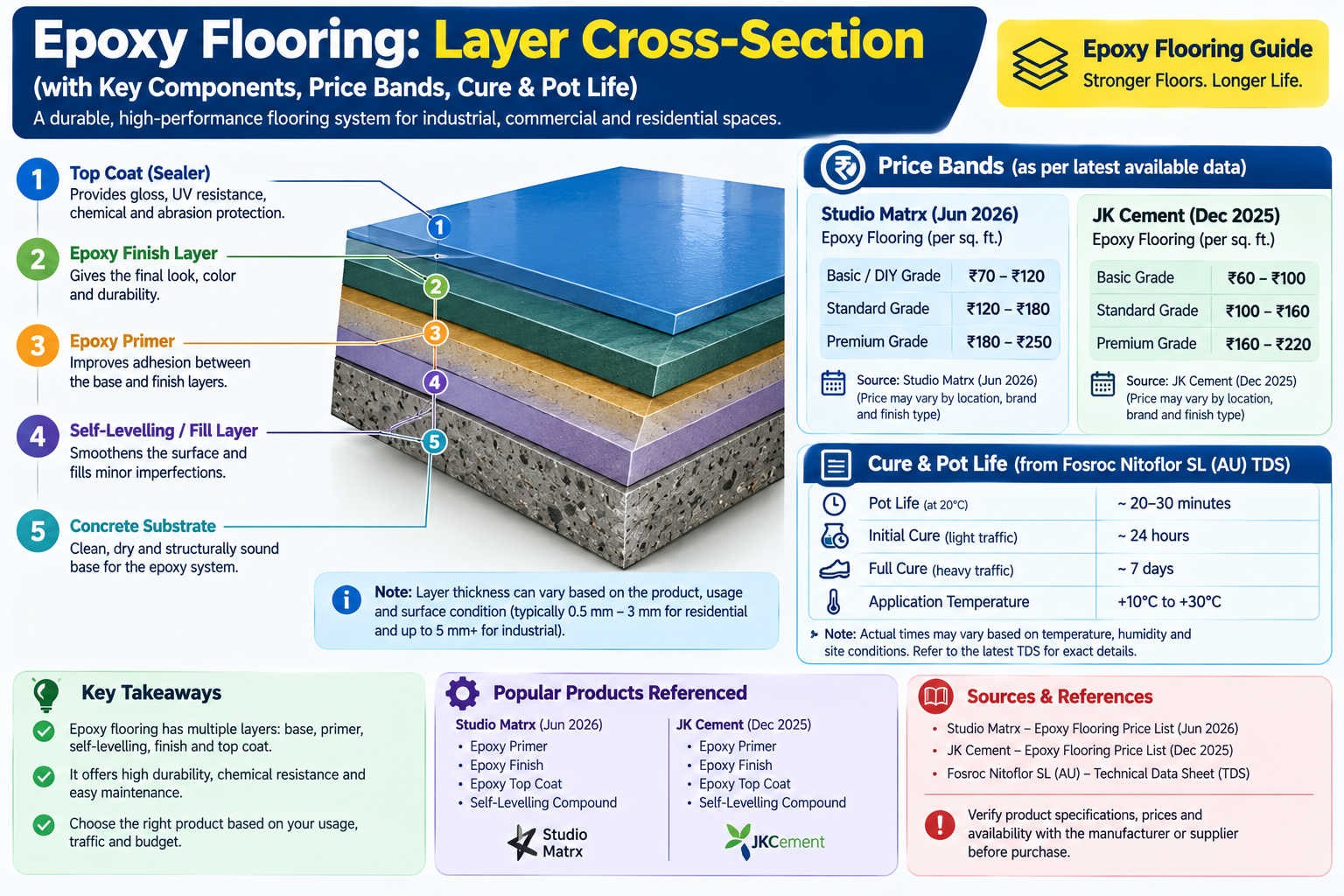
Epoxy flooring is a resin system that hardens by a chemical reaction, not by drying like paint. The resin (Part A) and the hardener (Part B) are mixed in a ratio set by each manufacturer. Once mixed, the liquid starts to set into a solid, plastic-like layer.
A typical epoxy floor is built in three layers:
- Primer. A thin coat that soaks into the concrete and gives the next layers something to grip.
- Body coat. The main layer. It can be a rolled coating, a pourable self-levelling layer or a thick mortar.
- Topcoat. A clear or coloured final coat that sets the gloss, grip and wear resistance.
Epoxy bonds to concrete. It does not hold a weak, dusty or damp slab together. If the concrete cracks, crumbles or pushes up moisture, the epoxy fails with it.
What Are the Types of Epoxy Flooring?
The main types of epoxy flooring are thin coatings, self-levelling floors, mortar or quartz floors, and special systems such as anti-static, flake and 3D floors. They differ in thickness, strength and look.
Epoxy flooring systems compared
Thickness ranges from Indian guides and manufacturer data| System | Typical thickness | Best for | Duty |
|---|---|---|---|
| Epoxy floor coating (paint) | 0.1–0.3 mm | Homes, stores, light workshops | Light |
| Self-levelling epoxy | 1–4 mm | Showrooms, hospitals, labs, modern homes | Medium |
| Epoxy mortar or quartz | 4–9 mm | Factories, warehouses, car parks | Heavy |
| Anti-static (ESD) epoxy | Varies by system | Electronics units, server rooms | Specialist |
| Flake, metallic and 3D epoxy | Varies by design | Living rooms, retail, cafés | Decorative |
Epoxy products also come in three bases:
- Solvent-based: strong smell during application; needs good ventilation.
- Water-based: low odour; thinner film per coat.
- Solvent-free (100% solids): thick builds with low odour; used for self-levelling floors.
What Are the Benefits and Disadvantages of Epoxy Flooring?
Epoxy flooring is durable, jointless and easy to clean, but it is unforgiving of a poor slab, can be slippery and fades in sunlight. Weigh both sides before you ask for quotes.
Benefits
Why people choose itStrong points of a well-laid epoxy floor.
- No grout lines, so dirt and germs have fewer places to hide
- Resists oil, many chemicals and abrasion
- Easy to mop and keep hygienic
- Wide choice of colours, flakes and finishes
- Can be laid over sound existing concrete
Disadvantages
Plan around theseLimits that cause most complaints.
- Needs mechanical surface preparation and a dry slab
- Glossy finishes get slippery when wet
- Standard epoxy yellows or chalks in UV light
- Cracks if the slab under it moves or cracks
- Hard to remove, and needs days to cure
Epoxy resins break down under ultraviolet (UV) light. Fosroc's data sheet for its Nitoflor SL self-levelling epoxy states it is not UV stable and may discolour even indoors. For sunlit areas, ask for a polyurethane (PU) or polyaspartic topcoat. Both resin types are more UV stable than epoxy.
How Much Does Epoxy Flooring Cost per Sq Ft in India?
Epoxy flooring costs about ₹30–80 per sq ft for a thin coating and ₹100–250 per sq ft for self-levelling epoxy. Heavy-duty and decorative systems run ₹150–500 per sq ft or more. These rates include labour but usually not GST at 18%.
Epoxy flooring price per sq ft in India
Applied rates, mid-2026| System | ₹ per sq ft |
|---|---|
| Epoxy floor coating (roller) | 30–80 |
| Flake or chip epoxy | 90–180 |
| Self-levelling epoxy | 100–250 |
| Epoxy mortar | 150–300 |
| Anti-static epoxy | 150–300 |
| Metallic epoxy | 200–300 |
| 3D epoxy | 250–300+ |
A quote usually covers the primer, body coat, topcoat and labour. These items are often extra:
- Grinding or shot blasting a rough or painted slab (about ₹20–80 per sq ft more)
- Crack repair, levelling and moisture-barrier primer
- Anti-skid or UV-stable PU topcoat (about ₹20–60 per sq ft more)
- Skirting, coving at wall junctions, and 18% GST
Coverage figures are theoretical. Always use the coverage printed on the product's technical data sheet (TDS) for your chosen thickness.
What Factors Change the Cost of Epoxy Flooring?
The biggest factors are the system and thickness, the condition of your slab, and the finish you choose. Area size, access and city labour rates come next.
- System and thickness: a 3 mm self-levelling floor uses about ten times the resin of a 0.3 mm coating.
- Slab condition: cracks, oil stains, old paint and damp all add preparation cost.
- Finish: metallic, flake and 3D designs cost more than a plain colour.
- Area and access: small rooms cost more per sq ft than large, open floors.
- Brand and product grade: compare data sheets, not brand names alone.
Match the system to the real traffic. A living room rarely needs a heavy mortar floor. Never save money by cutting surface preparation, because poor preparation is the most common cause of peeling.
Where Should You Use Epoxy Flooring: Homes, Garages or Commercial Spaces?
Epoxy flooring works best indoors on concrete that carries traffic, spills or hygiene demands. It is a poor choice for open terraces in direct sun unless a UV-stable topcoat goes on top.
Matching the epoxy system to the space
General guidance| Space | Suitable system | Watch for |
|---|---|---|
| Living room or bedroom | Self-levelling, flake or metallic Default pick | Gloss gets slippery; use a satin or matt topcoat |
| Kitchen or utility | Self-levelling with anti-skid topcoat | Hot pans and dropped knives can mark the surface |
| Home garage or parking | Self-levelling or thin mortar | Hot tyres can lift thin coatings |
| Factory or warehouse | Epoxy mortar or quartz | Forklift loads need the heavier build |
| Hospital, lab or food unit | Self-levelling, coved at walls | Check food-grade and hygiene certifications |
| Open terrace or balcony Avoid | Not standard epoxy | UV yellowing and heat; ask for PU or polyaspartic |
Cured epoxy is generally inert. The bigger home concern is fumes during application and curing. Choose low-odour, solvent-free products, keep rooms ventilated, and keep children and pets away until the floor has cured. Check the product's safety data sheet.
Epoxy vs PU vs Tiles: Which Flooring Is Better?
Epoxy is better than tiles where you need a jointless, chemical-resistant floor. Tiles are better for most living spaces on a budget, and PU is better where the floor faces sun or temperature swings.
Epoxy flooring vs polyurethane vs vitrified tiles
Relative comparison| Feature | Epoxy | Polyurethane (PU) | Vitrified tiles |
|---|---|---|---|
| Joints | None | None | Grout lines |
| Hardness | Very hard | More flexible | Very hard |
| UV stability | Poor | Good | Good |
| Repair | Patch shows; recoat bay | Patch shows; recoat bay | Replace single tiles |
| Best use | Garages, industry, clean rooms | Topcoats, sunlit or cold areas | Homes and general use |
Pick epoxy for spills, chemicals, vehicles or a jointless look. Pick tiles for an everyday home floor. Add a PU topcoat to epoxy wherever sunlight reaches the floor.
Can Epoxy Be Applied Over Existing Tiles or Concrete?
Epoxy can be applied over sound concrete, and over existing tiles only if every tile is firmly bonded. Concrete is the better base once it is clean, roughened and dry.
Over tiles, the joints must be filled and the glaze ground or abraded so the primer can bite. If any tile sounds hollow when tapped, remove the tiles first. Epoxy will crack over a loose tile.
Moisture is the hidden risk in ground-floor and basement slabs, especially through Bengaluru's monsoon months. Three standard tests check it:
- Plastic sheet test (ASTM D4263): a 457 × 457 mm sheet taped down for at least 24 hours. Condensation under it signals damp.
- Calcium chloride test (ASTM F1869): measures moisture rising from the slab. Most standard primers need 3 lb per 1,000 sq ft per 24 hours or less.
- Relative humidity probe (ASTM F2170): a probe set into the slab. Most standard primers need 75–80% RH or less.
Slab readiness checklist before the contractor starts
- New concrete has cured for the time the epoxy maker specifies
- A moisture test has passed, or a moisture-barrier primer is in the quote
- Cracks and joints are marked for repair, not coated over
- Oil, grease and old paint will be ground off
- No hollow-sounding patches in the slab or tiles
How Is Epoxy Flooring Installed, Step by Step?
Epoxy flooring installation follows eight steps, and the first three decide whether the floor lasts:
- Inspect and test. Check slab strength, cracks and moisture.
- Prepare the surface mechanically. Diamond grinding or shot blasting opens the concrete so the primer can soak in.
- Repair cracks and joints. Fill with epoxy mortar. Leave moving joints open and seal them with a flexible sealant.
- Vacuum the dust. Fine dust left behind stops the primer from bonding.
- Prime. Apply primer within the recoat window shown on the data sheet.
- Lay the body coat. Roll a coating or pour and spread a self-levelling layer. Spiked rollers release trapped air.
- Broadcast, if specified. Scatter quartz sand or flakes for grip or design.
- Topcoat. Apply the final coat, with anti-skid additive or a PU topcoat where needed.
Be wary of a contractor who offers only acid washing or light sanding, with no grinding or shot blasting. Mixed epoxy also has a short working time. Fosroc's Nitoflor SL gives 30 minutes at 20°C, and the time shortens in heat.
How Long Does Epoxy Flooring Take to Cure?
Most epoxy floors take about 24 hours before you can walk on them and about 7 days to cure fully. Cooler or more humid conditions slow every stage.
Pot life
Mixed epoxy stays workable for roughly 30 minutes at 20°C (Fosroc Nitoflor SL).
Foot traffic
Walk carefully in clean socks or shoe covers.
Light use and vehicles
Light furniture can return. Fosroc allows vehicles after 48 hours on Nitoflor SL.
Full cure
Full chemical resistance. Keep water and heavy loads off until then.
These times come from one product's data sheet and an Indian cost guide. Your product's data sheet is the final word. Fosroc also advises against applying its epoxy below 10°C.
Why Do Epoxy Floors Fail, and How Do You Avoid It?
Epoxy floors fail mainly because of poor surface preparation, moisture in the slab or a slab that moves. The resin itself is rarely the cause.
Signs of a failed epoxy job
- Peeling or lifting: weak bond from poor grinding, dust or damp
- Blisters and bubbles: moisture pushing up from the slab
- Pinholes: air escaping from a warming slab during application
- Sticky or soft patches: wrong mixing ratio or poor mixing
- Cloudy, greasy film: amine blush from cool, humid curing
- Cracks: slab cracks or joints coated over without treatment
- Yellowing: sunlight on an epoxy without a UV-stable topcoat
A well-laid residential epoxy floor lasts roughly 7–15 years before it needs a recoat, according to Indian flooring guides. Traffic, preparation quality, product grade and care decide where in that range your floor lands.
Most epoxy floors that peel were lost before the first coat went down, at the grinding and moisture-testing stage.
HomeRun Team
How Do You Maintain and Repair an Epoxy Floor?
You maintain an epoxy floor by sweeping often and mopping with a mild, pH-neutral cleaner. Simple care keeps the topcoat intact for years.
- Dust-mop daily and wet-mop weekly with a neutral cleaner
- Wipe oil, acids and solvents up quickly
- Avoid harsh acids, bleach in high strength and abrasive scrub pads
- Use felt pads under furniture and mats at entrances
- Repair chips and hairline cracks by grinding, filling and recoating
- Recoat the topcoat when the gloss wears through in traffic lanes
A patch repair may show a slight colour or gloss difference. Recoating the whole bay gives an even finish.
How Do You Choose the Right Epoxy Flooring and Contractor?
Choose the system first, then the contractor. Define the load, moisture risk and look you need, then ask at least three contractors for itemised quotes on the same specification.
Ask every epoxy flooring contractor these questions:
- Which system, product and dry film thickness are you quoting?
- How will you prepare the surface, and will you test for moisture?
- Can you share the technical and safety data sheets?
- What does the warranty cover, and for how long?
- Can I see a floor you laid at least two years ago?
An epoxy paint for flooring rolled on at home is a thin coat, a fraction of a millimetre thick. It brightens and protects a garage or store room. It does not match a ground, primed, self-levelling floor laid by a trained crew.
Prepare the slab before the epoxy goes down
Cement, waterproofing and repair materials for levelling, crack filling and damp-proofing, delivered across Bengaluru. Genuine stock, GST invoice.