On this page
- How Is Screed Different from Concrete and Mortar?
- Which Type of Concrete Screed Should You Choose?
- What Mix Ratio and Thickness Should You Use in Each Room?
- How Much Cement and Sand Will You Need?
- How Is Concrete Screed Laid, Step by Step?
- How Long Should Screed Cure Before Tiling?
- What Does Concrete Screed Cost in India?
- Why Does Screed Crack, Sound Hollow or Dust?
- Concrete screed is a non-structural layer; it levels the slab and sets falls to drains.
- Pick the type by build-up: bonded 25–40 mm, unbonded 50 mm or more, floating 65–75 mm.
- Most sand-cement screeds use 1:3 to 1:4.5 cement to sand, with clean, well-graded sand.
- Wet areas need a fall of 1:80 to 1:100, with waterproofing below the screed.
- Keep screed moist for at least 7 days, then check it is dry before wood or vinyl goes down.
Concrete screed is a thin layer of cement, sand and water laid over a concrete slab to give a flat, level base for the floor finish. On Indian sites the mason may call it the base coat, bedding or levelling layer.
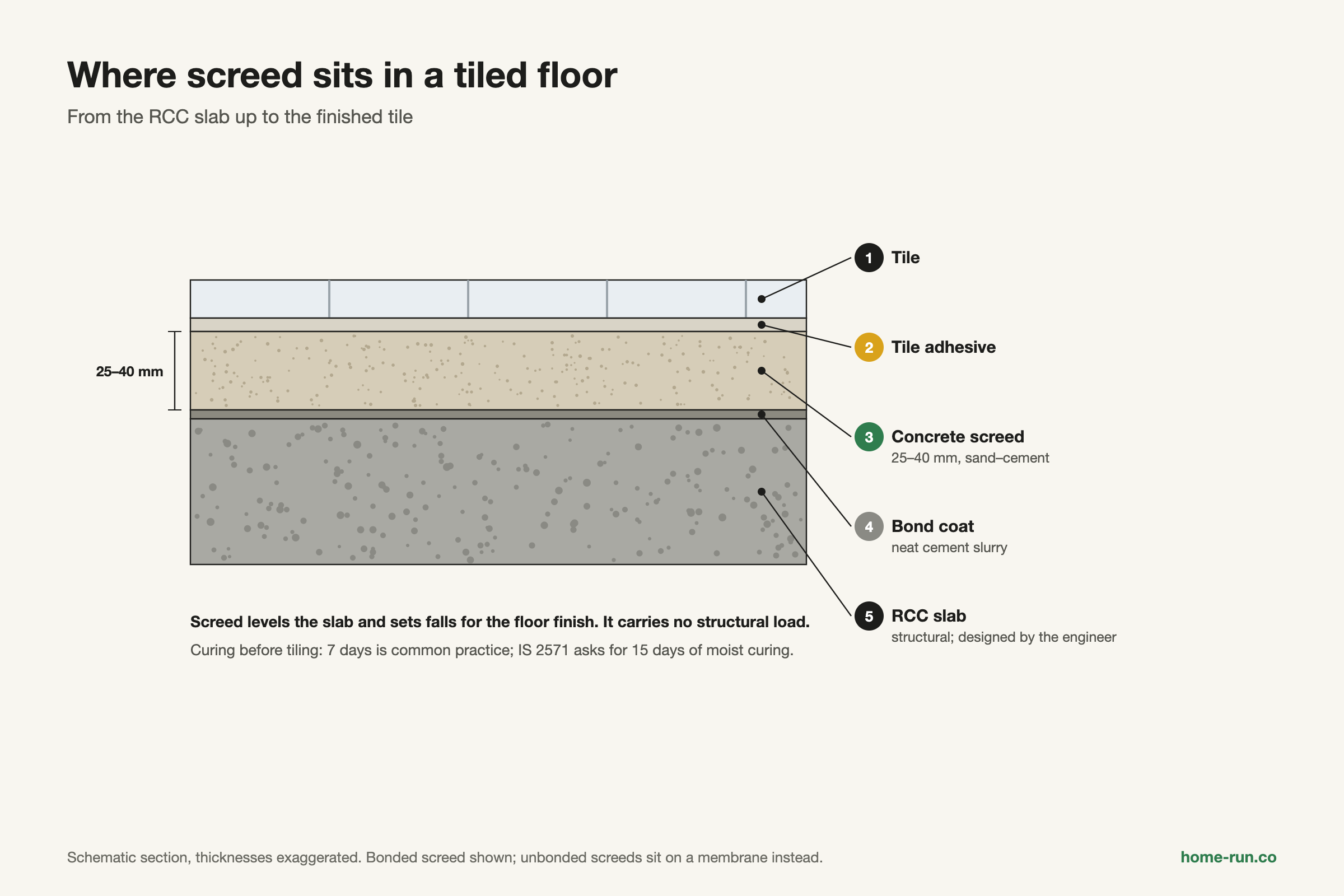
Screed sits between the rough RCC (reinforced cement concrete) slab and your tiles, marble, vinyl or wood, and sets the slope to drains.
How Is Screed Different from Concrete and Mortar?
Concrete screed uses only fine aggregate (sand), so it gives a smooth, level surface but carries no structural load. Concrete contains coarse stone aggregate and forms the load-bearing slab.
Screed vs concrete vs mortar
Typical house use| Material | Aggregate | Usual thickness | Job | Structural? |
|---|---|---|---|---|
| Concrete screed | Sand, grains up to about 4 mm | 25–75 mm | Level base and falls for the floor finish | No |
| Concrete (PCC or RCC) | Sand plus crushed stone | Set by the structural design | Slabs, beams, footings, base concrete | Yes (RCC) |
| Mortar | Sand | About 10 mm joints; plaster coats | Binds bricks or blocks; plasters walls | No |
Screed is judged on flatness and bond; concrete on strength. Thick screed never fixes a weak slab, so slab design stays with your structural engineer. For slab grades, see our concrete mix ratio guide.
Which Type of Concrete Screed Should You Choose?
Choose the concrete screed type by what lies beneath it: bonded for a clean slab, unbonded over a membrane, floating over insulation or heating pipes, and flowing screed for large flat areas.
Screed types and minimum thickness
Sand-cement unless noted| Type | Laid on | Thickness | Best for |
|---|---|---|---|
| Bonded Most homes | Slab, with a bonding slurry or agent | 25–40 mm | Rooms with a sound, clean slab |
| Unbonded | A damp-proof or waterproofing membrane | 50 mm min. | Ground floors, damp-prone areas |
| Floating | Thermal or acoustic insulation | 65 mm (domestic) to 75 mm | Insulated floors, underfloor heating |
| Liquid (flow) screed | Pumped over slab or insulation | Per datasheet | Large, open, flat areas |
| Self-levelling compound Thin fix | Primed screed or slab | Per datasheet | Renovation, fixing small level errors |
Bonded screed
Sound slabPonit
- Thinner, at 25–40 mm, so less dead load and cost
- Moves with the slab, so curling is less likely
- Needs a clean, rough slab and bonding slurry
Floating screed
Insulated floorPoint
- Thicker, at 65–75 mm, and usually reinforced
- Needs edge strips so the screed can move
- Higher curling risk if it dries too fast
What Mix Ratio and Thickness Should You Use in Each Room?
Most concrete screed for Indian homes is mixed at 1:4 cement to sand by volume, laid 25–40 mm thick on indoor slabs. Sand-cement screeds generally range from 1:3 to 1:4.5.
Screed mix and thickness by room
Confirm with your engineer| Area | Mix (cement:sand) | Thickness | Watch for |
|---|---|---|---|
| Living room, bedrooms | 1:4 | 25–40 mm | Flat to a straight edge, no hollows |
| Bathroom (sunken slab) | 1:4 to 1:5 | 25 mm min. at the drain | Waterproofing below; fall 1:80–1:100 to the trap |
| Balcony, utility | 1:4 to 1:5 | 25 mm min. at the outlet | Fall away from the door, 1:80–1:100 |
| Terrace | 1:4 to 1:5 | Set by the slope | Slope to rainwater outlets agreed with the waterproofing contractor |
- Sand: use clean, well-graded sharp sand, either washed river sand or M-sand (manufactured sand) that is not dusty. Silty plastering sand weakens the surface.
- Water: just enough for a damp, compactable mix; extra water causes cracks and dusting.
- Additives: polypropylene or glass fibres reduce plastic cracking; an SBR (styrene-butadiene rubber) bonding agent improves grip on the slab.
How Much Cement and Sand Will You Need?
To find screed material, multiply area by thickness, add 33% for dry volume, then split that volume by the mix ratio.
Laying screed this week?
Cement, sand and waterproofing delivered across Bengaluru.
How Is Concrete Screed Laid, Step by Step?
Concrete screed is laid by cleaning the slab, applying a bond coat, setting level guides, then spreading, compacting and finishing the mix.
- Prepare the slab. Chip off loose material, roughen and wash it. IS 2571, the Indian code for laying in-situ cement concrete flooring, asks for soaking the base first.
- Waterproof wet areas first. In bathrooms, balconies and terraces, the waterproofing coat goes on the slab before the screed.
- Apply the bond coat. Brush neat cement slurry, or slurry with a bonding agent, just ahead of the screed.
- Set levels. Mark the finished level and falls, then lay mortar dots or guide strips with a spirit level.
- Spread and compact. Fill between the guides and tamp out air pockets.
- Level and finish. Run a straight edge across the guides, then close the surface with a wood float or steel trowel.
- Allow for movement. Carry slab movement joints through the screed, and add edge strips on floating screeds.
For the wet-area sequence in detail, read our bathroom waterproofing guide.
How Long Should Screed Cure Before Tiling?
Keep concrete screed moist for at least 7 days, or 10–14 days in hot, dry or windy weather, before tiling. IS 2571 asks for 15 days of moist curing on cement concrete flooring.
Light foot traffic
Walk on boards; start wet curing once set.
Moist curing
Ponding, wet hessian or plastic sheet.
Tiling with cement adhesive
Once curing ends and the surface is sound.
Wood, vinyl or epoxy
Test moisture first; drying runs about 1 mm per day for the first 40 mm.
Monsoon humidity slows drying. Ask the supplier for the moisture limit before laying finishes like epoxy flooring.
What Does Concrete Screed Cost in India?
Site-mixed cement-sand screed costs about ₹40–90 per sq ft with labour, depending on thickness. Sloped screed in wet areas costs about ₹50–100 per sq ft (StudioMatrx, June 2026, before GST).
Bagged premix and flowing screeds cost more but give a steadier mix. Pumped or machine screeding pays off only on large floors.
Why Does Screed Crack, Sound Hollow or Dust?
Concrete screed fails mostly from too much water, poor bond, fast drying or missing joints.
- Cracks: drying shrinkage or joints not carried through. Fix: rake and fill fine cracks; cut out moving ones.
- Hollow sound when tapped: poor bond to a dirty or dry slab. Fix: cut out and relay the area.
- Curling edges: the top dried faster than the base. Fix: grind or replace the lifted section.
- Dusting or crumbling: wet mix, weak sand or poor compaction. Fix: grind and seal, or overlay.
Before work starts, lock the mix and thickness per room, the method and the curing plan. Then compare finishes in our guide to types of tiles.