On this page
- What Is Microcement, and How Is It Different from Micro Concrete?
- Which Rooms and Surfaces Can It Cover in an Indian Home?
- How Does It Hold Up in Monsoon Humidity and Hard Water?
- Is It Slippery, and Will It Crack?
- How Much Does Microcement Cost in India, and How Does It Compare?
- Which Existing Surfaces Can Take a Coat?
- How Is It Applied, and When Can You Use the Room?
- How Do You Clean and Reseal It, and How Long Does It Last?
- Should You Use a DIY Kit or a Professional Applicator?
- Is Microcement Right for Your Project?
- Microcement is a decorative surface finish, 2 to 3 mm thick, not a structural concrete.
- In India, "micro concrete" bags usually mean a flowable repair mortar for damaged RCC, a different product.
- It can go over existing tiles, plaster or concrete, but only on a dry, sound, flat base.
- The sealer protects the surface; wet areas still need a waterproofing membrane underneath.
- Expect ₹250 to ₹500 per sq ft installed, more than most vitrified tiling.
Microcement is a thin decorative coating made of cement, fine aggregates, polymers and pigments. Applicators trowel it by hand in thin coats over floors, walls and counters to get a smooth, joint-free, concrete-look finish.
Below: its uses, properties, cost, cure times and care, and when tiles are the better pick.
What Is Microcement, and How Is It Different from Micro Concrete?
Microcement is a surface finish, while most "micro concrete" sold in India is a structural repair material. A microcement system is a stack of thin layers:
- Primer: helps the coating grip. A quartz primer adds fine grit for glazed tile.
- Base coats with fibreglass mesh: coarser layers that build strength; the woven glass-fibre mesh holds them together.
- Finish coats (topcoat): finer layers that set the colour and texture.
- Sealer: a clear protective coat, often polyurethane, that blocks stains and water.
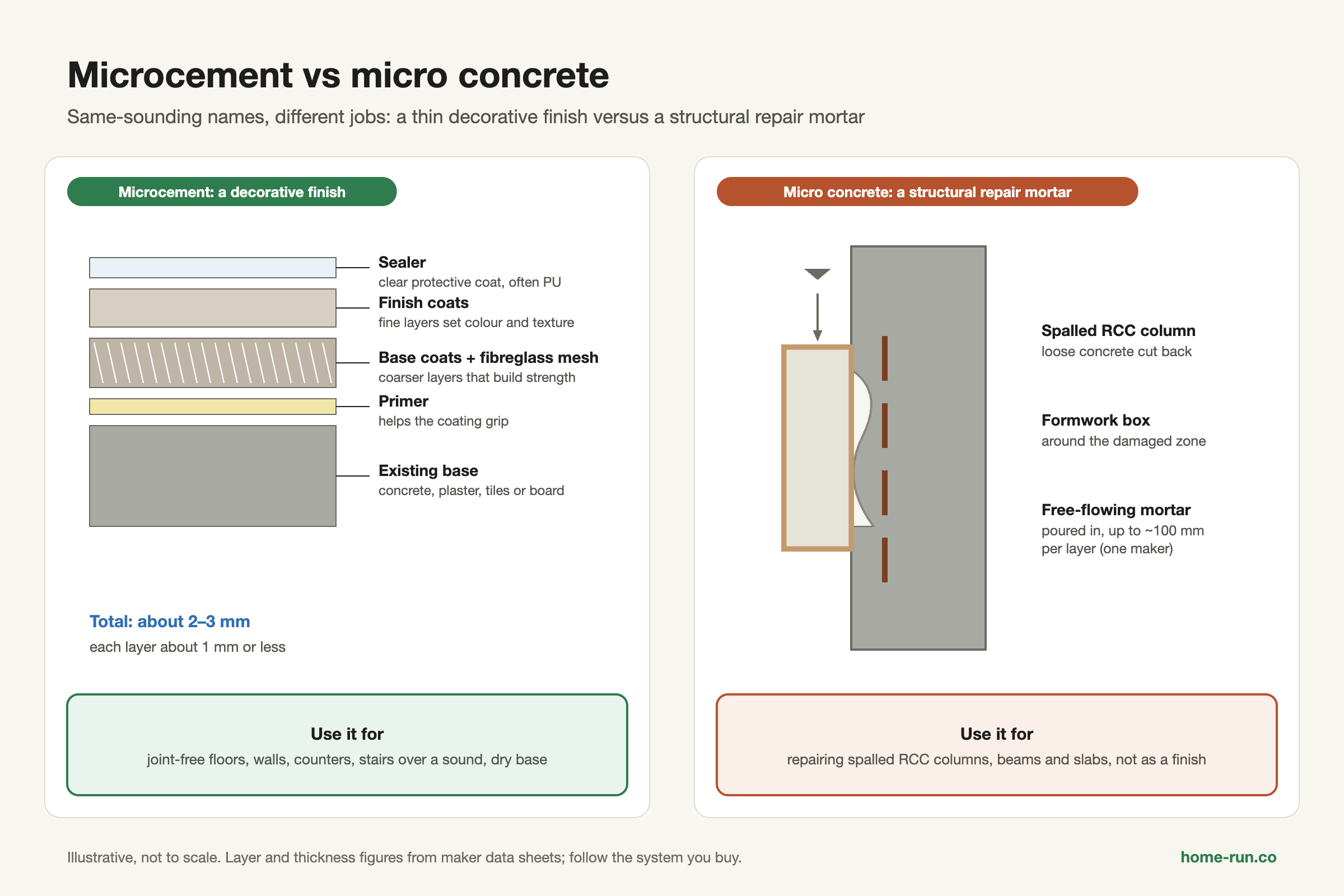
Topciment's Sttandard Microbase data sheet limits each layer to 1 mm. HomeLane and Studio Matrx give a typical total of 2 to 3 mm.
Dr. Fixit Micro Concrete, sold in 25 kg bags, is a free-flowing, shrinkage-compensated mortar for repairing spalled RCC columns, beams and slabs. Pidilite rates it at 55 N/mm² at 28 days and up to 100 mm per layer. Its bag price tells you nothing about microcement cost.
Which Rooms and Surfaces Can It Cover in an Indian Home?
You can use microcement on floors, walls, bathrooms, kitchen counters, stairs and furniture. It bonds to concrete, cement plaster, gypsum board and existing tiles when the base is prepared.
- Floors: living rooms and bedrooms, with no grout lines.
- Microcement walls: feature and TV walls with a soft plaster-like texture.
- Bathrooms and showers: one continuous surface from floor to wall, over a membrane.
- Counters and furniture: worktops, vanities and tables, kept away from heat.
- Over old tiles: renovation without breaking tiles.
- Balconies and terraces: only with an exterior-rated system and anti-slip sealer.
How Does It Hold Up in Monsoon Humidity and Hard Water?
Microcement performs well indoors in India when the base is dry and the sealer is maintained. Moisture causes most problems.
- Monsoon humidity: slows drying and curing. Topciment specifies application between 10°C and 30°C.
- Damp bases: Topciment asks for base moisture of 5% or less on a moisture meter before work starts.
- Hard water: hard water is a concern in many parts of Bengaluru, especially on borewell supply. Wipe shower scale often.
- Heat and sun: exterior use needs a UV-stable, exterior-rated sealer.
Do not lay microcement over a wall with active seepage. Fix the source first. Our guide to water seepage causes and solutions explains how to trace it.
Is It Slippery, and Will It Crack?
Microcement is only as slip-resistant as its sealer, and it cracks mainly when the base moves.
Slip resistance
A glossy sealer feels slippery when wet. Anti-slip sealers add fine grit for grip in showers and balconies. Ask for the tested slip rating of the exact sealer, and wet a sample before approving.
Cracking
Topciment states that microcement will not crack if the base under it does not crack. Mesh helps, but it cannot fix a moving base.
- Cracks or hollow tiles in the existing floor
- Structural movement joints covered over instead of carried through
- Coats laid thicker than about 1 mm
- No mesh on floors, or skipped primer
How Much Does Microcement Cost in India, and How Does It Compare?
Microcement costs roughly ₹250 to ₹500 per sq ft installed in India, as of mid-2026. Studio Matrx gives ₹250 to ₹450 for a basic floor and ₹450 to ₹800 for premium or imported systems, plus 18% GST. HomeLane gives ₹250 to ₹500.
It costs more than tiling because skilled hands lay five or more layers. Get at least three quotes.
Microcement vs common alternatives
Qualitative; confirm with quotes| Finish | Joints | Added thickness | Wet rooms | Spot repair |
|---|---|---|---|---|
| Microcement Joint-free look | None | 2–3 mm | Yes, over a membrane | Hard to colour-match |
| Vitrified tile Default pick | Grout lines | 12–15 mm | Yes | Swap one tile |
| Epoxy coating | None | 1–3 mm | Limited | Recoat area |
| Polished concrete New slabs only | Saw-cut joints | Slab itself | Needs sealing | Visible patch |
Read our epoxy flooring guide if you want a joint-free floor for a garage or utility area.
Preparing walls and floors in Bengaluru?
Order prep and finishing materials with a GST invoice and delivery across Bengaluru.
Which Existing Surfaces Can Take a Coat?
You can apply microcement over concrete, cement plaster, gypsum board, MDF and existing tiles. Each base needs its own primer, and loose or damp bases must be fixed first.
Microcement over common Indian substrates
Confirm with the system's data sheet| Substrate | Prep needed | Verdict |
|---|---|---|
| Concrete or cement screed | Fully cured, dry, dust-free; absorbent-surface primer | Suitable |
| Brick wall with cement plaster | Sound plaster, cracks repaired, absorbent primer | Suitable |
| Vitrified or ceramic tiles Common reno | Fill grout joints, quartz or non-absorbent primer, mesh | Suitable if no tile sounds hollow |
| Old Kota or mosaic floor | Degrease, level, non-absorbent primer | Suitable if level and sound |
| Cracked terrace slab Avoid | Waterproof and repair the slab first | Not until the slab is stable |
How Is It Applied, and When Can You Use the Room?
Microcement goes on in sequence: prep, primer, base coats with mesh, finish coats, then sealer. Full use takes weeks.
Prepare the base
Repair cracks, fill joints, confirm moisture of 5% or less, prime.
Base coats with mesh
First coat, mesh, second coat; sand lightly between.
Finish coats
Fine coloured coats set the texture.
Seal
Seal 24 to 48 hours after the last coat hardens, in 2 to 3 sealer coats.
Light foot traffic
Walk gently. Do not wet or clean the surface.
Water, then full use
Water after day 7, cleaning products after about day 21, full hardness near day 30.
Sources differ on foot traffic. Studio Matrx says 24 to 48 hours; the Cemher Microne care guide says light traffic after day 7. Follow your data sheet, allow longer in monsoon humidity, and ventilate while sealers cure.
How Do You Clean and Reseal It, and How Long Does It Last?
Care for microcement with water and a pH-neutral cleaner, and reseal when the surface starts to dull. Studio Matrx says a well-sealed finish can last 10 to 15 years or more.
- Sweep or vacuum grit daily, since sand scratches the sealer.
- Mop with water or a pH-neutral cleaner the brand approves.
- Skip bleach, ammonia, acid toilet cleaners, vinegar and steel wool.
- Wipe turmeric, curry, tea and oil within the hour.
- Use trivets for hot pans and a board for knives on counters.
- Inspect yearly and reseal when water stops beading.
Resealing costs about ₹30 to ₹90 per sq ft (Studio Matrx).
Should You Use a DIY Kit or a Professional Applicator?
Use a professional for floors and wet areas. A DIY kit suits only small dry projects.
DIY microcement kit
Small dry jobsFeature walls, shelves, furniture.
- Lower cash cost
- Fine for low-risk surfaces
- Steep learning curve with the trowel
- No warranty if it fails
Professional applicator
Floors and wet areasBathrooms, kitchens, full floors.
- Moisture testing and base repair
- Correct membrane and sealer
- Even texture over large areas
- Written warranty on the job
Before you pay a deposit, ask each applicator:
- Which brand and product system will you use, and can I see the data sheet?
- Does the quote include base repair, membrane, primer and mesh?
- What does the warranty cover, and what voids it?
- Can I see a job at least a year old, and a sample panel?
Is Microcement Right for Your Project?
Microcement is right if you want a joint-free look over a sound base and can pay for skilled labour and resealing. Choose tiles for low upkeep and easy repairs.
- The base is dry, level and free of cracks or hollow tiles.
- Your budget covers ₹250 or more per sq ft plus GST.
- You accept gentle cleaning and periodic resealing.
- Wet areas will get a membrane and an anti-slip sealer.
Ask applicators for a site visit, sample panel and itemised quote. For budget tinted finishes, see our guide to white cement properties and uses.