On this page
- What Are Concrete Bricks, and How Are They Different from Blocks and Red Bricks?
- What Types of Concrete Bricks Are Available in India?
- What Grades and Sizes Do Concrete Blocks Come In Under IS 2185?
- What Are the Benefits and Drawbacks of Concrete Bricks?
- Where Are Concrete Bricks Used?
- How Should Concrete Bricks Be Laid?
- How Much Do Concrete Bricks Cost in Bengaluru?
- Concrete bricks are cement-bound and cured, so they differ from fired red clay bricks.
- Solid and hollow concrete blocks follow IS 2185 (Part 1):2005, in grades A, B and C.
- Solid Grade C blocks need a density of at least 1800 kg/m³ and 4.0 N/mm² strength.
- Water absorption must stay at or below 10% by mass.
- Solid units suit low-rise load-bearing walls; hollow and lightweight units suit infill and partitions.
Concrete bricks are masonry units made by moulding a mix of cement, sand, aggregate and water, then curing it instead of firing it in a kiln. In India the name covers small cement bricks and the larger solid and hollow concrete blocks used for walls, boundary walls and paving.
What Are Concrete Bricks, and How Are They Different from Blocks and Red Bricks?
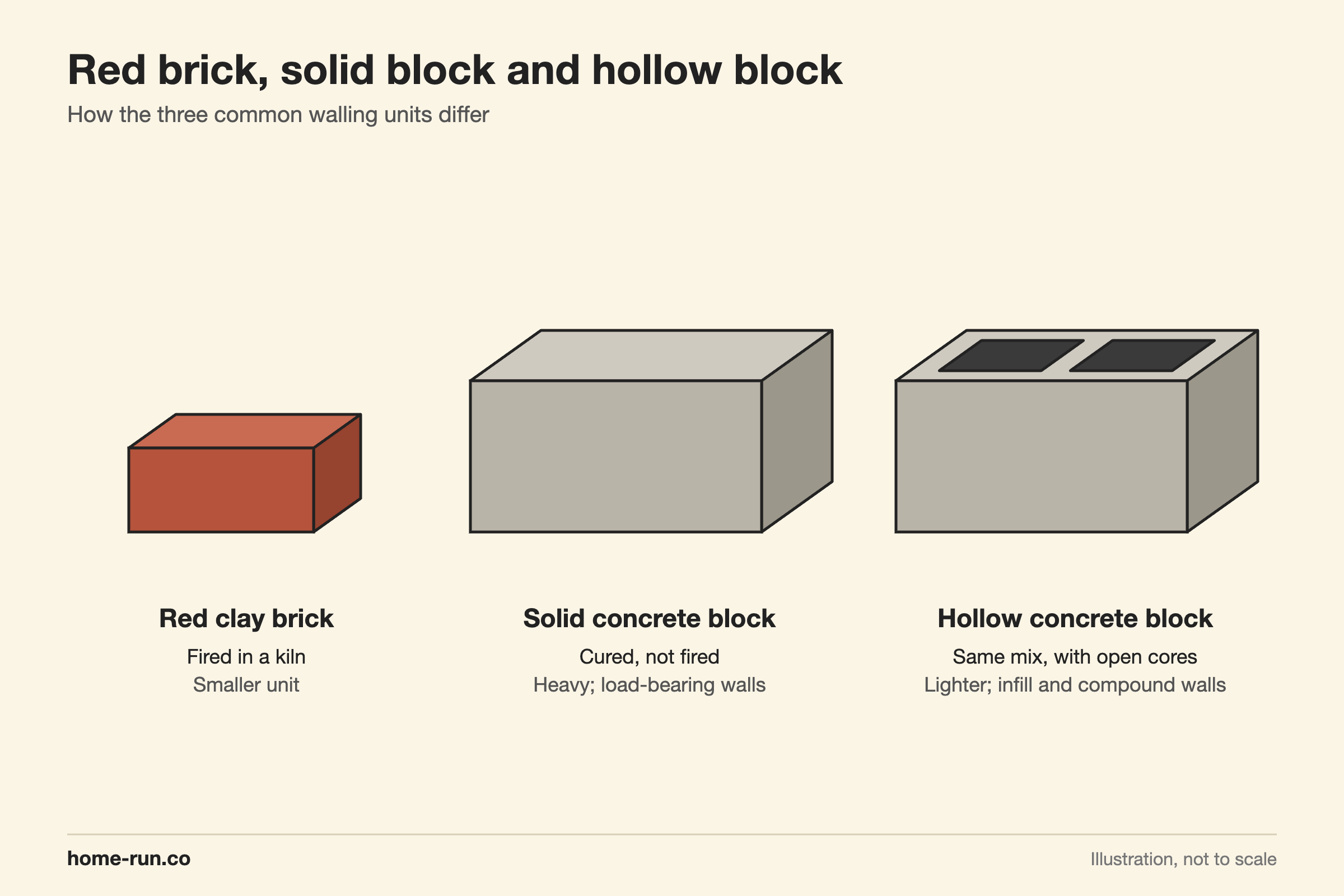
A concrete brick is a cement-bound unit that gains strength by curing in water or steam. A red clay brick gains strength by firing in a kiln.
Dealers use "concrete brick", "cement brick" and "solid block" loosely. A "brick" is usually small; a "block" is usually 400 × 200 mm or larger on its face.
Ask for size, grade and IS code before you compare quotes. For the small brick-sized unit, see our explainer on cement bricks; for the fired option, read about red brick characteristics.
What Types of Concrete Bricks Are Available in India?
The main types of concrete bricks in India are solid, hollow, interlocking, CLC and AAC units. Fly ash bricks sit next to this family but use a different raw mix and standard.
Concrete brick and block types compared
Weight is relative| Type | Made of | Indian standard | Weight | Typical use |
|---|---|---|---|---|
| Solid concrete block or brick Load-bearing | Cement, sand, crushed stone or stone dust | IS 2185 (Part 1), Grade C | Heavy | Load-bearing walls, boundary walls |
| Hollow concrete block | Same mix, with open cores | IS 2185 (Part 1), Grade A or B | Medium | Infill walls, compound walls, framed buildings |
| Interlocking concrete brick | Concrete or soil-cement, keyed shape | Depends on the mix | Medium to heavy | Mortar-light walls, paving |
| CLC (foam concrete) block | Cement slurry with pre-formed foam | IS 2185 (Part 4) | Light | Partitions, upper-floor infill |
| AAC block Lightest | Cement, lime, fly ash or sand, aerating agent | IS 2185 (Part 3) | Very light | Infill walls in RCC frame buildings |
| Fly ash brick Related product | Fly ash, sand, lime or cement | IS 12894 | Medium | Walls in place of red bricks |
See our guides to hollow bricks and fly ash bricks for detail.
What Grades and Sizes Do Concrete Blocks Come In Under IS 2185?
IS 2185 (Part 1):2005, the Bureau of Indian Standards (BIS) specification for hollow and solid concrete blocks, sorts blocks into three grades by density and 28-day compressive strength.
IS 2185 (Part 1) block grades
Confirm with the current BIS text| Grade | Block type | Density (kg/m³) | Strength classes (N/mm²) |
|---|---|---|---|
| Grade A | Hollow, load-bearing | 1500 or more | 3.5 to 15.0 |
| Grade B | Hollow, load-bearing | 1000 to 1500 | 3.5 and 5.0 |
| Grade C Solid | Solid, load-bearing | 1800 or more | 4.0 and 5.0 |
Nominal block lengths are 400, 500 or 600 mm, with heights of 100 or 200 mm. Widths (wall thickness) run from 50 to 300 mm, and 100, 150 and 200 mm are the sizes most dealers stock. The standard allows ±5 mm on length and ±3 mm on height and width.
A "4-inch", "6-inch" or "8-inch" block is about 100, 150 or 200 mm thick.
What Are the Benefits and Drawbacks of Concrete Bricks?
The main benefits of concrete bricks are uniform size, dependable strength and faster wall building. The main drawbacks are weight and cracking if the blocks are poorly cured.
Where concrete bricks win
BenefitsWhy builders choose them.
- Even size means thinner, straighter joints and plaster
- Strength is graded and testable under IS 2185
- Large blocks cover more wall per unit laid
- No kiln firing, and many plants run near Bengaluru
Where they fall short
DrawbacksAnd how to manage each one.
- Solid blocks are heavy; use hollow or AAC on upper floors
- Under-cured blocks shrink and crack; buy well-aged stock
- Salts can cause efflorescence; keep stacks off wet ground
- Price follows cement rates; lock quotes for bulk orders
Where Are Concrete Bricks Used?
Concrete bricks are used for low-rise load-bearing walls, infill walls in RCC frames, compound walls and paving.
Matching the concrete brick to the job
Your engineer has the final word| Job | Usual choice |
|---|---|
| Load-bearing walls, ground or G+1 house | Solid concrete blocks, Grade C |
| Infill walls in an RCC frame Most common | Hollow, AAC or CLC blocks |
| Internal partitions | 100 mm solid, AAC or CLC blocks |
| Compound and boundary walls | Solid or hollow blocks, 150–200 mm |
| Driveways and footpaths | Concrete paver blocks |
Wall thickness, height and block grade for load-bearing masonry come from IS 1905, the Indian code for structural use of unreinforced masonry, and your seismic zone. Ask a structural engineer for anything beyond a small house.
How Should Concrete Bricks Be Laid?
Concrete bricks should be laid dry or barely damp, with 10 mm mortar joints, under IS 2572:2005, the code of practice for hollow and solid concrete block masonry.
- Do not soak concrete blocks the way you soak red bricks; lightly moisten the laying face only in hot, dry weather
- Keep horizontal and vertical joints at about 10 mm
- Use the mortar mix your engineer specifies from IS 2572
- Keep the finished wall moist for at least 7 days
How Much Do Concrete Bricks Cost in Bengaluru?
A 400 × 200 × 200 mm solid concrete block costs about ₹41–51 per piece in Bengaluru, and a hollow block of the same size about ₹33–43 (InfraLens, 22 May 2026).
Indicative Bengaluru concrete block prices
Per piece, before GST and transport| Block | Price (₹) | Source and date |
|---|---|---|
| Solid, 400 × 200 × 200 mm | 41–51 | InfraLens price index, May 2026 |
| Hollow, 400 × 200 × 200 mm | 33–43 | InfraLens price index, May 2026 |
| Solid, 400 × 200 × 100 mm | 30 | One Bengaluru IndiaMART listing |
Building a block wall?
Get cement, sand and masonry tools delivered across Bengaluru with a GST invoice.