On this page
- What Are Cement Bricks?
- How Are Cement Bricks Made?
- Cement Bricks vs Concrete Blocks: What Is the Difference?
- What Types and Sizes of Cement Bricks Are Available?
- How Strong Are Cement Bricks?
- Where Are Cement Bricks Suitable?
- What Are the Advantages and Disadvantages of Cement Bricks?
- Cement Bricks vs Red Bricks vs Fly Ash Bricks: Which Is Better?
- How Do You Check Cement Brick Quality on Site?
- How Many Cement Bricks Do You Need, and How Much Cement for 1,000 Bricks?
- What Is the Price of Cement Bricks in Bengaluru?
- Cement bricks are cement-bound units cured with water, not clay baked in a kiln.
- Dealers say "cement brick"; IS 2185 calls the same product a concrete block.
- Solid load-bearing blocks must reach at least 4.0 N/mm² at 28 days.
- Strength depends on curing and drying time, so never accept a fresh batch.
- They suit walls, boundary walls and infill; load-bearing use needs an engineer's sign-off.
Cement bricks are building units made from cement, sand, fine stone dust and water. The mix is pressed into moulds and cured with water instead of being fired. In India, cement bricks and solid concrete blocks are the same family of product.
What Are Cement Bricks?
A cement brick is a masonry unit bound by Portland cement and hardened by curing. It is grey, has sharp edges and comes out of a steel mould at a fixed size.
The cement reacts with water and binds the sand and stone dust together. That is why cement bricks gain strength over weeks, not hours.
Dealers call them cement bricks or solid blocks. The Bureau of Indian Standards (BIS) covers them in IS 2185 (Part 1):2005, the code for hollow and solid concrete blocks. Always confirm the size and whether the unit is solid or hollow.
For the basics of how bricks and mortar work together, see our explainer on what masonry means.
How Are Cement Bricks Made?
Cement bricks are made in five stages: batching, mixing, moulding, curing and drying. Machines range from manual moulds to fully automatic vibro-press lines.
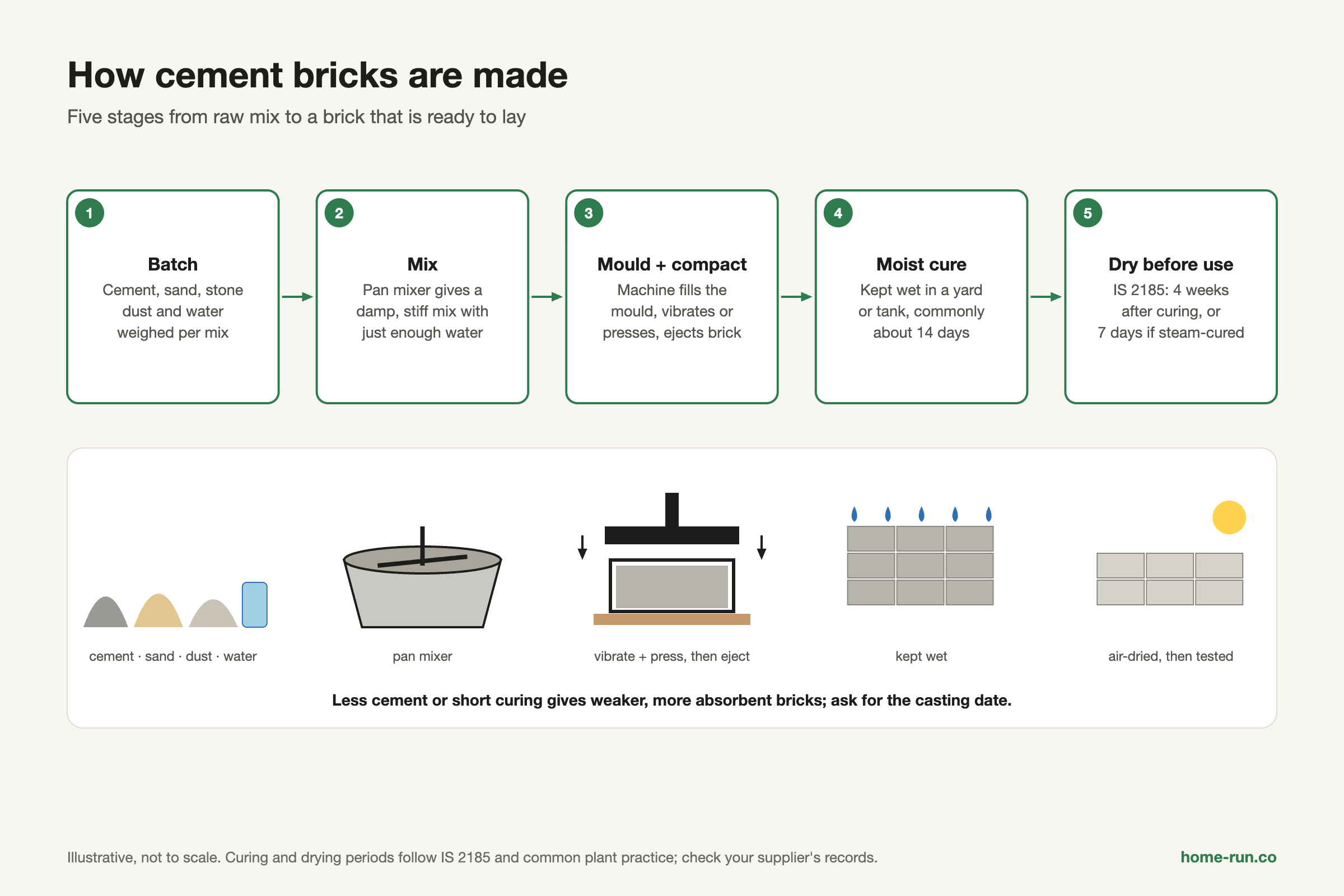
Batch the raw materials
Cement, sand, stone dust (crushed rock powder) and water are measured. Less cement lowers cost and strength.
Mix
A pan mixer blends a damp, stiff mix with just enough water to bind.
Mould and compact
The machine fills the mould and vibrates or presses it, then pushes the brick out onto a pallet.
Moist curing
Bricks are kept wet in a curing yard or tank, commonly for about 14 days.
Dry before use
IS 2185 asks for 4 weeks of drying after curing, or 7 days for steam-cured blocks.
Under-cured bricks shrink in the wall and cause hairline cracks in plaster. Curing is the step cheap suppliers rush.
Cement Bricks vs Concrete Blocks: What Is the Difference?
The difference between cement bricks and concrete blocks is mainly size. The material and the standard are the same.
Brick-size cement bricks vs concrete blocks
Confirm actual size with your supplier| Feature | Brick-size cement brick | Concrete block |
|---|---|---|
| Typical size | 230 × 110 × 75 mm (about 9 × 4 × 3 in) | 400 × 200 mm face, 100–200 mm thick |
| Solid or hollow | Solid | Solid or hollow |
| Units per 100 sq ft of wall | about 478 | about 122 |
| Laying speed | Like red bricks | Faster, fewer joints |
| Covered by IS 2185 sizes? | No, smaller than its 400 mm minimum length | Yes |
Brick-size cement bricks fall outside the IS 2185 size list, so ask for a strength and absorption test report rather than a code number alone.
What Types and Sizes of Cement Bricks Are Available?
Cement bricks come as solid bricks, solid blocks, hollow blocks and interlocking blocks. Fly ash bricks and AAC blocks are often listed with them but are separate products.
Types of cement bricks and related products
Sizes are common examples| Type | Common size | Best use |
|---|---|---|
| Solid cement brick | 230 × 110 × 75 mm | Load-bearing and general walls, repairs |
| Solid concrete block Most used | 400 × 200 × 100, 150 or 200 mm | Infill walls, compound walls, low-rise load-bearing walls |
| Hollow concrete block | 400 × 200 × 200 mm | Lighter walls, boundary walls |
| Interlocking block | Varies by mould | Dry-stacked or thin-joint walls |
| Fly ash brick Separate product | 230 × 110 × 75 mm | Brick walls; covered by IS 12894 |
| AAC block Separate product | 600 × 200 × 100–200 mm | Light infill walls in RCC frames |
The "4-inch", "6-inch" and "8-inch" names refer to wall thickness: 100, 150 and 200 mm. Use 4-inch for partitions and 6- or 8-inch for outer walls.
IS 2185 allows ±5 mm on length and ±3 mm on height. Two suppliers' blocks can still differ, which throws courses out of line and wastes mortar.
For dry-stacked systems, read our guide to interlocking bricks.
How Strong Are Cement Bricks?
Solid cement blocks under IS 2185 (Part 1):2005 must reach an average of at least 4.0 N/mm² at 28 days. Compressive strength is the crushing load per unit area; N/mm² and MPa are the same unit.
IS 2185 (Part 1):2005 load-bearing grades
Minimum average strength at 28 days| Grade | Block type | Density (kg/m³) | Strength (N/mm²) |
|---|---|---|---|
| Grade A | Hollow, load-bearing | 1,500 or more | 3.5 to 15.0 |
| Grade B | Hollow, load-bearing | 1,100 to 1,500 | 3.5 or 5.0 |
| Grade C Solid | Solid, load-bearing | 1,800 or more | 4.0 or 5.0 |
Sellers often quote 7.5 or 10 N/mm², or kg/cm² (1 N/mm² is about 10.2 kg/cm²). Ask which test method and age the figure comes from.
Low water absorption helps in Bengaluru's monsoon, but it does not make a wall waterproof. Exposed walls still need plaster or a coating.
Where Are Cement Bricks Suitable?
Cement bricks suit most wall jobs in a home, from boundary walls to infill between RCC columns.
- Infill and partition walls: 100 or 150 mm blocks inside RCC frames.
- Outer walls: 150 or 200 mm solid blocks, plastered outside.
- Compound and boundary walls: solid or hollow blocks with piers.
- Parapets: solid blocks with a coping, as in our parapet wall design guide.
- Load-bearing walls: low-rise homes only, with a grade and thickness your structural engineer approves.
A block that works in a partition is not automatically fit to carry a slab. Check the grade on the invoice, not just the size.
Cement paver blocks for driveways are a different product with their own standard, IS 15658.
What Are the Advantages and Disadvantages of Cement Bricks?
The main advantages of cement bricks are uniform size and faster laying; the main disadvantages are weight and uneven quality between makers.
Advantages
Why builders pick themWhen the batch is well cured.
- Uniform size, so thinner joints and plaster
- Blocks cover more wall per unit laid
- No kiln firing or topsoil digging
- Made locally around most cities
Disadvantages
Watch forMostly quality and comfort.
- Solid blocks are heavy, adding dead load
- Less heat insulation than AAC blocks
- Poorly made units absorb water
- Strength varies with curing and cement
Cement Bricks vs Red Bricks vs Fly Ash Bricks: Which Is Better?
Cement bricks are the better choice for fast, uniform walls; red bricks for matching old work; fly ash bricks where a reliable ash-brick plant is nearby.
Cement brick vs red clay brick vs fly ash brick
Qualitative unless stated| Factor | Cement brick / block | Red clay brick | Fly ash brick |
|---|---|---|---|
| How it is made | Moulded and water cured | Moulded and kiln-fired | Pressed and cured |
| Indian standard | IS 2185 (Part 1) | IS 1077 | IS 12894 |
| Size accuracy | High | Varies | High |
| Max water absorption | 10% | Varies by class | 15–20% by class |
| Plaster needed | Thinner coat | Thicker coat | Thinner coat |
| Best for | Fast, uniform block walls | Repairs, matching old work | Brick-size walls |
Compare the brick-size option in our guide to fly ash bricks.
Planning a block wall?
Order masonry materials with a GST invoice and delivery across Bengaluru.
How Do You Check Cement Brick Quality on Site?
You check cement brick quality by testing a sample from each load before you accept it.
- Look: even grey colour, sharp corners, flat faces, no cracks.
- Measure: line up 10 units and compare with the stated size.
- Ring test: strike two together; a clear ring is good, a dull thud is not.
- Drop test: drop one from about waist height onto firm ground; it should not crumble.
- Soak test: weigh a dry unit, soak it 24 hours and reweigh; a gain over 10% fails IS 2185.
- Paperwork: ask for the casting date and a recent lab report for strength and absorption.
Reject the load if you see:
- Powdery surface that rubs off on your hand
- Crumbling corners or honeycombing (open voids)
- Damp, dark units delivered within days of casting
- Sizes that vary across the stack
How Many Cement Bricks Do You Need, and How Much Cement for 1,000 Bricks?
You need about 478 brick-size cement bricks or about 122 blocks of 400 × 200 mm face for 100 sq ft of wall, including 5% wastage.
The brick count gives a 110 mm wall; the block count gives a 100–200 mm wall, depending on block width. Mortar, labour and transport are extra.
Cement for 1,000 bricks: about 2.5 bags of 50 kg for 1:6 cement-sand mortar. At 500 bricks per m³, 1,000 bricks make 2 m³ of brickwork, needing about 0.60 m³ of dry mortar. Cement = 0.60 ÷ 7 × 1,440 kg/m³ = about 123 kg. Thicker joints or a richer mix use more.
What Is the Price of Cement Bricks in Bengaluru?
Solid concrete blocks of 400 × 200 × 200 mm cost about ₹41–51 per piece in Bengaluru, and hollow blocks about ₹33–43, based on InfraLens dealer data from May 2026.
- Thinner blocks: one Bengaluru seller lists 400 × 200 × 100 mm solid blocks at ₹30 per piece (IndiaMART, November 2026).
- Brick-size cement bricks: national IndiaMART listings mostly run ₹5–10 per piece, with no verified Bengaluru rate.
- GST: concrete blocks fall under HSN 6810 at 18% from 22 September 2025, against 12% for fly ash bricks under HSN 6815. Check the HSN code and rate on the invoice.
Price moves with size, grade, distance from the plant, order volume and unloading charges. Compare delivered prices, not ex-factory rates.
Before a bulk order, confirm size and grade, ask for test reports, compare two or three quotes and lay a small sample first.