On this page
- What Are Hollow Bricks Called, and What Are They Made Of?
- What Are the Face Shells, Webs and Cores of a Block?
- How Do Hollow Bricks Behave Under Load?
- Where Should You Use Hollow Bricks, and Where Should You Avoid Them?
- How Many Hollow Blocks Do You Need for a Wall?
- What Does a Hollow Block Cost in Bengaluru, and How Do You Check a Delivery?
- Hollow bricks are clay or concrete units with large cores.
- Load runs through the face shells and webs.
- Best fit: partition and infill walls in RCC-framed homes.
- Avoid them below plinth and in undesigned load-bearing walls.
Hollow bricks are masonry units with large voids, called cores, running through them. The cores cut weight, so hollow bricks mostly build partition and infill walls in RCC-framed homes.
What Are Hollow Bricks Called, and What Are They Made Of?
Hollow bricks are also sold as hollow blocks or cavity blocks. Three types are common in India:
- Hollow concrete blocks: cement, sand and aggregate, under IS 2185 (Part 1):2005, the Bureau of Indian Standards (BIS) concrete block code.
- Burnt clay hollow blocks: fired clay (terracotta) units under IS 3952:2013.
- Pressed 8-hole bricks: brick-size clay or fly ash units.
IS 2185 calls a block hollow when solid material is 50–75% of its volume. Many small holes make a brick perforated instead.
What Are the Face Shells, Webs and Cores of a Block?
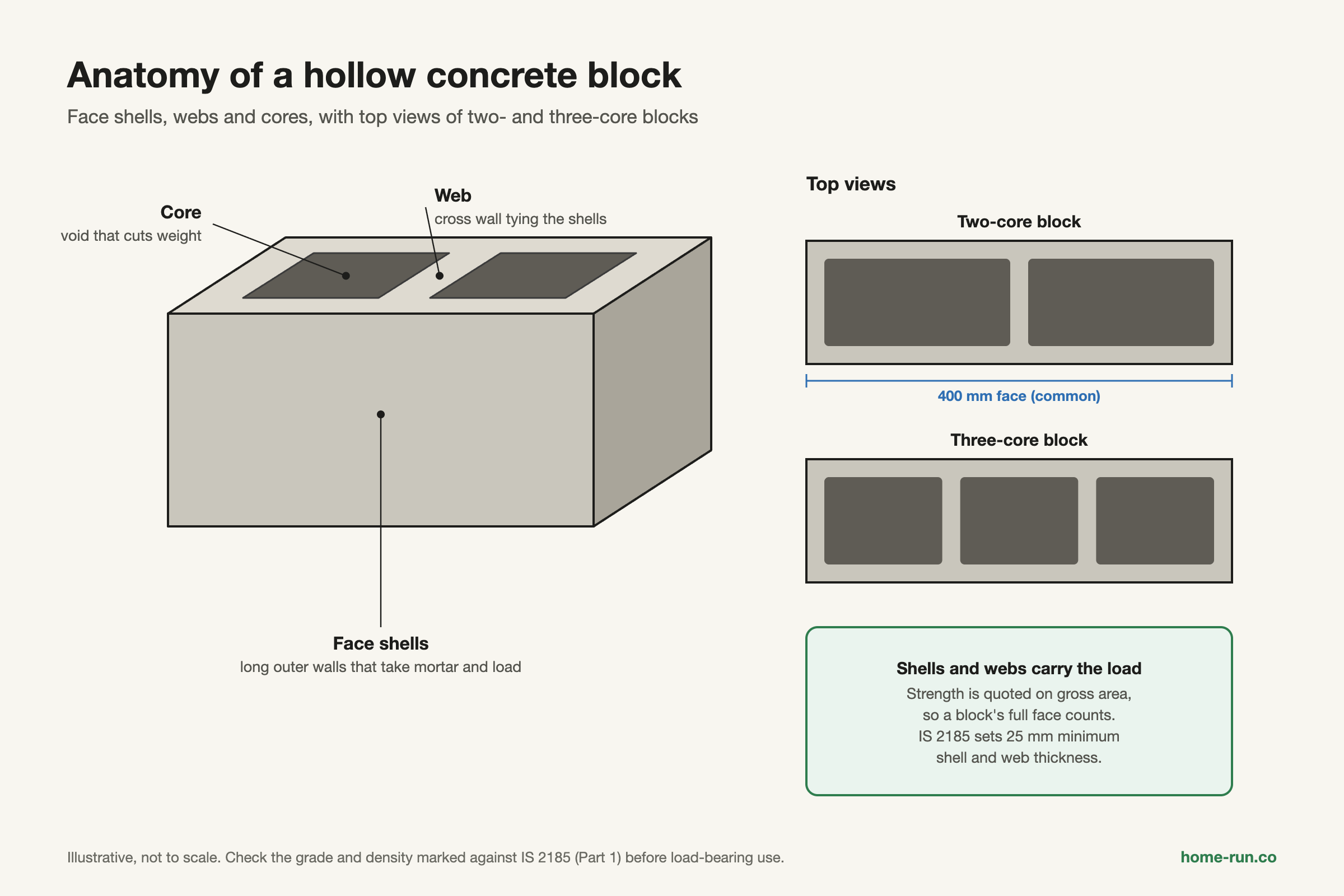
A hollow brick has three parts: face shells, webs and cores.
- Face shells: the long outer walls that take mortar and load.
- Webs: cross walls tying the shells together.
- Cores: the voids, vertical in most concrete blocks.
IS 2185 sets 25 mm minimum shells and webs for blocks up to 100 mm wide.
How Do Hollow Bricks Behave Under Load?
Hollow bricks carry less load than solid units because only the shells and webs take the weight. Compressive strength (crushing load per unit area) is quoted on gross area, voids included.
IS 2185 (Part 1):2005 block grades
Minimum average strength at 28 days| Grade | Type | Strength (N/mm²) | Mass of 8-inch block (kg) |
|---|---|---|---|
| Grade A | Hollow, load-bearing | 3.5 to 15.0 | 21.1 or more |
| Grade B Lighter | Hollow, load-bearing | 3.5 or 5.0 | 15.5 to 21.1 |
| Grade C Solid | Solid, load-bearing | 4.0 or 5.0 | 25.3 or more |
- Shell bedding: mortar goes on the shells, where load runs.
- Point loads: heavy fixtures can crack a thin shell unless the core is filled.
Many dealer blocks meet no IS 2185 grade. Load-bearing walls need an engineer's design under IS 1905, or solid cement blocks.
Where Should You Use Hollow Bricks, and Where Should You Avoid Them?
Hollow bricks suit walls that carry only their own weight. For brick-size solid walls, compare fly ash bricks.
Good uses
RecommendedWalls that divide space.
- Partition walls inside RCC frames
- Upper-floor infill, to cut dead load
- Compound walls built with piers
- Walls needing heat and sound control
Avoid or take care
Use solid unitsWalls with loads, soil or water.
- Load-bearing walls without an engineer
- Foundations, plinths and walls touching soil
- Heavy fixtures, unless cores are filled
- Wet areas without plaster and waterproofing
How Many Hollow Blocks Do You Need for a Wall?
You need about 13 hollow blocks of 400 × 200 mm face per square metre of wall, including 5% wastage.
What Does a Hollow Block Cost in Bengaluru, and How Do You Check a Delivery?
An 8-inch (400 × 200 × 200 mm) hollow concrete block costs about ₹33–43 in Bengaluru, against ₹41–51 for a solid block (InfraLens, May 2026).
Reject a batch with:
- Honeycombing (open gaps) in the face shells
- Crumbling corners or shells that chip by hand
- Damp, dark blocks delivered days after casting
Ask for the casting date and a test report before a bulk order.
Building a block wall?
Order masonry materials with a GST invoice and delivery across Bengaluru.