On this page
- Cement board is a rigid sheet of cement, cellulose fibre and mineral fillers.
- It does not rot, swell or feed termites, so it suits wet, humid and exterior spots.
- The usual Indian sheet is 2440 × 1220 mm, in thicknesses from about 4 to 18 mm.
- Fibre cement flat sheets must carry the ISI mark under IS 14862.
- It is water-resistant, not waterproof: bathrooms still need a membrane.
Cement board is a flat building panel made of cement bound with reinforcing fibres, used for walls, partitions, ceilings and floors. Cement board resists water, termites and fire far better than gypsum board or plywood, which is why builders pick it for bathrooms, kitchens and exterior walls.
What Is Cement Board Made Of?
Cement board is made of Portland cement, cellulose fibres and fine mineral fillers such as silica. The wet mix is formed into thin layers, pressed into sheets and cured with high-pressure steam so the board stays stable.
In India, sellers use several names for the same family of boards:
- Cement board / fibre cement board (FCB) / cement fibre board: the same product, cement reinforced with fibres.
- Cement-bonded particle board (CBPB): a different product. Wood chips are bound with cement instead of resin. It follows IS 14276, the Indian standard for cement bonded particle boards.
- Calcium silicate board: looks similar but uses a lime-silica binder, not cement.
Old grey roofing and flat sheets often contain asbestos, and asbestos cement sheets are still sold in India under their own standards. Modern fibre cement flat sheets under IS 14862 use non-asbestos fibres. Check the sheet marking before you buy.
What Are the Properties of Cement Board?
The key cement board properties are high density, good bending strength, non-combustibility and stability in damp conditions. The figures below come from one Indian maker's datasheet, so treat them as a reference point.
Typical fibre cement board properties
Ramco Hicem Flexo datasheet| Property | Value | What it means for you |
|---|---|---|
| Apparent density (dry) | > 1200 kg/m³ | Heavy and hard; needs firm framing |
| Bending strength (parallel / perpendicular) | 14 / 8 MPa | Resists cracking under impact and load |
| Compressive strength | > 30 MPa | Takes tile and floor loads |
| Moisture content | < 12% | Ships dry and stable |
| Thermal conductivity | 0.18 W/m·K | Slows heat transfer slightly |
| Combustibility Fire safe | Non-combustible (BS 476 Part 4) | Does not feed a fire |
| Screw withdrawal | > 1300 N | Holds fixings well |
Termite resistance comes from the material itself: cement and mineral fibre give termites nothing to eat. Cement board is also dimensionally stable, so it does not warp the way plywood can in a humid Bengaluru monsoon.
Where Is Cement Board Used?
Cement board is used wherever a wall, ceiling or floor faces moisture, weather or fire risk.
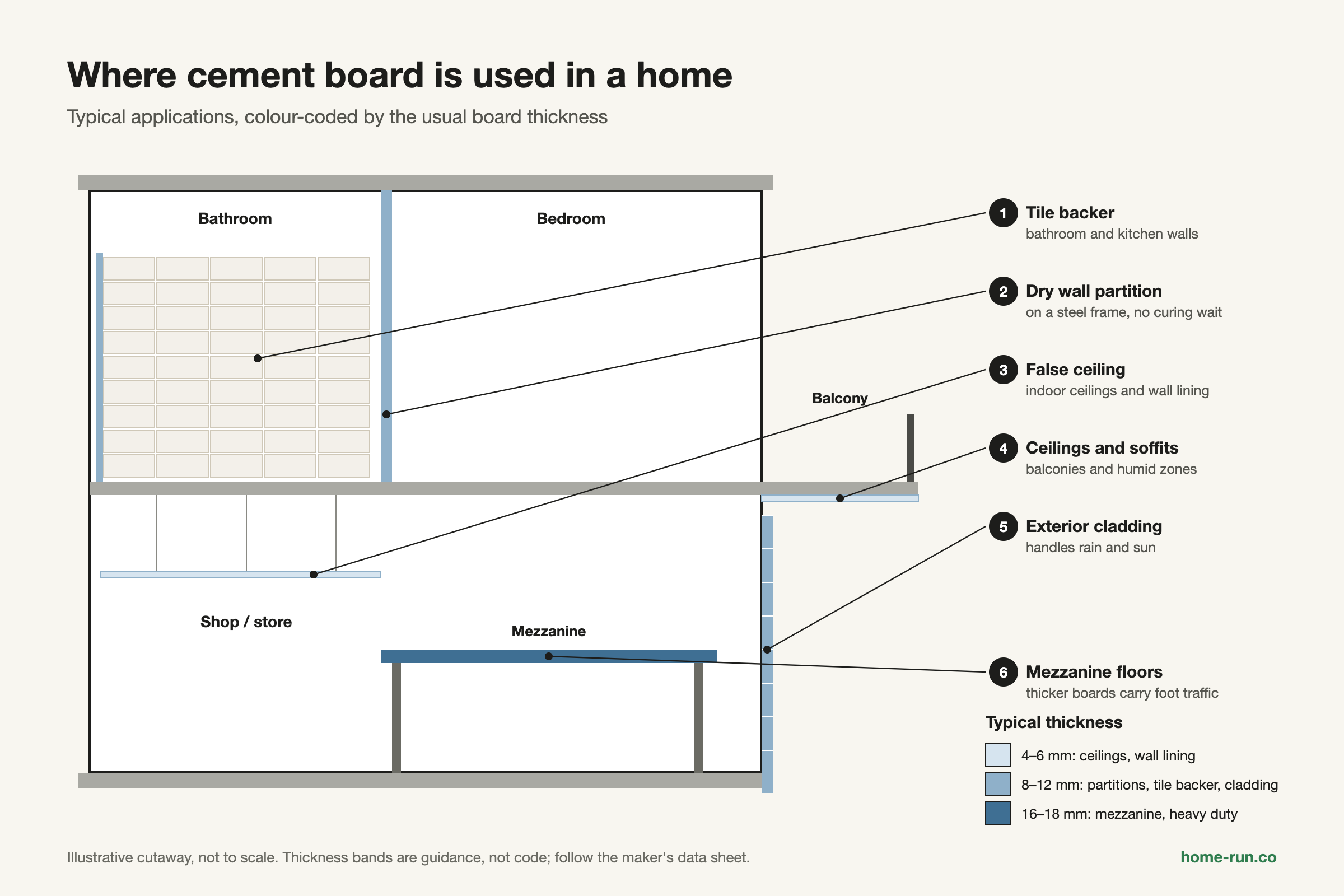
Typical cement board applications
Check thickness with the maker| Application | Why cement board suits it |
|---|---|
| Tile backer in bathrooms and kitchens Most common | Firm base that will not soften when damp |
| Dry wall partitions | Fast to build on a steel frame, no curing wait |
| False ceilings and soffits | Survives humidity in balconies and wet zones |
| Exterior cladding | Handles rain and sun without rotting |
| Mezzanine floors and floor underlay | Thicker boards carry foot traffic and tiles |
Is Cement Board Waterproof?
Cement board is water-resistant, not waterproof. Cement board will not rot or swell when wet, but water can still pass through the sheet and its joints.
In a shower or wet wall, seal the joints and apply a waterproofing membrane over the cement board before tiling. Our bathroom waterproofing guide covers the layers.
Cement Board vs Gypsum Board: Which Should You Choose?
Choose cement board for wet, humid or exterior areas, and gypsum board for dry indoor walls and ceilings. Gypsum has a plaster core that loses strength when it gets wet.
Cement board
Wet areas and exteriorsBathroom walls, balconies, cladding.
- Stays stable when damp
- Heavier; needs firm framing
- Harder to cut; scoring and power tools
- Needs careful joint finishing for a smooth wall
Gypsum board
Dry interiorsBedroom ceilings, living-room partitions.
- Softens and sags if it stays wet
- Lighter and easier to lift
- Cuts with a utility knife
- Finishes smoothly with jointing compound
If water, steam or rain can reach the surface, use cement board. If the room stays dry, gypsum board is usually lighter and quicker. See our explainer on gypsum board properties for the dry-side option.
What Sizes and Thicknesses Does Cement Board Come In?
The standard cement board size in India is 2440 × 1220 mm (8 × 4 ft), with 1830 × 1220 mm (6 × 4 ft) also sold. Common thicknesses run from 4 mm to 18 mm, and 6, 8, 12 and 18 mm are widely listed by dealers.
- 4–6 mm: ceilings and wall lining.
- 8–12 mm: partitions, tile backer and cladding.
- 16–18 mm: mezzanine floors and heavy-duty use.
Price per sheet rises with thickness, brand and quantity, so get a current quote for your exact sheet. Under IS 14862:2000, the BIS specification for fibre cement flat sheets, a Quality Control Order notified in March 2024 made the ISI mark mandatory for these boards.
How Is Cement Board Installed?
Cement board is screwed to a galvanised steel or timber frame, then the joints are taped and filled. One Indian maker's method statement for dry wall partitions gives these figures:
- Frame: studs at a maximum of 610 mm centre to centre, with noggins behind every horizontal board edge.
- Cut: score and snap, or use a saw with dust extraction. Wear a dust mask, because cutting releases fine cement dust.
- Fix: board screws at 300 mm centres in dry areas, at least 15 mm from edges and 50 mm from corners.
- Gap: leave 2–3 mm between boards for movement.
- Joints: fibre tape on the joints, then jointing compound in three coats.
How Do You Choose a Good Cement Board?
Choose a cement board by matching thickness to the job, then checking certification and the delivered sheets.
- ISI mark and IS 14862 printed on the sheet or invoice
- Non-asbestos marking
- Thickness suited to the wall, ceiling or floor
- Datasheet and installation guide from the maker
Reject sheets on delivery if you see
- Chipped or crumbling edges and corners
- Hairline cracks across the face
- Warped sheets that rock on a flat floor
- Damp patches from rain in transit
Cement board's main drawbacks are weight, harder cutting and visible joints if finishing is rushed. For other walling options, read our explainers on masonry and hollow bricks.
Building a dry wall or wet-area wall?
Get boards, fixings and waterproofing delivered across Bengaluru with a GST invoice.