On this page
- What Is Particle Board and What Is It Made Of?
- How Is Particle Board Made, Step by Step?
- How Does Raw Particle Board Become Prelam Board?
- What Are the Grades of Particle Board in India?
- Does the Way Particle Board Is Made Affect Quality and Safety?
- Where Is Particle Board Used in Furniture?
- What Should You Check Before Buying Particle Board?
- Particle board is made from wood chips, resin and wax, hot-pressed into a flat sheet.
- IS 3087:2025 sets four grades: REG A, REG B, MR and HMR.
- Look for the ISI mark and E1 class to limit formaldehyde emission.
- Use it for dry-area furniture; choose plywood where it may get wet.
Particle board is an engineered wood panel made by bonding small wood particles with resin under heat and pressure. In short, this is how particle board is made: wood is chipped, dried, glued, formed into a mat and hot-pressed.
What Is Particle Board and What Is It Made Of?
Particle board, also sold as chipboard, is a flat panel of wood chips, shavings and sawdust glued into a solid slab. Unlike plywood, it has no full wood sheets (veneers) inside.
- Wood: sawmill residue, shavings and plantation wood. Indian makers also use agro-residues such as bagasse (sugarcane waste) and rice husk.
- Resin: urea-formaldehyde (UF) is the most common glue. Melamine- or phenol-based resins resist moisture better.
- Additives: wax, about 0.3–1% of dry particle weight, slows water uptake. A hardener helps the resin set.
Particle board uses chips. MDF (medium density fibreboard) uses fine wood fibres, so its edges are smoother; see MDF board types and grades. OSB (oriented strand board) uses long aligned strands and is mainly structural.
How Is Particle Board Made, Step by Step?
Particle board is made in eight stages, from chipping to sanding.
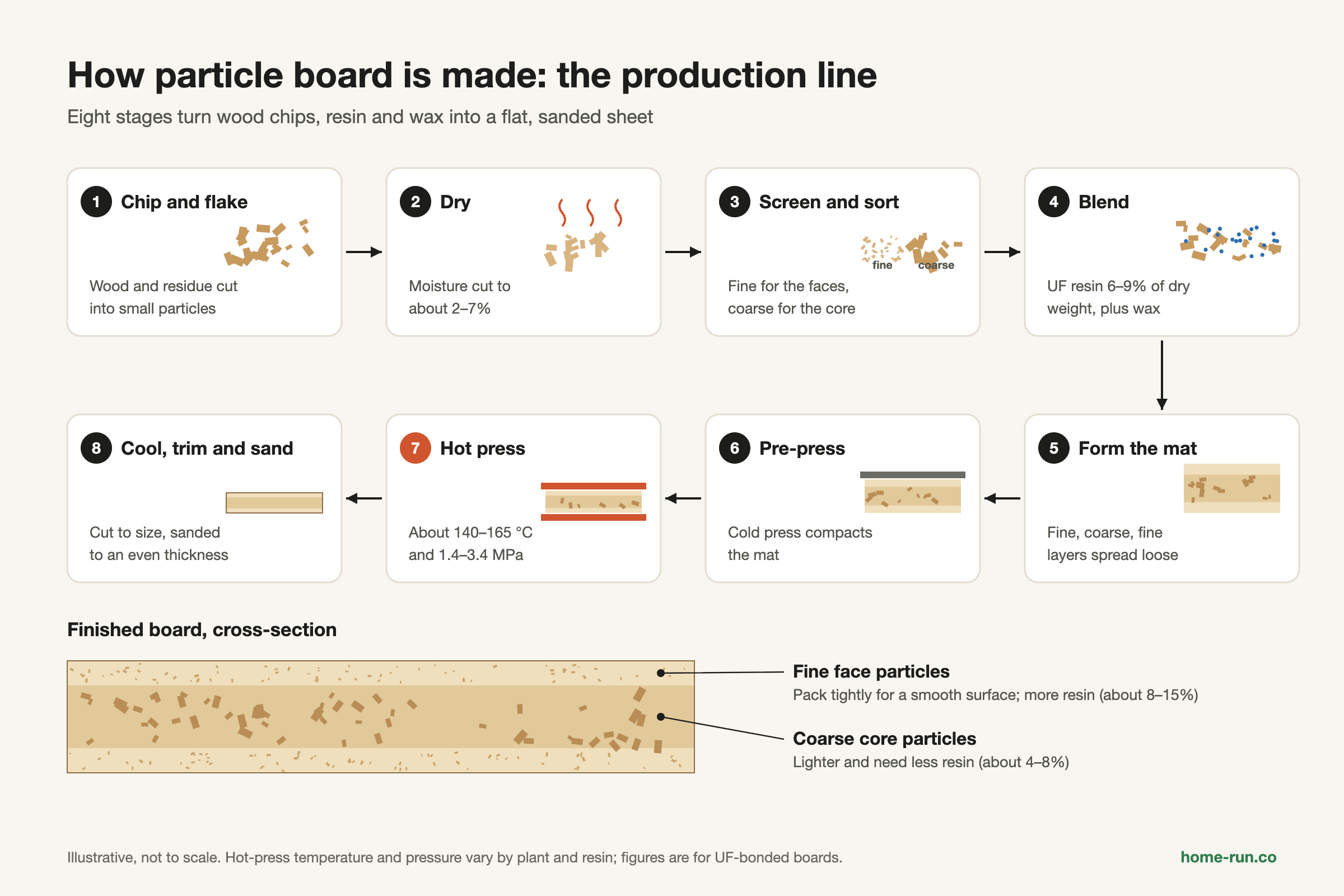
Chip and flake
Chippers and flakers cut wood and residue into small particles.
Dry
Dryers cut moisture to about 2–7%, so no steam blisters form in the press.
Screen and sort
Screens separate fine particles for the faces from coarse ones for the core.
Blend
Blenders coat particles with resin and wax. UF resin is usually 6–9% of dry particle weight.
Form the mat
A forming machine spreads a loose layer: fine particles top and bottom, coarse in the middle.
Pre-press
A cold press compacts the mat so it holds together.
Hot press
Heated plates press the mat at about 140–165 °C and 1.4–3.4 MPa. The resin cures and the board sets.
Cool, trim and sand
Boards are cooled, cut to size and sanded to an even thickness.
Fine face particles pack tightly and give a smooth surface for laminate or paint. Coarse core particles need less resin and keep the board lighter. Face layers usually carry more resin (about 8–15%) than the core (about 4–8%).
How Does Raw Particle Board Become Prelam Board?
Prelam board is raw particle board with melamine-impregnated decorative paper fused to its faces under heat and pressure. The core is unchanged, so it still decides strength.
- Plain board (IS 3087): sanded only; you add laminate, veneer or paint later.
- Prelaminated board (IS 12823): decorative melamine face from the factory.
- Veneered board (IS 3097): a thin real-wood face.
Cut edges on all three are raw board and need edge banding.
What Are the Grades of Particle Board in India?
IS 3087:2025, the Bureau of Indian Standards (BIS) specification for medium density particle boards for general purpose, sets four grades by service condition.
Particle board grades under IS 3087:2025
Third revision, August 2025| Grade | Service condition | Typical use | Edge screw holding, min (N) |
|---|---|---|---|
| Regular, Grade A Dry rooms | Dry | Wardrobe carcasses, shelves, cabinets | 700 |
| Regular, Grade B | Dry, lower strength than A | General furniture | 700 |
| MR (moisture resistant) | Humid | Kitchen and bathroom cabinets | 850 |
| HMR (high moisture resistant) Damp-prone | High humidity | Kitchen and vanity cabinets | 850 |
Each grade is also classed E1 or E2 for formaldehyde. E1 allows at most 8 mg per 100 g of dry board; E2 allows up to 30 mg (perforator test, IS 13745).
IS 3087 has no E0 class, so "E0" is a maker's own claim. Older stock may still show the 2005 edition's Grade I or Grade II. A BIS Quality Control Order has required the ISI mark on particle board since February 2025.
Does the Way Particle Board Is Made Affect Quality and Safety?
Yes. Particle size, drying, resin spread and press settings decide strength, swelling and emission.
For indoor furniture, an E1 board in a ventilated room is considered safe. Signs of a poorly made board:
- Large chips or gaps in the core at a cut edge
- Soft, crumbly edges that do not hold a screw
- Edges that puff up soon after contact with water
- A strong, sharp smell from a fresh sheet
- No ISI mark, grade or E class printed on the board
Where Is Particle Board Used in Furniture?
Particle board works best for dry-area furniture with light to moderate loads.
- Wardrobe carcasses and shutters
- Bookshelves and TV units
- Study tables, office workstations and partitions
- Bed headboards and storage boxes
For a modular kitchen design, use MR or HMR grade, with plywood under the sink. For bathroom doors, choose PVC doors instead.
Particle board
Dry roomsWardrobes, shelves, study tables.
- Usually cheaper per sheet
- Flat, smooth face for prelam finishes
- Uniform, with no knots or core gaps
- Holds screws less firmly
Plywood
Wet or heavy dutySink units, vanities, beds that take weight.
- Usually costs more per sheet
- Holds screws and hinges better
- Handles damp better in water-resistant grades
- Better for long spans and heavy loads
Building furniture for your home?
Boards and fittings delivered across Bengaluru.
What Should You Check Before Buying Particle Board?
Check the marking, grade and core before you pay.
- ISI mark with IS 3087 (plain) or IS 12823 (prelam)
- Grade matched to the room: REG, MR or HMR
- E1 formaldehyde class printed on the board
- A dense, even core at the cut edge