On this page
- What Is Wall Crack Repair and Why Does It Matter?
- What Types of Wall Cracks Are There, and What Causes Them?
- How Do You Know If a Wall Crack Is Structural?
- How Do You Prepare a Wall for Crack Repair?
- How Do You Repair a Wall Crack Step by Step?
- How Much Crack Filler Do You Need, and What Does It Cost?
- How Do You Smooth and Waterproof a Repaired Crack?
- How Can You Prevent Wall Cracks From Coming Back?
- What Mistakes Should You Avoid in Wall Crack Repair?
- Most wall cracks in Indian homes are plaster cracks from shrinkage, heat or moisture, and you can repair them yourself.
- Measure the width first: under 0.1 mm needs only paint, up to 5 mm takes a crack filler, wider needs opening up and often an engineer.
- Diagonal, stepped, tapered or growing cracks are warning signs of structural movement. Get them inspected before any repair.
- The repair order is open, clean, prime, fill, dry, sand, putty, prime and paint.
- Fix any water source first, or the crack will reopen after the June to November rains in Bengaluru.
Wall crack repair means opening up a crack, filling it with a material that bonds to the wall and moves with it, and then refinishing the surface so the line does not return. Done right, a plaster crack repair takes one or two days of work. The hard part is the first step: deciding whether the crack is cosmetic or a sign that the building is moving.
What Is Wall Crack Repair and Why Does It Matter?
Wall crack repair is the process of cleaning, filling and sealing a crack in plaster or masonry so the wall looks even and stays weather-tight.
Ignoring a crack costs more later. Rain enters open cracks in outside walls and shows up inside as damp patches and peeling paint. In reinforced concrete, water reaching the steel starts rust, which swells and cracks the concrete further.
Most cracks in homes run only through the plaster layer. The brick or block behind is sound. A plaster crack is a finishing problem; a crack that runs through the masonry or a beam is a structural one, and the repair is completely different.
What Types of Wall Cracks Are There, and What Causes Them?
Wall cracks fall into five common types by shape: hairline, map (crazing), vertical, horizontal and diagonal or stepped. The shape points to the cause.
Wall crack types, likely causes and risk
Read the shape before you buy a filler| Crack type | What it looks like | Likely cause | Risk |
|---|---|---|---|
| Hairline Cosmetic | Thin line in paint or plaster, under 0.1 mm | Drying shrinkage of plaster or paint | Low |
| Map cracks (crazing) | Net of short cracks across a plastered area | Rich mix, fast drying, poor curing | Low |
| Vertical at column or beam edge | Straight line where brickwork meets concrete | Concrete and brick move differently with heat | Low to medium |
| Diagonal at window or door corners | Crack running out at an angle from a corner | Roof slab heat movement on top floors, or settlement | Medium |
| Stepped or tapered Inspect | Zig-zag along brick joints, wider at one end | Uneven foundation settlement | High |
| Horizontal in a load-bearing wall Inspect | Long level crack, wall may bulge | Overload, soil pressure or roof thrust | High |
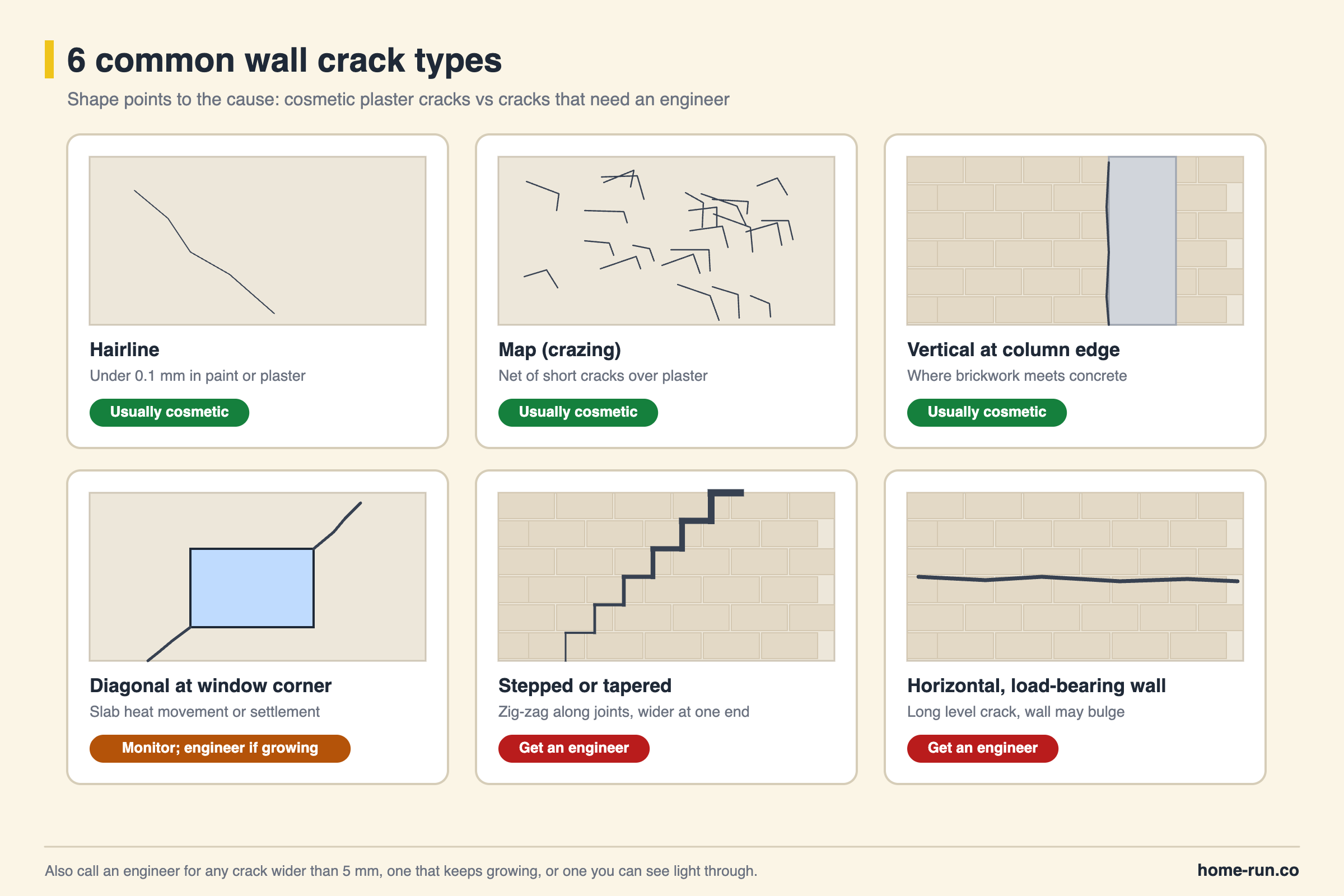
Shrinkage and poor curing
Shrinkage is the most common cause of plaster cracks. Cement mortar loses water as it dries and pulls in on itself. UltraTech notes that sand mortar shrinks 2–3 times as much as concrete, so plaster cracks more easily. Skipping the 7 days of wet curing that CBRI recommends for plaster makes shrinkage cracking worse.
Heat and the monsoon
Concrete roof slabs expand by day and contract at night, pushing on the walls below. That is why top-floor rooms show diagonal cracks at window corners. Bengaluru averages about 1,077 mm of rain a year, and wet-dry cycles from June to November widen small cracks.
Settlement and structural movement
Settlement is the downward movement of a foundation as soil compresses. Uneven settlement twists the wall and produces stepped or tapered cracks, which need an engineer, not a filler.
If the crack sits in a damp or stained patch, read our guide to the causes of wall dampness and fix the water first.
How Do You Know If a Wall Crack Is Structural?
A wall crack is likely structural when it is wider than 5 mm, wider at one end, stepped along brick joints, horizontal in a load-bearing wall, or still growing. Surface cracks stay thin, even in width and stable over months.
BRE Digest 251, the UK Building Research Establishment's damage scale that engineers widely use, grades cracks by width:
Crack width and what it means (BRE Digest 251)
Measure at the widest point| Category | Crack width | Typical repair |
|---|---|---|
| 0 · Hairline DIY | under 0.1 mm | No repair; repaint |
| 1 · Fine DIY | up to 1 mm | Routine filling and redecoration |
| 2 · Easily filled DIY | up to 5 mm | Crack filler; doors may stick |
| 3 · Needs opening up Engineer | 5–15 mm | Cut out, repoint or replace brickwork |
| 4 · Extensive Engineer | 15–25 mm | Break out and rebuild wall sections |
| 5 · Structural Engineer | over 25 mm | Shoring and major structural repair |
- A crack wider than 5 mm, or one that lets light or air through the wall
- A crack that is wider at the top or bottom (tapered)
- Stepped, zig-zag cracks following brick joints
- A horizontal crack in a load-bearing wall, or a wall that leans or bulges
- Cracks in beams, columns or slabs, especially with rust stains
- Doors and windows that start to jam at the same time the crack appears
- A crack that grows after you mark and measure it
To check whether a crack is moving, pencil a line across each end with the date and measure the width monthly. A crack that keeps widening is active. Do not sign off a red-list crack yourself; a structural engineer should inspect it.
How Do You Prepare a Wall for Crack Repair?
You prepare a wall for crack repair by fixing any leak, clearing loose material from the crack and gathering the right filler for its width. Work on a dry day, since crack fillers should not go on in rain.
- Crack checked against the red-flag list above
- Any water leak or seepage behind the crack fixed and the wall dry
- Putty knife (a flat, flexible blade for pressing in filler) and a scraper or crack cutter
- Wire brush and a soft brush to clear dust
- Crack filler matched to the width, plus fibre mesh tape for recurring cracks
- Fine sandpaper, wall putty, primer and matching paint
- Dust mask and safety glasses for scraping and sanding
Scrape wall putty or POP (plaster of Paris) off the crack edges until bare plaster shows; Dr Fixit's data sheet says its filler is not for cracks in POP or putty. If you are repainting the room, finish all crack work first.
How Do You Repair a Wall Crack Step by Step?
To repair a wall crack, widen it into a V-groove, clean and dampen it, prime it, press in a crack filler, let it dry, then sand, putty, prime and paint. The steps below suit interior and exterior plaster cracks up to 5 mm wide.
- Open the crack. Use a scraper or crack cutter to widen the crack into a V-groove about 3–5 mm wide. Dr Fixit's data sheet asks for this on any crack wider than 0.5 mm, so the filler has room to grip.
- Clean it out. Brush out dust, loose plaster and old paint. Do not power-wash the wall.
- Dampen the groove. Wet the groove lightly with a brush so the dry plaster does not suck water out of the filler.
- Prime the groove. For acrylic crack paste, brush in a primer coat of paste and water mixed 1:1, as the Dr Fixit data sheet specifies.
- Fill while the primer is tacky. Press the filler firmly into the groove with a putty knife in one pass, then level it with the wall. Avoid air pockets.
- Build deep cracks in layers. Fill deeper grooves in two coats. Let the first coat set for about 2 hours before the second.
- Reinforce recurring cracks. For a crack that has come back before, or one at a column or beam edge, bed fibre mesh tape over it in a thin coat of filler.
- Let it dry, then sand. Wait at least 8 hours before putty or POP. Sand the patch flush with fine sandpaper.
- Putty, prime and paint. Apply wall putty over the patch, sand, prime and paint. Wait 24 hours after filling before painting.
Dr Fixit's product page gives a 24-hour wait before paint, while its technical data sheet allows polymer paints after 6 hours. Use the longer gap unless the label on your pack says otherwise.
How to repair a hairline crack in plaster
A hairline crack under 0.1 mm needs no filling. Sand the line lightly, apply a coat of primer, then repaint. If a fine crack of about 1 mm keeps showing through paint, open it into a V-groove and fill it as above.
How to repair a wide crack (5–10 mm)
A crack wider than 5 mm is beyond most ready-to-use pastes, so check the red-flag list first. If an engineer confirms it is only a plaster crack, use a powder filler rated for wider gaps; Dr Fixit's Crack-X Shrinkfree covers plaster cracks up to 10 mm. Beyond 10 mm, cut out and replaster the strip.
Wall crack repair products: which one for which crack
Check the pack's rated width before you buy| Material | Best for | Crack width | Watch out |
|---|---|---|---|
| Acrylic crack filler paste Default pick | Interior and exterior plaster cracks | up to 5 mm | Not for structural members or expansion joints |
| Elastomeric crack filler | Exterior cracks that open and close with heat | as rated on pack | Pair with an exterior waterproof coat |
| Powder crack filler (shrink-free) | Wider plaster cracks | up to 10 mm | Not for cracks in POP or putty |
| Polymer-modified mortar or grout | Wide cracks after opening up, patch repairs | over 10 mm | Only after an engineer rules out movement |
| Cement slurry Avoid on live cracks | Fine cracks in fresh plaster or concrete | fine cracks only | Rigid; cracks again if the wall moves |
| Wall putty | Smoothing over a filled crack before paint | surface only | Not a crack filler; cracks with the wall |
Fixing wall cracks this week?
Crack fillers, wall putty, primers and paints delivered across Bengaluru.
How Much Crack Filler Do You Need, and What Does It Cost?
A 1 kg pack of acrylic crack filler paste fills about 25–30 running metres of a 5 mm wide, 5 mm deep groove, according to Dr Fixit. At the brand's listed MRP of ₹475 per kg, most rooms need one pack.
Prices are the brand's listed MRP, checked in November 2026; shop prices vary.
Inspect, open and clean
Check the red flags, cut the V-groove, clean and dampen.
Prime and fill
Second coat about 2 hours after the first.
Sand and putty
At least 8 hours after filling.
Prime and paint
24 hours after filling, two finish coats.
How Do You Smooth and Waterproof a Repaired Crack?
You smooth a repaired crack by sanding the dry filler flush, skimming it with wall putty and sanding again before primer. On outside walls, finish with a waterproof exterior coat so rain cannot get back in.
Feather the putty a little beyond the crack on each side so the patch blends into the wall. For tips on getting a level, even coat, see our guide to wall putty application and designs. Textured walls need the texture rebuilt with the same tool used originally, or the patch will show under raking light.
A crack filler seals the line, but the wall around it still takes rain. On exterior walls, apply a waterproof or elastomeric exterior coating over the repaired area or the whole face. Indian paint makers such as Asian Paints, Berger Paints and Nerolac each sell crack-bridging exterior systems; follow the chosen product's own data sheet for coats and gaps. If paint bubbles over a repaired crack later, our guide to paint bubbling on walls explains how to trace the moisture.
How Can You Prevent Wall Cracks From Coming Back?
You prevent wall cracks by curing plaster properly, using the right mix, reinforcing weak joints and keeping water out of the walls.
Rigid materials crack again when a wall moves. Use a flexible filler or mesh at joints between concrete and brick, and keep cement slurry for cracks that will not move.
- Keep new plaster and masonry wet for 7 days, as CBRI's good-practice guide advises
- Fill the gap between brickwork and the beam above just before plastering
- Lay no more than 1.2 m height of brickwork in a day, so mortar can set
- Bed mesh across joints where brick walls meet RCC columns and beams
- Waterproof the terrace so roof heat and leaks do not reach the walls below
- Fix leaking pipes and recheck exterior cracks after every monsoon
Good plastering practice prevents most cracks in the first place. Our plastering work guide covers mix ratios, thickness and curing.
What Mistakes Should You Avoid in Wall Crack Repair?
The most common wall crack repair mistake is filling the crack without fixing its cause, followed by using the wrong filler for the width.
- Filling a crack that is still growing or is on the structural red list
- Smearing putty straight over a crack without opening and filling it
- Applying filler in rain or on a wall that is still wet from a leak
- Using rigid cement on a crack at a concrete and brick joint
- Painting before the filler is fully dry
DIY crack repair
Plaster cracksPoints
- Suits stable plaster cracks up to 5 mm
- One 1 kg filler pack (₹475 MRP) covers most rooms
- Takes about 2 days including drying
- Risk: hiding a structural crack you have not checked
Professional repair
Wide or structuralPoints
- Needed for cracks over 5 mm or on the red list
- Quoted after a site visit; engineer fees extra
- Can include crack injection, rebuilding or waterproofing
- Benefit: the cause is diagnosed and fixed, not just the line