On this page
- What Is Paint Bubbling on Walls?
- What Causes Paint Bubbling on Walls?
- What Are the Signs of Blistering Paint?
- How to Fix Paint Bubbling on Walls: A Step-by-Step Guide
- How Can You Prevent Blistering on Painted Walls?
- Which Primer and Paint Suit Indian Conditions?
- How Much Does a Bubbled Wall Repair Cost in Bengaluru?
- When Should You Call a Professional for Bubbling Walls?
- Paint bubbling on walls is almost always a moisture or surface-preparation fault, not a paint fault.
- Cut one blister open: bare plaster underneath means moisture; an older paint coat underneath points to poor adhesion or heat.
- Fix the water source first, let the wall dry, then scrape, sand, putty, prime and repaint.
- Give new plaster 28 days to cure, and do not paint below 10°C or above 90% humidity.
- Bengaluru gets most of its rain from June to November, so plan repairs after the rains.
Paint bubbling on walls happens when the paint film loses its grip on the wall and lifts into raised pockets, usually because water, vapour or trapped air is pushing it away. The bubbles are a symptom. To stop them coming back, you need to find and fix what sits behind them.
What Is Paint Bubbling on Walls?
Paint bubbling, also called blistering, is the formation of raised bubbles or blisters in a painted surface where the coating has separated from the layer below. The bubbles can be pinhead-sized or several centimetres wide.
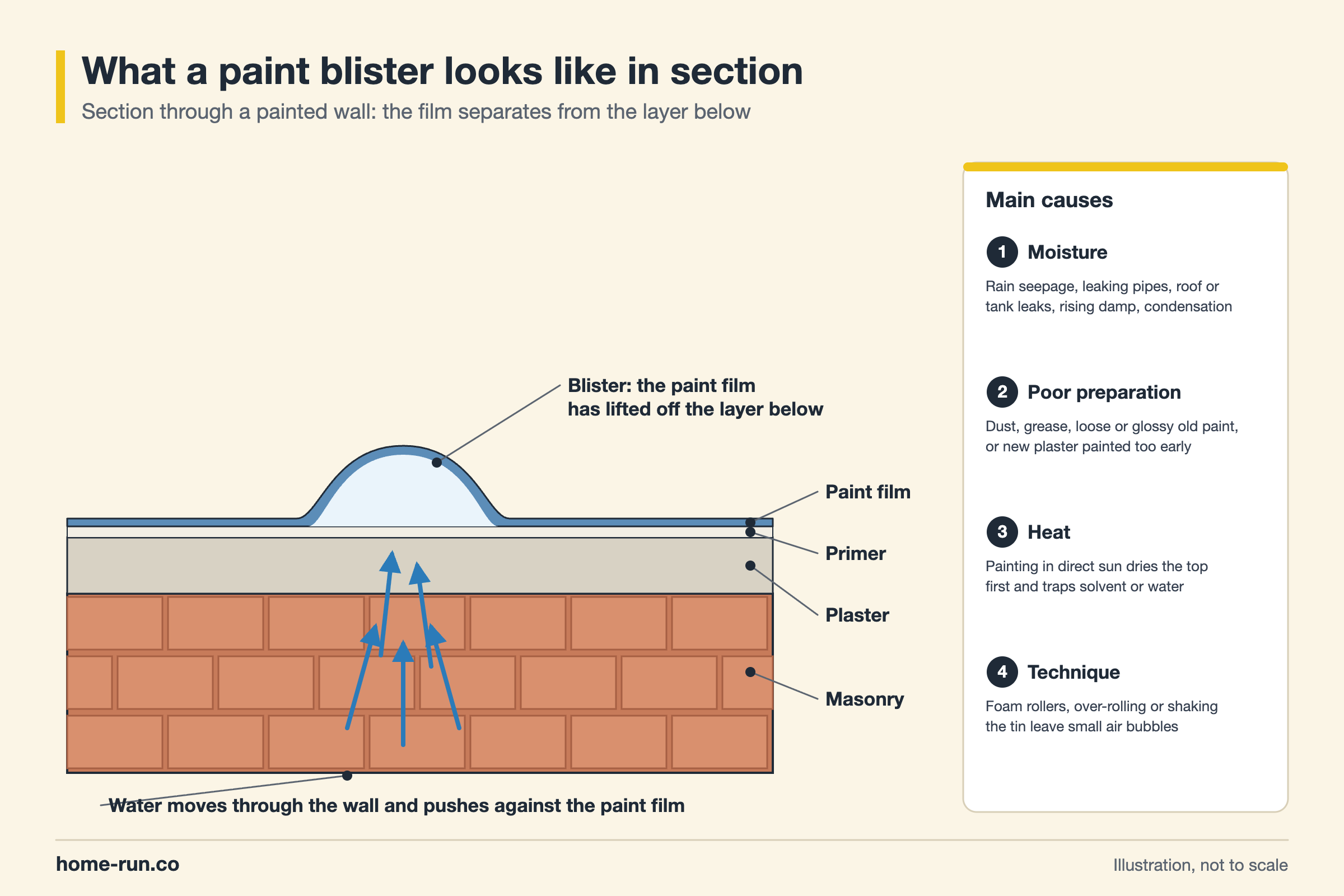
Bubbling matters for two reasons. The patch looks bad, and it often signals water inside the wall that can weaken plaster and feed mould behind the paint.
Bubbling is paint lifting into pockets. Peeling is paint coming away in strips or flakes, often after bubbles burst. Efflorescence is a white, powdery salt deposit that moisture carries to the surface, and it can push paint up from below.
What Causes Paint Bubbling on Walls?
Moisture is the most common cause of paint bubbling on walls, followed by poor surface preparation, heat during painting and faulty painting technique.
Moisture and humidity
Paint bubbles on a wall from moisture when water moves through the masonry and pushes against the paint film. The water can come from rain seepage, a leaking pipe, a roof or overhead tank leak, or rising damp at the base of the wall. Our guide to the causes of wall dampness explains each source in detail.
Kitchens and bathrooms add condensation. Water-based paint that meets steam, dew or rain soon after drying can blister, especially with poor ventilation.
Poor surface preparation
Paint bubbles when it goes over dust, grease, loose old paint, a glossy coat or a damp wall. New plaster painted too early still holds moisture and alkalinity, which also causes blistering.
Temperature effects
Painting a surface in direct sun, or one that is too warm, makes the top of the film dry before the layer below. The trapped solvent or water then lifts the film into small blisters.
Incorrect painting technique
Why is my paint bubbling while painting? Tiny bubbles that appear as you roll usually come from a foam roller, over-rolling, shaking the tin, or painting a porous wall without primer. These are air bubbles and they differ from moisture blisters.
Paint bubbling causes and what to fix first
Match the sign you see to the likely cause| Cause | Where it shows | Tell-tale sign | Fix first |
|---|---|---|---|
| Seepage or leak Most serious | Exterior walls, below terraces, near pipes | Blisters reach bare plaster, damp patch, musty smell | Stop the water source |
| Rising damp | Bottom of ground-floor walls | Tide mark, white salt powder near the floor | Damp-proofing at the base |
| Condensation | Bathrooms, kitchens, ceilings | Blisters after hot showers or cooking | Exhaust fan and ventilation |
| Poor preparation | Any wall, often in patches | Old paint coat visible under the blister | Scrape, sand and prime |
| Heat or sun | Sun-facing walls, fresh paint | Small blisters within hours or days of painting | Repaint in shade or cooler hours |
Bengaluru averages 1,077.1 mm of rain a year (IMD 1990–2020). The southwest monsoon arrives in early June, and September to November is usually the wettest stretch. Most bubbling shows up during or just after these months.
What Are the Signs of Blistering Paint?
The signs of paint bubbling are raised pockets that feel soft or hollow when pressed, often with damp patches, fine cracks or flaking around them.
- Early stage: small bubbles you notice only when light falls across the wall.
- Middle stage: larger patches, wrinkling and hairline cracks in the paint.
- Advanced stage: burst blisters, peeling, dark damp patches and crumbling plaster.
- Water inside: a blister that releases liquid when pierced confirms active moisture.
To diagnose a blister, cut one open with a sharp blade. If it goes down to bare plaster, moisture escaping from the wall is the likely cause. If an older paint coat shows underneath, the new coat failed to bond, usually because of a glossy, dirty or hot surface.
How to Fix Paint Bubbling on Walls: A Step-by-Step Guide
To fix paint bubbling on walls, stop the moisture source, let the wall dry, scrape and sand the damaged paint, fill and prime the patch, then apply two finish coats. Skipping the first two steps is why repainted bubbles return.
- Find the source. Check the other side of the wall, the terrace above, nearby bathrooms and concealed pipes. Read our guide on water seepage causes and solutions if water is coming from outside.
- Fix the source. Repair the leak, seal external cracks or waterproof the terrace. A roof leak needs its own fix, covered in our guide to a permanent solution for roof leakage.
- Let the wall dry fully. Check it with a moisture meter, a handheld device that reads water content in plaster. Follow your meter's own scale; Berger's meter, for example, rates 0–5 as safe and above 25 as high risk.
- Scrape off all loose paint. Use a scraper or putty knife until you reach paint that is firmly stuck. Wire-brush away any fungus, moss or white salt deposits and wipe with clean water.
- Sand the edges. Feather the edges of the scraped area so the repair does not show as a ridge. Sand any glossy old paint to give the new coat grip.
- Fill and level. Fill dents with acrylic wall putty and seal cracks up to 3 mm with a crack filler. Sand smooth once dry.
- Prime the patch. Apply one coat of wall primer, or a damp-resistant basecoat where the wall stays humid.
- Repaint. Apply two coats of interior emulsion. Asian Paints gives a 4-hour recoat gap for Royale Matt at 30°C and 50–60% relative humidity.
Bubbling paint on plaster walls that were replastered recently needs patience. Asian Paints recommends 28 days of curing for new masonry, and painter training guides allow at least 4 weeks for water-based paint and 12 weeks for oil-based (alkyd) paint.
Bubbling paint on basement walls or lower ground floors usually means water is coming through the soil side. Treat that wall with a damp-proofing or waterproofing coat before any decorative paint.
Diagnose and fix the source
Cut a blister, trace the water, repair the leak.
Let the wall dry out
Check with a moisture meter; new plaster needs 28 days.
Scrape, sand, putty and prime
Let putty and primer dry as the label states.
Two finish coats
About 4 hours apart at 30°C.
How Can You Prevent Blistering on Painted Walls?
You prevent paint bubbling by painting only clean, dry, cured walls in the right weather, with a primer and paint matched to the room.
- Fix leaks, seepage and terrace cracks before any repaint
- Wait 28 days before painting new plaster
- Paint only when the moisture meter reads dry
- Avoid painting below 10°C or above 90% humidity
- Keep fresh paint out of direct sun and away from rain, dew and steam
- Remove dust, grease and loose paint, and sand glossy coats
- Use primer on bare or porous plaster
- Fit exhaust fans in bathrooms and kitchens; a dehumidifier helps in closed rooms
A dehumidifier lowers room humidity but cannot stop water coming through a wall. Use it to dry a room after the leak is fixed, not instead of fixing it.
Which Primer and Paint Suit Indian Conditions?
For most Indian interior walls, a water-based wall primer under a water-based emulsion is the safer choice against bubbling, because water-based (latex) paint tolerates residual moisture better than oil-based paint.
Water-based emulsion
Most wallsPoint
- Also called latex or acrylic paint, though it contains no rubber latex
- Copes better with slight residual moisture in plaster
- Dries fast, with low odour and water cleanup
- Pairs with a water-based wall primer or damp-resistant basecoat
Oil-based paint
Wood and metalPoint
- Enamel or alkyd paint that forms a hard, glossy film
- Blisters readily if applied over a damp or wet surface
- Needs at least 12 weeks on new plaster
- Pairs with an oil-based primer on wood, metal and grilles
Read our explainer on oil-based primer before using one on a wall. For walls that stay humid, Indian paint makers sell damp-resistant basecoats; Asian Paints, for example, advises its DampBlock for excessive dampness. No decorative paint is meant for walls with continuous seepage.
Paint is the last layer of the repair. If the wall behind it is wet, even the best emulsion will bubble again.
HomeRun Team
How Much Does a Bubbled Wall Repair Cost in Bengaluru?
Repainting a bubbled wall in Bengaluru costs about ₹32–53 per sq ft including labour, primer, putty touch-ups and paint, according to NoBroker's 2026 rate guide. Leak or waterproofing work is charged separately.
Rates vary by paint range and site condition, so get a written quote after a site visit. Replastering a damaged patch is quoted separately.
Fixing a bubbled wall this week?
Primers, wall putty, paints and waterproofing delivered across Bengaluru.
When Should You Call a Professional for Bubbling Walls?
Call a professional when bubbling returns after a repaint, covers a large area, or comes with damp smells, crumbling plaster or a suspected hidden leak.
- Bubbles that come back within months of repainting
- Walls that feel damp or smell musty
- Plaster that crumbles or sounds hollow when tapped
- Bubbling next to concealed pipes, bathrooms or the terrace
- Black mould spreading under or around the blisters
A waterproofing contractor or plumber can trace hidden leaks with moisture meters and pressure tests. In older homes, wear a dust mask when sanding, since old paint layers may contain lead.