On this page
- What Is Lime Plaster and What Is It Made Of?
- What Types of Lime Plaster Are There?
- Why Choose Lime Plaster? What Are Its Benefits?
- What Are the Disadvantages of Lime Plaster?
- Lime Plaster vs Cement Plaster vs Gypsum Plaster: Which Is Better?
- How Do You Prepare a Wall for Lime Plaster?
- How Is Lime Plaster Applied? The Three-Coat System
- What Finishes Can You Get with Lime Plaster?
- Can You Use Lime Plaster in Bathrooms and Showers?
- How Much Does Lime Plaster Cost in India, and How Long Does It Last?
- Is Lime Plaster Right for Your Home?
- Lime plaster is lime, sand and water; it hardens slowly by carbonation, not by a fast chemical set like cement.
- IS 2394:1984 uses Class A or B lime for undercoats and Class C (fat) lime for second and finishing coats.
- Lime is soft and breathable, so it suits old brick, stone and damp-prone walls.
- Expect slower work: 3–5 days between coats and 7 days of wet curing.
- Lime render costs about ₹60–150+ per sq ft, against about ₹25–35 for internal cement plaster (2026).
Lime plaster is a wall finish made of lime, sand and water that hardens by slowly absorbing carbon dioxide from the air. Builders across India used lime plaster for centuries before cement arrived. Today it is back in demand for heritage repair, damp old walls and natural-finish homes.
What Is Lime Plaster and What Is It Made Of?
Lime plaster is a mix of a lime binder, sand (the aggregate) and water, sometimes with natural fibres or additives. The lime glues the sand grains together. The sand gives body and limits shrinkage.
The lime starts as limestone. Burning limestone in a kiln makes quicklime (calcium oxide). Adding water to quicklime, called slaking, makes slaked lime (calcium hydroxide).
Slaked lime comes in two forms:
- Lime putty: slaked lime kept as a wet paste and matured. Masons value putty for its smooth, workable mix.
- Hydrated lime: slaked lime sold as a dry bagged powder. Hydrated lime is easier to store and transport.
Lime plaster hardens by carbonation: the calcium hydroxide absorbs carbon dioxide and turns back into calcium carbonate, the same compound as limestone. Carbonation needs some moisture, which is why masons keep fresh lime plaster damp instead of letting it dry fast.
India has its own names for this family. Chuna is the everyday word for lime. Araish is the polished Rajasthani lime finish. Chettinad plaster from Tamil Nadu is another regional variant, covered in the finishes section below.
What Types of Lime Plaster Are There?
The main types of lime plaster are non-hydraulic (fat or air) lime plaster and hydraulic lime plaster, plus blends with cement, gypsum or surkhi. The difference lies in how each one sets.
- Non-hydraulic lime sets only by carbonation in air. It is soft, slow and very breathable.
- Hydraulic lime also sets by reacting with water, so it hardens in damper conditions and thicker coats. "Hydraulic" means "able to set with water", not "contains water".
In India, IS 712:1984, the Bureau of Indian Standards (BIS) specification for building limes, groups lime into six classes.
Building lime classes under IS 712
Confirm against the current BIS text| Class | Type | How it sets | Typical use |
|---|---|---|---|
| Class A | Eminently hydraulic lime | Mostly with water | Waterproof mortar, water-retaining masonry |
| Class B | Semi-hydraulic lime | Partly with water, partly in air | Masonry mortar, plaster undercoats |
| Class C Finish coats | Fat (high-calcium) lime | In air, by carbonation | Finishing coats, whitewash |
| Class D | Magnesian or dolomitic lime | In air, slowly | Finishing coats |
| Class E | Kankar lime | Hydraulic | Rural lime work and plaster |
| Class F | Siliceous dolomitic lime | Varies by source rock | Local use near its quarries |
Imported natural hydraulic lime (NHL) is graded NHL 2, NHL 3.5 and NHL 5 under the European standard EN 459-1. These numbers are strength classes, not quality grades.
Which lime plaster mix for which job
Qualitative guide| Mix | Breathability | Setting speed | Best use |
|---|---|---|---|
| Lime putty and sand Default pick | Very high | Slow | Interior walls, heritage repair, finish coats |
| Hydrated lime and sand | High | Slow | General interior plaster where putty is hard to source |
| Lime-surkhi or lime-pozzolana | High | Moderate | Exterior walls, damper walls, second coats |
| Hydraulic lime (Class A/B, NHL) | Medium to high | Moderate to faster | Exposed exteriors, plinths, damp masonry |
| Cement-lime plaster | Medium | Fast | Modern walls needing better workability than plain cement |
| Gypsum-lime plaster Interior only | Medium | Fast | Dry interior walls and ceilings |
Lime concrete is different again. Lime concrete is a coarse mix of lime, surkhi and broken brick or stone, used in old roofs, floors and foundations rather than as a wall plaster.
Why Choose Lime Plaster? What Are Its Benefits?
The main benefit of lime plaster is breathability: water vapour passes through it, so a damp wall can dry outward instead of trapping moisture behind the finish.
- Moisture handling: old brick and stone walls hold moisture, and lime lets that moisture escape. Cement render is relatively impermeable, so trapped moisture pushes out paint and plaster.
- Flexibility: lime is softer than cement, so the wall can move slightly without large cracks. Fine hairline cracks can partly re-seal as lime keeps carbonating.
- Compatibility: a soft plaster on soft brick lets the plaster, not the brick, take the wear.
- Finish: lime gives a soft, mineral, slightly varied surface that paint cannot copy.
- Fewer synthetics: traditional lime mixes use no plastic binders. Fresh lime is strongly alkaline, which discourages mould.
Lime helps a wall release moisture. Lime cannot stop a leak, rising damp or a broken gutter.
HomeRun Team
If a wall is damp, find the cause first. Our guide to the causes of wall dampness explains how to trace leaks and rising damp before you re-plaster.
What Are the Disadvantages of Lime Plaster?
The main disadvantages of lime plaster are slow curing, the need for skilled masons and a higher cost than a quick cement or gypsum finish.
- Slow work: each coat needs days to firm up, and the plaster gains strength over months.
- Weather sensitivity: hot sun and dry wind can dry fresh lime too fast, and heavy rain can wash out a fresh coat.
- Skilled labour: few masons today train in lime, especially in fast-growing cities like Bengaluru.
- Lower strength: lime is softer than cement plaster and dents more easily on busy corners.
- Maintenance: limewash finishes need recoating every few years and can mark when rubbed.
Cement plaster displaced lime in mainstream building because cement is uniform, sold everywhere in bags, sets fast and suits the RCC frame and concrete block walls of modern houses. Lime remains the better choice only where its breathability and softness matter.
Lime Plaster vs Cement Plaster vs Gypsum Plaster: Which Is Better?
Lime plaster is better for old, soft or damp masonry; cement plaster is better for speed and hard-wearing modern walls; gypsum plaster is better for smooth, dry interior walls.
Lime, cement and gypsum plaster compared
Qualitative, typical conditions| Factor | Lime plaster | Cement plaster | Gypsum plaster |
|---|---|---|---|
| Breathability | High | Low | Medium |
| Flexibility | Flexible, fine cracks | Rigid, can crack wider | Rigid |
| Damp walls | Good, if the source is fixed | Traps moisture in old walls | Poor; avoid |
| Exterior use | Yes, with hydraulic lime or surkhi | Yes | No |
| Cure time | Days per coat, months to harden | Fast set, 7 days curing | Fastest; no water curing |
| Skill needed | High | Common | Common |
| Choose it if | Heritage or soft brick walls | Modern RCC and block walls | Smooth dry interiors fast |
Lime plaster on interior walls
BreathableWhere lime wins indoors.
- Lets old or damp walls dry out
- Soft, natural mineral finish
- Moves with soft brick without large cracks
- Pairs with breathable limewash or mineral paint
Cement plaster on interior walls
FastWhere cement still makes sense.
- Faster, cheaper and widely available
- Harder surface on busy corners
- Suits RCC and concrete block walls
- Takes wall putty and emulsion paint well
Lime patches on a cement-plastered wall, or cement patches on a lime wall, move and breathe differently. The joint between the two often cracks or traps damp. Strip back to one system on each wall.
How Do You Prepare a Wall for Lime Plaster?
You prepare a wall for lime plaster by fixing the moisture source, removing loose or impermeable layers, raking out joints and dampening the masonry.
- Fix leaks, rising damp, blocked drains and gutters before you plaster
- Remove loose plaster, failed cement render and plastic paint down to sound masonry
- Rake out mortar joints so the first coat can grip (create a "key")
- Brush off dust and loose grit
- Dampen the wall evenly so dry brick does not suck water out of the fresh lime
- Fill deep holes in thin layers ("dubbing out") instead of one thick coat
Lime over sound cement render or plastic emulsion loses most of its breathing benefit. Ask the mason to test a section and decide whether to strip it. For background on brick and stone walls, read our explainer on masonry and its types.
How Is Lime Plaster Applied? The Three-Coat System
Lime plaster is applied in thin coats: a first (scratch) coat that grips the wall, a second (float or brown) coat that levels it, and a thin finishing coat.
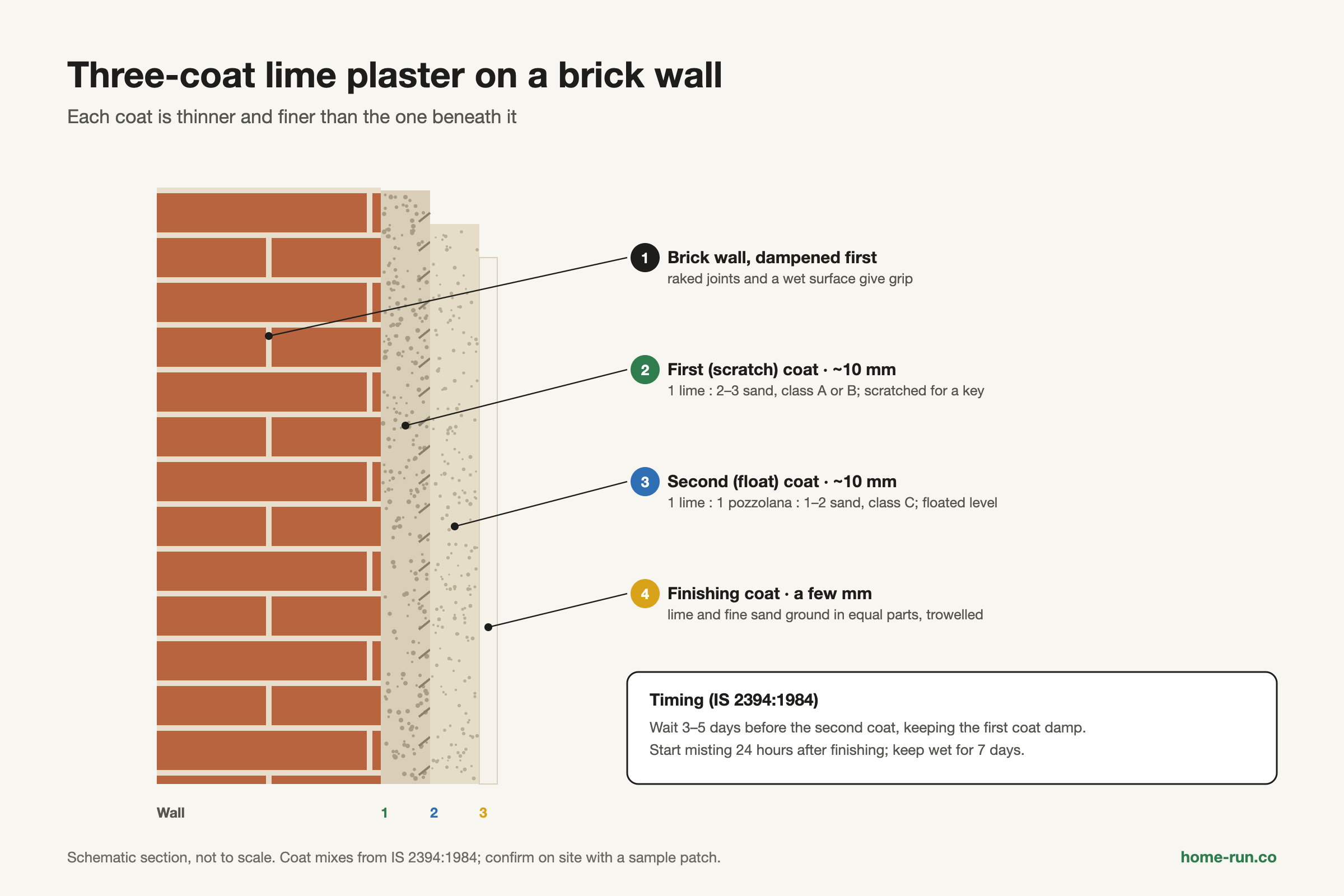
IS 2394:1984, the Indian code of practice for the application of lime plaster finish, sets these values:
Lime plaster coats under IS 2394:1984
Mix by volume; scanned table, verify| Coat | Mix (by volume) | Lime class | Thickness |
|---|---|---|---|
| Dubbing and first coat | 1 lime : 2–3 sand | A or B | About 10 mm on brick |
| Second coat | 1 lime : 1 pozzolana : 1–2 sand | C | About 10 mm on brick |
| Neat finishing coat | Lime and fine sand, ground in equal parts | C | Thin, a few mm |
| Single coat on brick | As first coat | A or B | About 15 mm |
Prepare and apply the first coat
Dampen the wall, then throw or trowel the first coat on hard. Scratch the surface to give the next coat a key.
Apply the second coat
IS 2394 asks for 3 to 5 days, depending on weather, with the first coat kept from drying out. Float the second coat level.
Apply the finishing coat
Lay a thin finishing coat once the second coat has firmed up, and trowel to the chosen texture.
Start curing
Begin wet curing 24 hours after finishing. Mist the wall, never hose it.
End wet curing
Keep the plaster wet for 7 days, then let it dry slowly while it keeps carbonating.
Protect fresh lime plaster from direct sun, drying wind and driving rain. In Bengaluru, hang wet hessian or shade cloth on sun-facing walls in summer and cover exteriors during the monsoon.
Signs your lime plaster job is going wrong
- Shrinkage cracks: the coat dried too fast or went on too thick
- Dusting or powdery surface: the plaster dried out before it could carbonate
- Soft, crumbly patches: weak mix, too much water or rain on a fresh coat
- Patchy colour: uneven suction from the wall or uneven curing
- Coat lifting off: poor key, dusty wall or the next coat went on too early
What Finishes Can You Get with Lime Plaster?
Lime plaster can be finished smooth, polished, textured or limewashed, and natural lime is white to off-white unless you add pigment.
- Smooth trowelled: a fine lime and sand finish, flat and soft.
- Araish: the Rajasthani polished lime, made from fine lime and marble powder in very thin layers, burnished with a hard stone to a mirror-like shine.
- Chettinad plaster: a Tamil Nadu finish of aged shell lime, with egg white and curd water in the final coat, burnished with marble or quartz stone.
- Venetian plaster and marmorino: polished, layered lime finishes, often sold factory-blended.
- Tadelakt: a Moroccan burnished lime finish sealed with soap for water resistance.
- Textured or rustic: float, sponge or hand-trowelled textures.
Colour comes from lime-compatible mineral pigments. The grey and pink shades seen in traditional work often come from the sand, surkhi or pigment, not from the lime itself.
Use a breathable finish such as limewash or a mineral (silicate) paint. Acrylic and plastic emulsions seal the surface and cancel the breathability you paid for. Check the paint maker's technical data sheet for lime compatibility. For a related white binder, see our explainer on white cement composition and properties.
Factory "lime finish" products from paint brands may contain acrylic binders. Read the composition before you assume a product is traditional lime plaster.
Can You Use Lime Plaster in Bathrooms and Showers?
Standard lime plaster tolerates humidity and occasional splashes but is not waterproof, so it should not take direct, constant water in a shower.
- Use lime plaster on bathroom walls outside the splash zone, with good ventilation.
- Tadelakt and Chettinad-style burnished finishes resist water better but need specialist masons and regular care.
- Use tiles over a proper waterproofing layer inside shower areas and around taps.
How Much Does Lime Plaster Cost in India, and How Long Does It Last?
Lime plaster costs about ₹60–150+ per sq ft for a lime-sand render, and ₹150–250 per sq ft for decorative lime finishes, including material and labour (2026 sources).
The price depends on these factors:
- Type of lime: local slaked lime, hydrated lime, putty or imported NHL
- Number of coats and total thickness
- Finish level: plain, textured, polished or araish
- Wall condition and how much old plaster must come off
- Availability of trained lime masons in your city
Indicative lime plaster rates in India
₹ per sq ft, material + labour| Finish | ₹ per sq ft | Source and date |
|---|---|---|
| Lime render (lime-sand, limewash or mineral paint) | 60–150+ | Studio Matrx guide, June 2026 |
| Traditional lime plaster (add-on rate) | 120 | Limemitti calculator, Hyderabad, 2024–25 |
| Lime wash finish Sources differ | 40 to 150–200 | Limemitti (₹40); AapkaPainter (₹150–200), 2026 |
| Venetian lime plaster | 160–250 | AapkaPainter, 2026 |
| Araish mirror finish | 250 | Limemitti calculator, 2024–25 |
| Cement plaster, internal 12 mm For comparison | 25–35 | HouseYog, March 2026 |
Ask your supplier for the bulk density of their lime to convert cubic metres to bags.
Well-made lime plaster can last for generations when maintained. Bengaluru's Fort High School, built of brick and lime, was restored by INTACH (the Indian National Trust for Art and Cultural Heritage) with traditional materials more than a century after it was built. Leaks, cement patches and plastic paint shorten the life of lime plaster most.
Planning a plastering job?
Get sand, cement, waterproofing and painting supplies delivered across Bengaluru with a GST invoice.
Is Lime Plaster Right for Your Home?
Lime plaster is right for your home if the walls are old brick or stone, prone to damp, or part of a heritage restoration. Cement or gypsum plaster usually suits new RCC and concrete block houses on a tight timeline.
- Wall type and age: soft brick, stone or an old lime wall points to lime
- Moisture: fix the water source first, then choose lime to let the wall dry
- Budget and timeline: allow more money and weeks, not days
- Labour: confirm the mason has done lime work before and can show past jobs
- Sample patch: approve a test area before the full job
Your next step is a site assessment. Ask a lime specialist or restoration mason to inspect the walls and quote on a defined mix, coat count and finish.