On this page
- What Are Aluminium Windows Made Of?
- What Are the Frame Sections of an Aluminium Window?
- What Are the Advantages of Aluminium Windows?
- Which Finish Survives Monsoon and Coastal Air?
- Do Aluminium Windows Save Energy?
- Aluminium vs uPVC vs Wood vs Steel: Which Window Is Better?
- What Are the Disadvantages of Aluminium Windows?
- Which Window Type Suits Each Room?
- What Should You Check Before Buying, and How Do You Maintain the Frames?
- Aluminium windows use extruded aluminium profiles for the frame and sashes, with glass, gaskets and hardware fitted in.
- The big advantages are strength with slim sections, no rot or termites, and low upkeep.
- Bare aluminium conducts heat very well; a polyamide thermal break and the right glass fix most of that.
- For coastal or harsh exposure, ask for a thick anodic coat (about 25 µm) or a warrantied powder coat.
- uPVC is usually cheaper and insulates better; aluminium wins on large openings and slim looks.
Aluminium windows are windows whose frames and opening sashes are made from extruded aluminium sections. Fabricators cut these sections, join them at the corners and fit glass, rubber gaskets, rollers and locks. Most homes use them as sliding or casement windows, from Bengaluru apartments to villas.
What Are Aluminium Windows Made Of?
An aluminium window is a system of four parts, and each part affects how well the window works.
- Profiles: the shaped aluminium lengths, made by pushing hot alloy through a die (extrusion).
- Glass: single, laminated or double-glazed units.
- Hardware: rollers, handles, hinges and locks.
- Seals: EPDM rubber gaskets and brush (wool-pile) seals that keep out rain and dust.
Wall thickness, alloy and finish vary widely between makers. Two windows that look the same can differ a lot in stiffness and lifespan.
What Are the Frame Sections of an Aluminium Window?
An aluminium window is built from a set of named frame sections. Knowing the names helps you read a fabricator's quote.
- Outer frame: the fixed section anchored to the wall opening.
- Track: the bottom and top rails a slider runs on. A 2-track holds two shutters; a 3-track adds a mosquito-mesh shutter.
- Sash (shutter): the moving frame that holds the glass.
- Interlock: the meeting section where two sliding sashes overlap and seal.
- Mullion and transom: vertical and horizontal bars that divide a large window into panels.
- Glazing bead: the clip-in strip that holds the glass in the sash.
Local fabricators also sell sliders by series. "Domal" sections have rounded edges, while slim series use narrow, flat faces. Ask for the section weight in kg per metre, because heavier sections usually mean thicker walls.
What Are the Advantages of Aluminium Windows?
The main advantages of aluminium windows are strength, slim frames, durability and low maintenance.
- Strength-to-weight: aluminium (2.7 g/cm³) weighs about a third as much as steel, yet slim sections can carry large panes.
- Slim sightlines: less frame means more glass and daylight than a uPVC or wooden frame of the same size.
- No rot or termites: unlike teak or sal frames, aluminium does not swell, warp or get eaten.
- Stable in heat: aluminium expands about 24 µm per metre per °C, against about 61 for uPVC.
- Low upkeep: powder-coated and anodised finishes need cleaning, not repainting.
- Recyclable: scrap aluminium can be remelted using about 5% of the energy of new metal.
Over a 1.5 m frame and a 30 °C swing, aluminium moves about 1.1 mm and uPVC about 2.7 mm.
Which Finish Survives Monsoon and Coastal Air?
Aluminium windows handle rain and humidity well, because aluminium does not rust the way steel does. The finish and the drainage decide how well they last.
Which aluminium finish for which exposure
Confirm thickness and warranty in writing| Finish | How it is made | Best for | Watch out |
|---|---|---|---|
| Powder coating Default pick | Coloured powder baked onto the metal | Inland cities such as Bengaluru, wide colour range | Scratches expose bare metal |
| Anodising Coastal | Natural oxide layer thickened electrically | Coastal homes, with a thick grade of about 20–25 µm | Limited colours; sealing must be tested |
| Mill finish Avoid | Bare extruded metal | Temporary or utility use | Dulls and stains outdoors |
Bengaluru falls in the temperate climate zone under the National Building Code (NBC) 2016, so standard powder coat suits most homes. Coastal cities such as Mumbai, Chennai and Goa need the thicker finish.
Sliders drain through weep holes in the bottom track. Blocked weep holes, open corner joints and a poorly sealed gap between frame and wall cause most leaks, and can lead to damp patches on the walls below.
Do Aluminium Windows Save Energy?
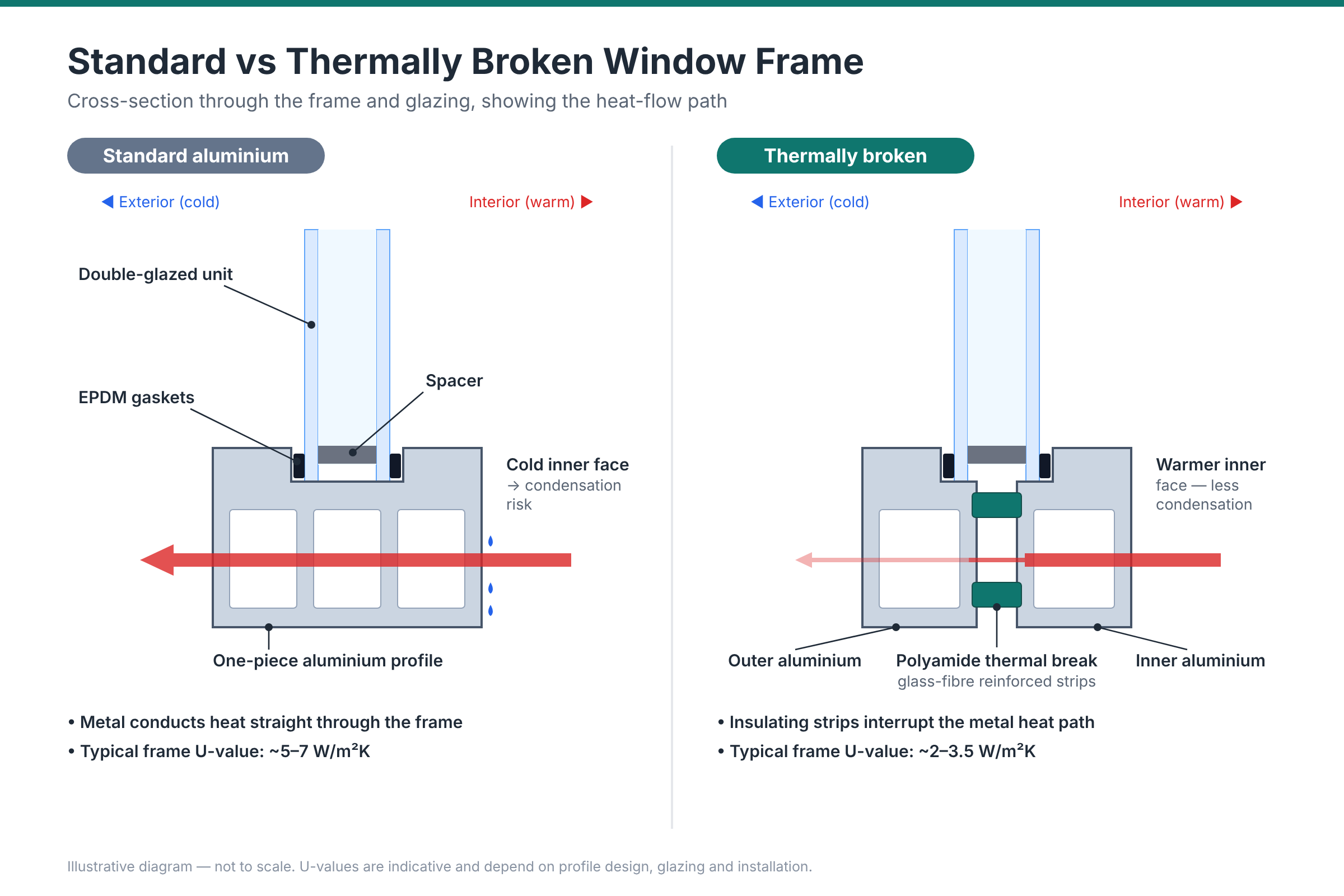
Aluminium windows save energy only when the frame has a thermal break and the glass blocks solar heat. Plain aluminium lets heat pass straight through the frame.
- Thermal break: a polyamide (nylon-type) strip locked between the outer and inner aluminium, cutting the metal heat path.
- U-value: how fast heat passes through. Uw is the whole window, Ug the glass, Uf the frame. Lower is better.
- SHGC (solar heat gain coefficient): the share of sunlight heat the glass lets in. Lower keeps rooms cooler.
- Low-E glass: glass with a thin metallic coating that reflects heat.
Indian homes mostly need to keep sun heat out. A low-SHGC glass on a sunny west or south wall often helps more than a better frame.
Aluminium vs uPVC vs Wood vs Steel: Which Window Is Better?
Aluminium is better for large openings and slim frames; uPVC is better for insulation and tight budgets.
Window frame materials compared
General behaviour; check each system's data| Material | Heat insulation | Moisture and termites | Frame slimness | Upkeep |
|---|---|---|---|---|
| Aluminium Large openings | Poor without thermal break | No rot, no rust, no termites | Slimmest | Low |
| uPVC Budget | Good, naturally | No rot or termites | Bulkier | Low |
| Wood (teak, sal) | Good | Can swell, rot or get termites | Bulky | Polish or paint regularly |
| Steel | Poor | Rusts if coating fails | Slim | Repaint to stop rust |
Prices vary by system, glass and city. One Bengaluru rate analysis by InfraLens puts a basic sliding window with 5 mm plain glass at ₹2,929–3,820 per sq m, about ₹272–355 per sq ft. Branded systems cost more; get at least three like-for-like quotes.
What Are the Disadvantages of Aluminium Windows?
The main disadvantages of aluminium windows are poor insulation without a thermal break, higher cost for good systems and sensitivity to poor fabrication.
- Frames feel hot in sun and can collect condensation in cold or AC rooms
- Thermal-break systems and double glazing raise the price
- Thin, cheap sections flex and let in dust and water
- Sliders seal less tightly than casement windows
Choose uPVC when budget or insulation comes first, or in cold hill climates without a thermal-break system.
Which Window Type Suits Each Room?
Aluminium windows suit any room, but the window type should match the room.
- Balconies: large sliding windows and doors with slim interlocks.
- Bedrooms and kitchens: casement windows for better airflow and a tighter seal.
- Bathrooms: top-hung or louvred ventilators with frosted glass.
- Living rooms: large fixed panes beside opening panels.
For styles and layouts, see our guide to window designs for home.
What Should You Check Before Buying, and How Do You Maintain the Frames?
Choose aluminium windows by checking the sections, finish, glass and hardware in writing.
- Standard: ask if the system meets IS 1948:2024, the BIS specification for aluminium framed doors, windows and sliders.
- Sections: profile brand, series and weight per metre.
- Finish: powder-coat warranty or anodic thickness in microns.
- Glass: type and thickness, and SHGC for sunny walls.
- Hardware and service: roller and lock brands, and spare-part support.
Keep the windows working with a short routine:
- Before the monsoon, vacuum the tracks and clear the weep holes.
- Wipe frames with mild soap and water; avoid abrasive or acidic cleaners.
- Lubricate rollers and locks with a silicone spray.
- Check gaskets and sealant each year and replace any that crack.
Fixing and sealing your windows
Order hardware, sealants and glass fittings with a GST invoice and delivery across Bengaluru.