On this page
- What Is a Mullion in Windows and Is It Structural?
- Mullion vs Transom vs Muntin: What's the Difference?
- What Types of Mullions Will You See on a Quote?
- Which Mullion Material Suits Indian Conditions?
- How Is Mullion Size and Placement Chosen?
- Where Do Mullion Joints Leak in the Monsoon?
- How Do Jaali and Jharokha Windows Relate to Mullions?
- Can You Remove or Add a Mullion in Windows?
- A mullion is vertical; a transom is horizontal.
- A muntin only splits glass inside one sash and rarely carries load.
- Many mullions are structural: they carry wind load and glass weight.
- Pick uPVC or coated aluminium for monsoon and coastal sites.
- Get structural advice before removing a mullion.
A mullion in windows is a vertical bar that divides one opening into two or more window units placed side by side. It holds the glass rigid and often helps carry the load above the opening.
What Is a Mullion in Windows and Is It Structural?
A mullion is the element that forms a division between units of a window or screen. Many mullions are structural, but some are only decorative.
A structural mullion does two jobs:
- Supports the glazing: it stops large glass panels from flexing in wind.
- Transfers load: it passes wind load and glass weight to the sill and to the window head or lintel (the beam over the opening).
In a curtain wall (a non-load-bearing glass facade), mullions carry only the transoms, glass and vents, not the floors above.
Mullion vs Transom vs Muntin: What's the Difference?
A mullion is vertical, a transom is horizontal, and a muntin divides small panes within a single sash (the movable glazed panel).
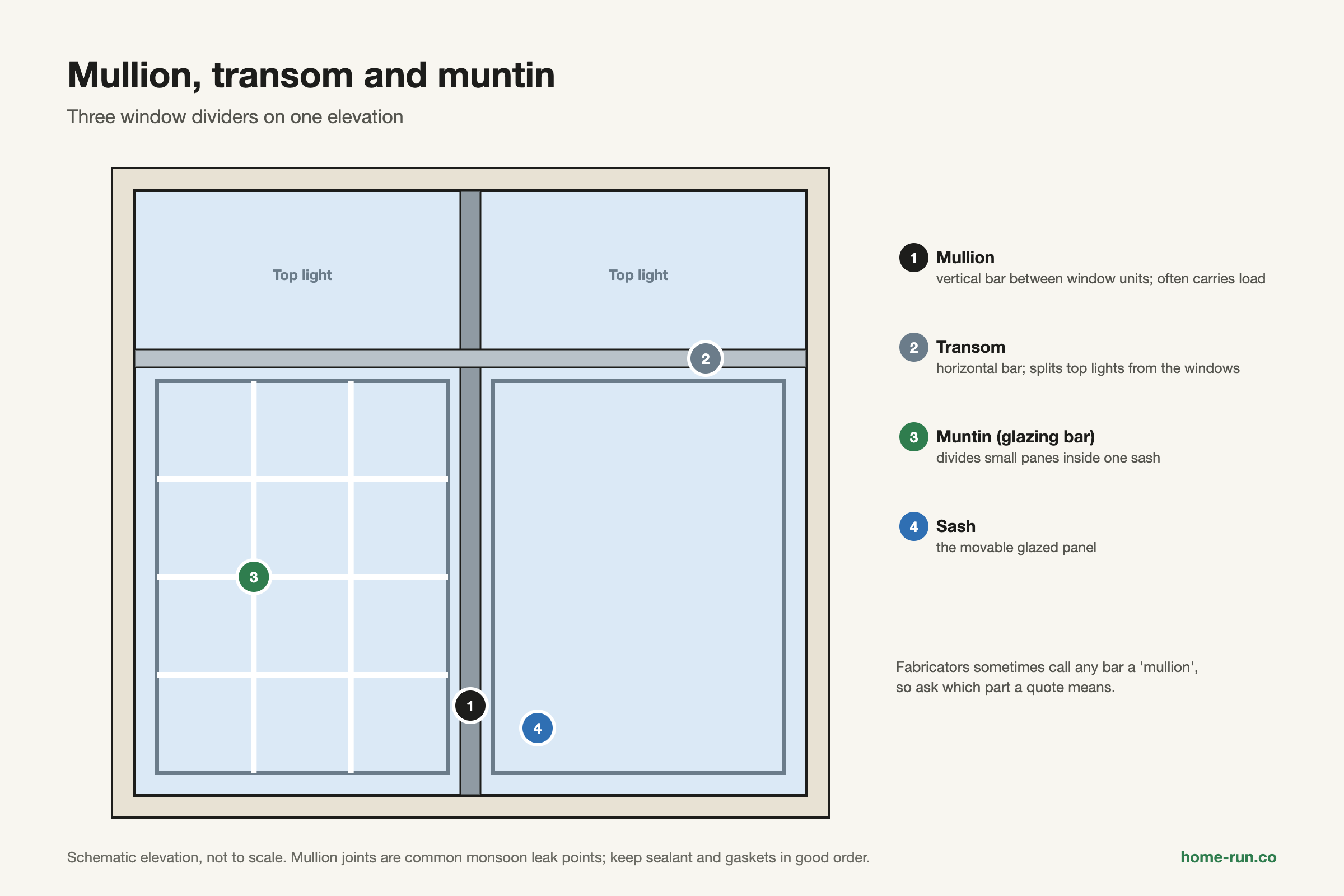
Three window dividers compared
UK usage calls a muntin a glazing bar| Part | Direction | What it divides | Carries load? |
|---|---|---|---|
| Mullion Main frame | Vertical | Separate window units | Often yes |
| Transom | Horizontal | Upper and lower lights, or door and window above | Sometimes |
| Muntin | Either | Small panes inside one sash | Rarely |
Mullion
Structural dividerBetween whole window units.
- Part of the main frame
- Carries wind and glass load
- Remove only with advice
Muntin
Pane dividerInside a single sash.
- Thin, light bar
- Mostly decorative
- Can be simulated or between glass
What Types of Mullions Will You See on a Quote?
Most quotes list a fixed structural mullion, but you may also see these types:
- Fixed structural mullion: joins casement, sliding or fixed panels in one opening.
- Coupling mullion: joins two factory-made frames side by side, common in uPVC and aluminium systems.
- Decorative or applied mullion: gives a divided look without carrying load.
- Movable or flying mullion: fixed to one sash, so both sashes open with no central post.
- Curtain wall mullion: an aluminium section that, with transoms, forms the grid holding facade glass.
For layout ideas, see these window designs for home.
Which Mullion Material Suits Indian Conditions?
uPVC and coated aluminium suit most Indian homes; timber and steel need more upkeep. A mullion usually matches the frame material.
Mullion materials for Indian weather
Qualitative ratings; confirm with your fabricator| Material | Monsoon and coast | Heat | Upkeep | Watch for |
|---|---|---|---|---|
| uPVC Default pick | Good; no rust or salt attack | Insulates well | Low | Steel reinforcement in wide spans; UV-stabilised grade |
| Aluminium | Good if powder-coated or anodised | Conducts heat | Low | Thermal break for hot rooms |
| Timber (teak, sal) | Fair; swells and rots | Insulates well | High | Termites; re-seal every 2–4 years |
| Steel | Poor unless galvanised | Conducts heat | Medium | Rust at joints |
| Stone or cast stone Heritage | Good | Heavy, stores heat | Low | Weight on the lintel |
Near the sea, choose uPVC or marine-grade coated aluminium. Avoid bare aluminium and ungalvanised steel.
Compare frames in our guides to aluminium windows and steel windows.
Fixing or sealing window frames?
Hardware, sealants and wood materials delivered across Bengaluru.
How Is Mullion Size and Placement Chosen?
Mullion size depends on span, glass weight, wind exposure and floor height, so your fabricator or a structural engineer should set it.
- Measure the full opening width and height.
- Note the floor level and how exposed the wall is to wind.
- Ask the fabricator for the profile depth and any reinforcement for that span.
- Check the glass type against IS 16231, the Indian code of practice for use of glass in buildings.
- Balance slim looks against strength; wider mullions block more view.
Wind pressure rises with height. Tall apartment towers need deeper or reinforced mullions, designed to IS 875 (Part 3), the Indian code for wind loads on structures.
Where Do Mullion Joints Leak in the Monsoon?
The joint between the mullion, frame and glass is a common leak point when sealant or gaskets fail.
- Cracked or shrunk silicone along the mullion
- Blocked drainage channels or weep holes
- Damp patches below one corner after rain
How Do Jaali and Jharokha Windows Relate to Mullions?
Jaali screens and jharokha windows also divide an opening into vertical bays, though they are not mullions in the strict technical sense.
Havelis used carved stone jaalis; Kerala and Goa homes used timber windows with vertical bars.
Can You Remove or Add a Mullion in Windows?
You can, but removing or adding a structural mullion changes the load path, so get structural advice first. In apartments, you may also need housing society permission.
- Opening width, height and floor level
- Wall exposure: sheltered, open or sea-facing
- Current frame material and any rust, rot or termite damage
- Your budget and preferred material
- Society rules on changing the facade