On this page
- What Is Caulk and What Is It Made Of?
- What Is the Difference Between Caulk and Silicone Sealant?
- What Are the Main Types of Caulk and Their Uses?
- Where Is Caulk Used in Indian Homes?
- How Do You Apply Caulk?
- How Long Does Caulk Last and How Do You Maintain It?
- How Much Does Caulking Cost in India?
- How Do You Choose the Right Caulk?
- Caulk is a gun-applied paste that fills and seals joints; it does not glue parts together.
- Acrylic caulk suits dry, painted joints; silicone suits wet areas and glass.
- Polyurethane (PU) suits outdoor joints in concrete, masonry and metal that move.
- Clean, dry joints and the right bead size matter more than the brand.
What is caulk? Caulk is a flexible paste squeezed into gaps and joints to seal them against water, air, dust and insects. It cures into a soft, rubbery bead that moves a little as the joint moves.
This guide covers what caulk is made of, the main types and where each one goes in an Indian home.
What Is Caulk and What Is It Made Of?
Caulk is a joint-sealing material made of a binder (acrylic, latex, silicone, polyurethane or butyl rubber) mixed with fillers and small amounts of additives. The binder decides how far the cured bead can stretch and whether it takes paint.
The word also works as a verb: to caulk a joint is to seal it.
Caulk and sealant seal joints that move. Grout fills the rigid gaps between tiles. Adhesive bonds two parts together. Joint compound fills drywall seams and is sanded smooth, not left flexible.
Tile joints need grout, covered in our bathroom tile grout guide. Drywall seams need filler, explained in our page on joint compound.
What Is the Difference Between Caulk and Silicone Sealant?
Caulk handles joints that move less than 12.5% of their width, while a sealant handles more, according to GE Sealants. In practice "caulk" means paintable acrylic or latex, and "sealant" means silicone or polyurethane.
Acrylic caulk
Dry, painted jointsPoints
- Water-based, cleans up with water when wet
- Paintable once dry
- Low joint movement
- Skirting, door casings, wall cracks, trim
Silicone sealant
Wet areasPoints
- Moisture-curing rubber, needs spirit to clean
- Cannot be painted
- High joint movement, stays flexible
- Sinks, showers, glass, window frames
The US standard ASTM C920 (elastomeric joint sealants) grades sealants by movement, for example Class 25 for ±25%. Older acrylic latex caulks were closer to ±7.5%, according to the Journal of Light Construction.
What Are the Main Types of Caulk and Their Uses?
The main types of caulk are acrylic (latex), siliconised acrylic, silicone, polyurethane and butyl. Each suits a different mix of moisture, movement and paint.
Types of caulk compared
Where each one works best| Type | Paintable | Wet areas | Best for |
|---|---|---|---|
| Acrylic / latex caulk Painter's caulk | Yes | No | Skirting, door and window casings, hairline wall gaps before painting |
| Siliconised acrylic | Yes | Splash zones only | Kitchen and bathroom gaps that see occasional water |
| Silicone Wet-area pick | No | Yes | Sinks, basins, showers, glass, aluminium and UPVC frames |
| Polyurethane (PU) | Usually yes | Yes | Exterior concrete, masonry and metal joints that move |
| Butyl rubber | Limited | Yes | Roof flashing, gutters, metal sheet laps |
Silicone comes in two cures. Acetoxy (acid-cure) silicone smells of vinegar and can attack metals and alkaline surfaces. Neutral-cure silicone suits plaster, stone, metal and exterior frames.
Will it be painted? Use acrylic. Will it get wet? Use silicone. Is it outdoors on concrete or metal and moving? Use PU or neutral-cure silicone.
Where Is Caulk Used in Indian Homes?
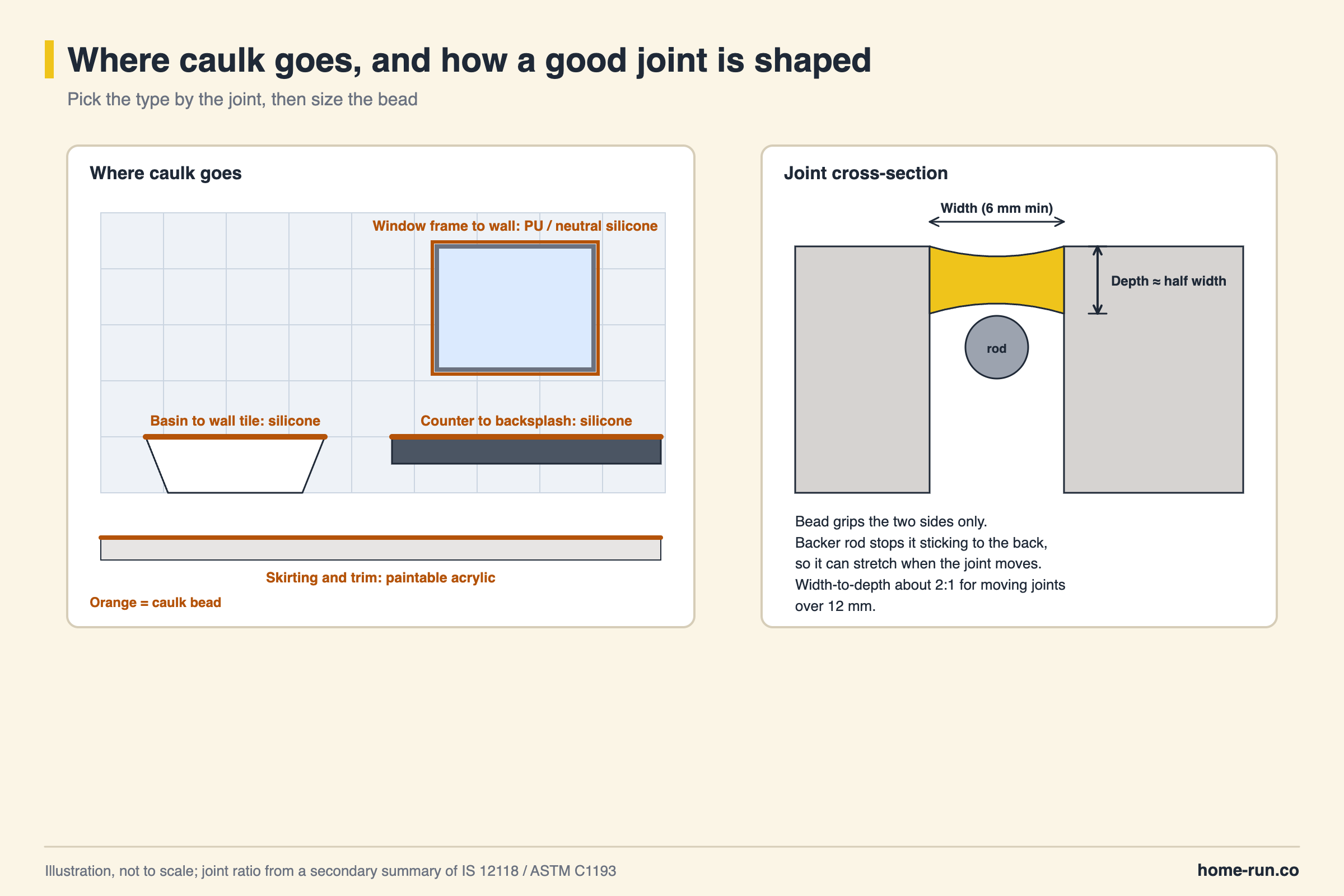
Caulk in construction seals the joints between materials that move differently, such as tile and ceramic sanitaryware, or masonry and a window frame. Indian homes use it most in these spots:
- Bathrooms: where wash basins, WCs and shower trays meet wall tiles, and along glass shower partitions.
- Kitchens: the joint between the granite counter, the sink and the backsplash.
- Windows and doors: the outside gap between aluminium, UPVC or wooden frames and the wall.
- Interiors: skirting, door casings and wall cracks before painting.
Bengaluru gets rain from both the southwest and northeast monsoons, so exterior frame joints face long wet spells and strong sun. A failed window bead is a common cause of damp patches; see our guide to water seepage causes and solutions.
How Do You Apply Caulk?
You apply caulk by cleaning and drying the joint, masking both edges, running one steady bead with a caulking gun and tooling it smooth before a skin forms.
Before you start
- Caulking gun, the right cartridge and a utility knife
- Masking tape, a tooling spatula or a wet finger
- Isopropyl alcohol or spirit and a lint-free cloth
- Backer rod for joints deeper than about 12 mm
Step-by-step
- Remove old caulk and clean. Cut out the old bead (new silicone will not bond to it), then wipe with alcohol and let it dry.
- Mask the edges. Run tape on both sides of the joint for a straight line.
- Cut the nozzle at 45°. Make the opening slightly smaller than the joint width.
- Run one bead. Push the gun along at a steady pace so the caulk fills the joint fully.
- Tool it. Smooth the bead within the skin time, which is 5–20 minutes for Feviseal GP silicone.
- Pull the tape and leave it. Remove the tape while the bead is wet and keep water off until the product's stated time.
Do not let caulk stick to the back of a deep joint. A bead bonded on three sides tears when the joint moves. Fit a backer rod so the bead grips only the two sides.
For moving joints over 12 mm, a common guide is a width-to-depth ratio of 2:1, with a minimum joint width of 6 mm.
How Long Does Caulk Last and How Do You Maintain It?
Caulk lasts until the bead cracks, peels or grows mould, and wet-area beads fail first. Check bathroom and kitchen joints every few months.
Signs the caulk needs replacing
- Black spots that do not wipe off: mould has grown into the bead.
- Bead pulling away from one side: poor surface prep or too much movement.
- Damp marks below a window: the frame joint is letting rain in.
Most caulks give off volatile organic compounds (VOCs) while curing. Water-based acrylics such as Feviseal Bathroom & Kitchen contain no organic solvent, and Los Angeles County caps architectural sealants at 250 g/L VOC. Ventilate the room and let the tube cure before you throw it away.
How Much Does Caulking Cost in India?
Caulking cost depends on the type, the brand and the length of joint. Acrylic is usually cheapest, then silicone, then PU and high-movement sealants.
Prices vary by brand and pack size and change often. Compare current rates from local suppliers, and buy about 10% extra for nozzle waste and touch-ups.
How Do You Choose the Right Caulk?
Choose caulk by the joint: wet or dry, painted or not, indoors or out, and moving or fixed. Then confirm on the data sheet that it bonds to both surfaces.
- Best decorator's caulk: a paintable acrylic for interior trim and wall gaps.
- Best caulk for exterior windows: neutral-cure silicone or PU rated for UV and movement.
Unsure about a leaking joint? Our guide to types of waterproofing explains when a joint needs more than caulk.
Sealing a joint this week?
Sealants, waterproofing and tools delivered across Bengaluru.