On this page
- What Is Bathroom Tile Grout and Why Does It Matter?
- What Types of Tile Grout Can You Buy?
- Which Grout Suits Indian Bathrooms?
- How Do You Apply Bathroom Tile Grout Step by Step?
- How Do You Seal and Clean Grout Lines?
- What Mistakes Make Bathroom Tile Grout Crack?
- Where Can You Buy Grout and When Should You Hire a Pro?
- Bathroom tile grout fills the joints between tiles, locks the edges and keeps water and dirt out of the gaps.
- Use epoxy grout in showers and on bathroom floors; use polymer-modified cement grout on walls that stay mostly dry.
- Pick unsanded grout for joints up to 3 mm and sanded grout for wider joints.
- Use silicone sealant, not grout, at corners and where tiles meet the floor trap, tub or basin.
- Seal cement grout after it cures and reseal yearly; epoxy grout does not need a sealer.
Bathroom tile grout is the paste that fills the joints between tiles and hardens into a firm, water-resistant line. The right bathroom tile grout keeps water out of the tile bed, stops tile edges from chipping and makes the floor easier to clean.
What Is Bathroom Tile Grout and Why Does It Matter?
Bathroom tile grout is a cement- or resin-based filler pressed into tile joints after the tile adhesive sets. The adhesive holds each tile; the grout seals the joints between them.
Grout does three jobs in a bathroom:
- Keeps water out: it stops shower water from running behind tiles into the adhesive bed and the slab.
- Protects tile edges: a filled joint stops edges from chipping under foot traffic.
- Keeps the surface hygienic: an open joint collects soap, hair and mould.
Ordinary cement grout is water-resistant, not waterproof, and absorbs water if left unsealed. The waterproof layer of a bathroom is the membrane under the tiles. Our bathroom waterproofing guide covers that layer.
Can you have a bathroom floor tile with no grout? No. Rectified tiles, which have machine-cut straight edges, can sit with very thin joints, but even those joints need grout to stay sealed.
What Types of Tile Grout Can You Buy?
The main types of bathroom tile grout are cement grout (sanded or unsanded), polymer-modified cement grout and epoxy grout. Furan grout exists too, but it is an industrial product.
Packs carry codes from EN 13888 (the European standard for grout for tiles) and ISO 13007-3. CG1 is basic cement grout, CG2 is improved cement grout (W adds reduced water absorption, A adds abrasion resistance) and RG is reaction-resin grout such as epoxy.
Bathroom tile grout types compared
Pick by joint width and how wet the area stays| Grout type | Joint width | Water resistance | Best bathroom use |
|---|---|---|---|
| Unsanded cement grout | Narrow, up to about 3 mm | Low unless sealed | Dry wall tiles, polished stone, glass mosaic |
| Sanded cement grout | Wider than 3 mm | Low unless sealed | Floor tiles with wide joints |
| Polymer-modified (CG2W) Budget | Usually up to 3 mm | Moderate | Walls outside the shower zone |
| Epoxy grout (RG) Default pick | As printed on the pack | High, stain resistant | Shower walls, bathroom floors, around drains |
| Furan grout Avoid | Industrial joints | High, chemical resistant | Not for homes; for labs and plants |
Sanded grout resists shrinkage cracks in wide joints but can scratch polished marble. Our explainer on epoxy grout covers its make-up, coverage and brands in detail.
How do you choose grout colour for bathroom tiles?
Choose a grout colour one shade darker than the tile on floors, and a matching or lighter shade on walls. Dark or grey grout hides dirt on a white bathroom floor. White grout on white tiles looks clean but shows stains first, so pair it with epoxy.
Which Grout Suits Indian Bathrooms?
For most Indian bathrooms, epoxy grout is the best tile grout for the shower area and floor, and polymer-modified cement grout is enough for dry wall zones. Indian bathroom floors often stay wet for hours after bucket-and-mug bathing.
Weigh these factors before you buy:
- How wet the area stays: shower floors, walls up to shower height and the floor-trap area stay wet longest.
- Humidity and ventilation: a bathroom without an exhaust fan stays damp, and damp cement grout grows mould.
- Cleaning habits: acid toilet cleaners and scrubbing wear cement grout faster than epoxy.
- Budget: epoxy grout costs about nine to ten times more per kg than cement grout, but a bathroom needs only a few kg.
If water reaches a joint every day, use epoxy grout there. If a joint only sees splashes, a CG2W polymer-modified cement grout is enough.
Epoxy grout
Wet zonesPoint
- Resin and hardener with a coloured filler powder
- Resists water, stains and most cleaners
- Needs no sealer and stays colour-fast
- Sets fast, so mix small batches and work quickly
Cement grout
Dry wallsPoint
- Cement, fine aggregate and pigment mixed with water
- Absorbs water and stains unless sealed
- Needs sealing after cure and resealing yearly
- Easy for a first-time DIY job and cheap to redo
What does tile grout cost in India?
Cement tile grout costs about ₹80–120 per 1 kg pack in India, while epoxy grout costs about ₹740–800 per 1 kg kit (prices checked November 2026).
Bathroom tile grout prices and grouting rates
Material per pack; labour in Bengaluru| Item | Pack or unit | Price |
|---|---|---|
| MYK Laticrete 600 cement grout | 1 kg | ₹82 (₹120 MRP) |
| MYK Laticrete SP-100 epoxy grout Epoxy | 1 kg kit (Part A+B ₹610, colour ₹130) | ₹740 |
| Roff T34 Starlike epoxy grout Epoxy | 1 kg | ₹800 |
| Floor or wall grouting labour | per sq ft | ₹35–40 |
| Epoxy grouting labour | per sq ft | ₹55–65 |
| Full bathroom regrouting | per bathroom | ₹3,000–4,500 |
How much grout do you need for a bathroom?
Grout quantity in kg per m² = density × tile thickness × joint width × (tile length + tile width) ÷ (tile length × tile width), with all sizes in mm. JSW's Tylfix data sheet gives this formula with a mixed density of 1.4–1.8 kg per litre.
How Do You Apply Bathroom Tile Grout Step by Step?
To grout bathroom tile, clean the joints, mix the grout to the pack ratio, press it into the joints with a rubber float, wipe off the excess with a damp sponge, and keep the area dry while it cures. The same steps apply to bathroom wall tile and floor tile.
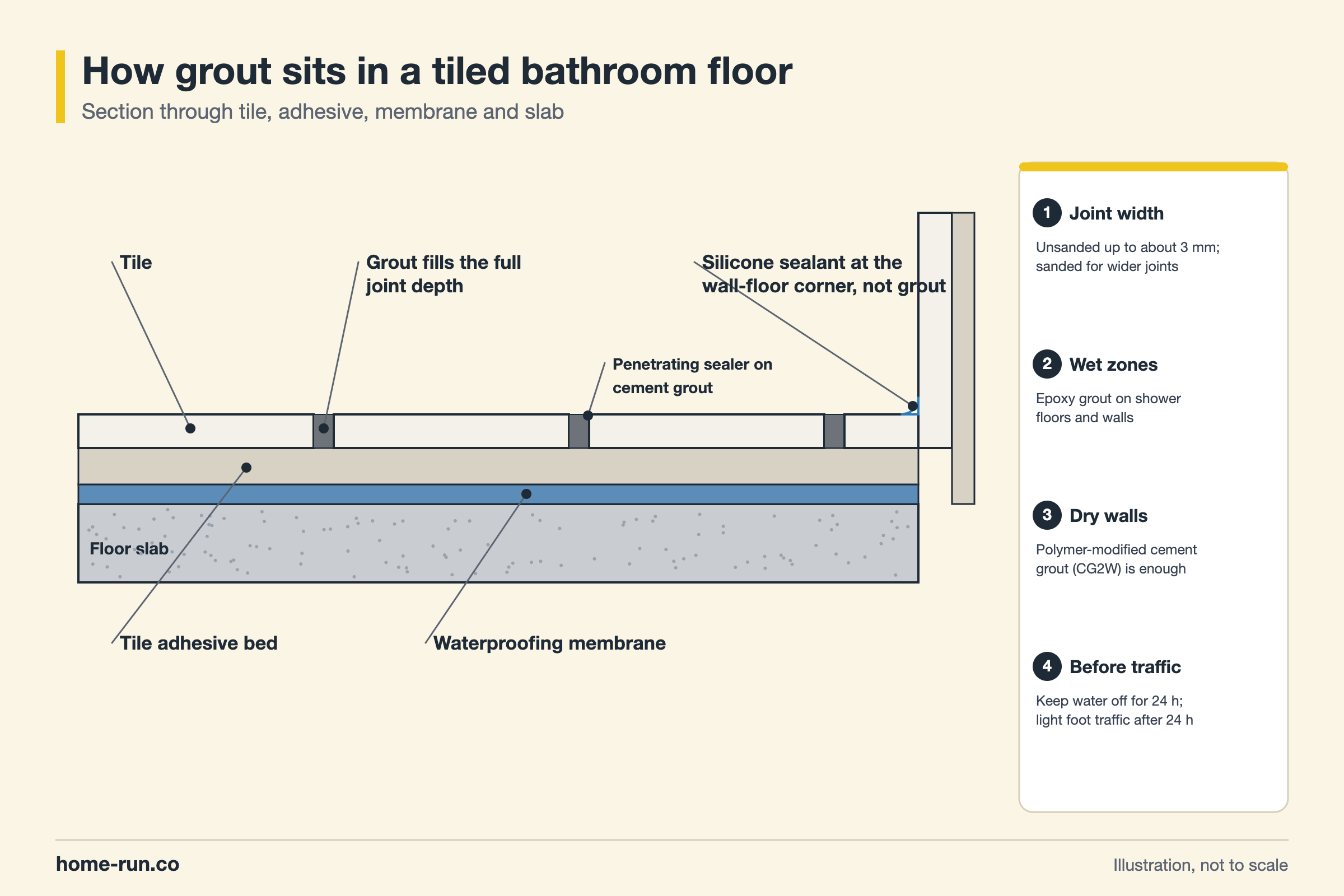
Tools you need: rubber float (a flat rubber pad on a handle), grout sponge, two buckets, a mixing paddle or trowel, a grout rake, gloves and clean water.
- Let the adhesive set. Wait until the tile adhesive has hardened, usually about 24 hours. Check the adhesive pack for the exact time.
- Clean the joints. Rake out spacers, adhesive and dust so the grout fills the full tile depth.
- Mix the grout. For cement grout, add the powder to clean water at the pack ratio. JSW Tylfix, for example, asks for 0.33–0.40 kg of water per 1 kg of powder. Mix to a smooth paste and let it rest a few minutes.
- Work in small areas. Use the mix within its pot life, about 45–60 minutes for cement grout. Epoxy sets faster, so mix one small batch at a time.
- Press the grout in. Hold the rubber float at about 45° and sweep it diagonally across the joints so the grout packs in without being dragged out.
- Wipe the surface. Once the joints firm up, wipe diagonally with a damp, well-wrung sponge. Rinse the sponge often.
- Polish off the haze. Buff the dried film off the tiles with a clean dry cloth.
- Keep it dry. Keep water off the grout for at least 24 hours. JSW allows light foot traffic after 24 hours and regular traffic after 7 days.
- Seal the corners. Fill corners and joints where tiles meet the tub, basin or floor trap with waterproof silicone sealant, not grout.
Adding water to grout that has started to set weakens it and causes powdery, cracked joints. Throw the stiff batch away and mix a fresh one.
How do you replace tile grout in a bathroom?
To replace bathroom tile grout, remove at least 3 mm (1/8 inch) of old grout, or about half the tile depth, with a grout saw or oscillating tool. Vacuum the dust, wipe the joints damp, and regrout with the steps above.
How Do You Seal and Clean Grout Lines?
Seal cement-based bathroom tile grout with a penetrating grout sealer once it has cured, usually after 48 hours, and reseal it about once a year. Epoxy grout does not need sealing.
A penetrating sealer soaks into the grout pores and suits showers. A surface (membrane) sealer can trap moisture in a bathroom, so skip it in wet areas.
- Wait for the cure time on the grout pack before sealing; damp grout makes sealer flake
- Apply sealer with a small brush only on the grout lines, and wipe spills off the tiles
- Test with a few drops of water: they should bead up, or apply another coat
- Clean grout lines weekly with a mild pH-neutral cleaner and a soft brush
- Avoid strong acid cleaners on cement grout; they eat into the joints
- Reseal shower grout yearly, or sooner if water stops beading
For mould in bathroom tile grout, use a diluted bleach-based cleaner in a ventilated room, and never mix bleach with acid cleaners.
What Mistakes Make Bathroom Tile Grout Crack?
Bathroom tile grout cracks mostly from wrong mixing, grouting over a moving base, and using grout where flexible sealant belongs.
- Too much water in the mix: weak, shrinking joints that crack and dust. Measure water by weight.
- Grouting too soon: tiles still moving in wet adhesive crack fresh grout. Wait for the adhesive to set.
- Grout in corners: walls and floors move slightly, so rigid grout cracks at changes of plane. Use silicone.
- Shallow joints: joints filled only at the top crack and wash out. Rake joints clean first.
- Skipping the sealer: unsealed cement grout soaks up soap and water and turns dark.
Where Can You Buy Grout and When Should You Hire a Pro?
You can buy bathroom tile grout from tile shops, hardware stores and online material suppliers in 1 kg and 5 kg packs. Buy all packs from one batch so the colour matches across the room.
A DIY job suits cement grout on a small, sound wall. Hire a trained grouting applicator when:
- You are using epoxy grout for the first time, since it sets fast and leaves haze if wiped late
- Old grout is cracked across a whole floor, or tiles sound hollow when tapped
- The room below shows leaks, which points to a waterproofing fault
Still choosing tiles? Our guide to the types of tiles explains which ones suit bathroom walls and floors.
Grouting your bathroom this week?
Tile grout, epoxy grout, tile adhesive and waterproofing delivered across Bengaluru.