On this page
- What Does a Waterproofing Quote Cover, and Why Do Rates Vary?
- What Factors Affect Waterproofing Cost?
- What Are the Types of Waterproofing and How Much Does Each Cost?
- How Does Waterproofing Cost per Sq Ft Change by Area?
- How Do You Estimate Waterproofing Cost for Your Home?
- What Do Waterproofing Materials Cost on Their Own?
- Is DIY Waterproofing Cheaper Than Hiring a Professional?
- What Hidden Costs Should You Expect in Waterproofing?
- How Do You Get an Accurate Waterproofing Cost Estimate?
- How Does Maintenance Make Waterproofing Last Longer?
- Are There Eco-Friendly Waterproofing Options, and Do They Cost More?
- What Signs Show Your Waterproofing Needs Attention?
- How Should You Budget for a Waterproofing Project?
- The average waterproofing cost in India is about ₹35–250 per sq ft, including material and labour.
- The area sets the band: walls and bathrooms sit low, terraces in the middle, basements at the top.
- The method sets the life: coatings last 3–5 years, membranes 5–10 years, two-part PU up to 15 years.
- Labour is 30–45% of a typical quote, and surface damage can add 20–40% more.
- Compare quotes on the same specification: product, coats, preparation and written warranty.
Waterproofing cost in India is about ₹35 to ₹250 per sq ft, applied, according to Asian Paints' waterproofing cost guide. That works out to roughly ₹375 to ₹2,700 per square metre.
Where your rate falls depends on two things: the part of the house you treat and the method you choose. This guide covers the whole house, from terrace to basement, and shows how to build your own estimate.
What Does a Waterproofing Quote Cover, and Why Do Rates Vary?
A waterproofing cost covers surface preparation, the waterproofing material, its application in coats or sheets, and any protective layer on top. Most contractors quote it as one rate per sq ft of treated area.
Waterproofing is a barrier that stops water entering concrete, plaster or brickwork. Without it, water rusts steel bars, lifts paint and grows mould.
The rate swings widely because a ₹35 job and a ₹250 job are different products. A thin cement coat on a sound wall and a reinforced PU system on a cracked terrace both count as "waterproofing".
The cheapest rate per sq ft is rarely the cheapest job. A coating that fails in three years costs you the work twice, plus the damage in between. Compare cost per year of life as well as cost per sq ft.
What Factors Affect Waterproofing Cost?
Seven factors decide your waterproofing cost: method, area type, surface condition, size, access, material brand and labour rates in your city. Surface condition alone can raise a quote by 20–40%, according to Houseyog's 2026 rate guide.
- Waterproofing method: cementitious coatings cost the least; PU and sheet membranes cost the most.
- Area type: exposed terraces and wet basements need heavier systems than an interior wall.
- Surface condition: cracks, hollow plaster, old failed coatings and active leaks all add preparation work.
- Size: larger areas usually get a lower rate per sq ft, because setup is spread over more work.
- Access: high exterior walls need scaffolding or rope access, which adds labour and safety cost.
- Material brand: branded systems from Dr. Fixit, Asian Paints, Fosroc or BASF MasterSeal cost more but come with data sheets and warranties.
- City labour rates: metro labour runs about ₹20–35 per sq ft, against ₹10–20 in tier-2 and tier-3 cities.
Location matters too. Aecord's 2026 survey puts Bengaluru at ₹45–110 per sq ft, Delhi at ₹40–100 and Mumbai at ₹50–120. Delhi NCR towns such as Gurgaon, Noida, Ghaziabad and Faridabad price close to Delhi, so get local quotes.
Aecord lists a national range of ₹15–150 per sq ft, while Asian Paints and Houseyog start nearer ₹25–35. The lowest figures usually mean material-only or a single coat on a sound surface. Ask what a quote includes before you compare.
What Are the Types of Waterproofing and How Much Does Each Cost?
The main types of waterproofing are cementitious coatings, liquid membranes, bituminous and APP membranes, polyurethane (PU) systems, crystalline treatment and injection grouting. Rates run from about ₹25 per sq ft for an acrylic coat to ₹350 per sq ft for basement injection work.
- Polymer-modified cementitious coating: cement slurry with added polymer for flexibility and grip. It is the common choice under bathroom tiles and inside water tanks.
- APP membrane: a bitumen sheet modified with Atactic Polypropylene (APP), laid by torch. A torch-applied bitumen membrane needs trained crews because of the open flame.
- PU liquid membrane: a rubbery, joint-free coat that bridges hairline cracks and handles sun on exposed terraces.
- Crystalline waterproofing: chemicals that react inside concrete to form crystals that block pores. It works within the concrete, not as a surface film.
- Injection grouting: polyurethane or epoxy grout pumped into cracks and voids to stop active leaks from inside.
Waterproofing cost per sq ft by method
Material and labour, 2026 rates| Method | ₹ per sq ft | Typical life | Best for |
|---|---|---|---|
| Acrylic or polymer coating Budget | ₹25–45 | 3–5 years | Sound terraces, exterior walls |
| Cementitious coating Default pick | ₹35–90 | Not stated by sources | Bathrooms, tanks, sunken slabs |
| Bituminous membrane | ₹80–180 | 5–10 years | Covered roofs, foundations |
| APP membrane, 3 mm | ₹80–130 | 5–8 years | Flat roofs with a protective screed |
| APP membrane, 4 mm | ₹120–160 | 8–10 years | Large flat roofs |
| Liquid membrane | ₹90–220 | Not stated by sources | Terraces, balconies |
| PU, two-component Exposed roofs | ₹200–300 | 10–15 years | Sun-exposed terraces |
| Crystalline | ₹150–320 | Life of the concrete | Basements, sumps |
| Injection grouting | ₹180–350 | Not stated by sources | Active leaks through cracks |
For how each system works and where it suits, see our guide to the types of waterproofing.
How Does Waterproofing Cost per Sq Ft Change by Area?
Waterproofing cost per sq ft is lowest for walls and highest for basements. Asian Paints lists exterior walls at ₹35–100, bathrooms at ₹40–120, terraces at ₹60–250 and basements at ₹120–300 per sq ft.
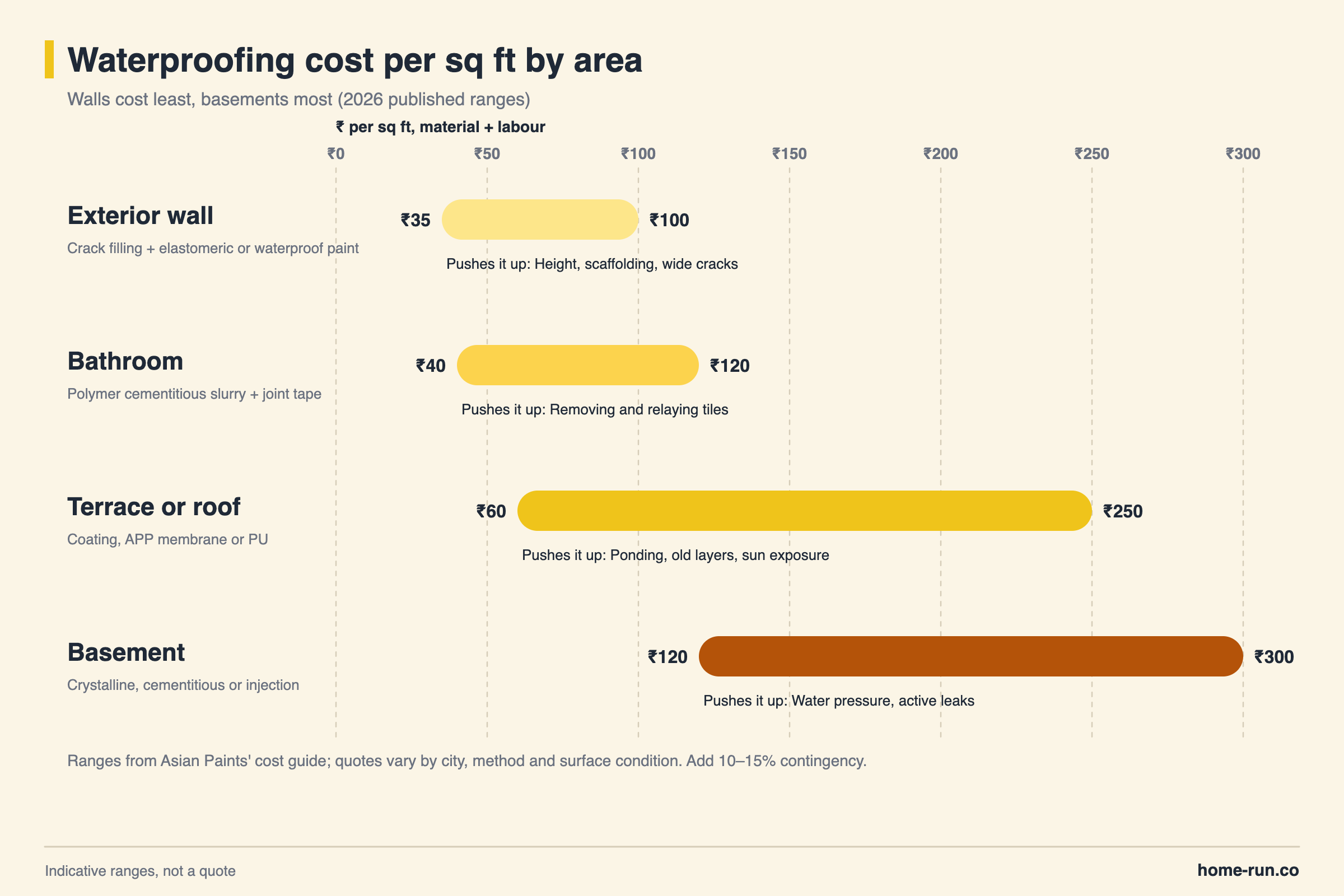
Waterproofing cost by area of the house
₹ per sq ft of treated area| Area | ₹ per sq ft | Usual system | What pushes it up |
|---|---|---|---|
| Exterior wall | ₹35–100 | Crack filling plus elastomeric or waterproof paint | Height, scaffolding, wide cracks |
| Bathroom | ₹40–120 | Polymer cementitious slurry with joint tape | Removing and relaying tiles |
| Terrace or roof | ₹60–250 | Coating, APP membrane or PU | Ponding, old layers to strip, sun exposure |
| Basement | ₹120–300 | Crystalline, cementitious or injection | Water pressure from outside, active leaks |
Two of these areas have their own detailed guides. See terrace waterproofing cost for roof rates by method and city, and our bathroom waterproofing guide for the floor and wall process.
One square metre is 10.764 sq ft. To convert a rate, multiply the ₹ per sq ft figure by 10.764. A ₹100 per sq ft quote equals about ₹1,076 per sq m.
How Do You Estimate Waterproofing Cost for Your Home?
You estimate waterproofing cost by multiplying each area by its rate per sq ft, adding preparation work, then adding 10–15% contingency. Asian Paints suggests that contingency for cracks and repairs found once work starts.
The rates above are mid-points of the published ranges, chosen for illustration. A cracked terrace or a PU system would push the terrace line alone past ₹2,00,000.
Planning waterproofing before the rains?
Waterproofing chemicals, cement and tiles delivered across Bengaluru.
What Do Waterproofing Materials Cost on Their Own?
Waterproofing materials and other non-labour costs make up roughly 55–70% of the applied rate, because labour is 30–45% of a typical quote. Material-only prices help you check a quote, but they leave out preparation, mesh, primer and labour.
- Dr. Fixit Roofseal Ultra, 20 litres: MRP ₹11,330 on the Dr. Fixit website. The maker's theoretical coverage is 1.40 litres per sq m for two coats with glass fibre mesh, so one pail covers about 14.3 sq m (about 154 sq ft).
- Other Roofseal grades, 20 litres: NoBroker lists about ₹7,355 for Classic, ₹7,900 for Select and ₹6,999 for Top Coat, updated November 2026.
- Dr. Fixit LW+ and Raincoat: about ₹250–450 per litre, per Houseyog.
- APP membrane rolls: about ₹1,500–2,800 for 3 mm and ₹2,200–3,400 for 4 mm, per Houseyog.
- PU coatings: about ₹250–450 per kg for single-component and ₹350–600 per kg for two-component.
At ₹11,330 for roughly 154–200 sq ft (the maker's figure and NoBroker's two-coat estimate), Roofseal Ultra works out to about ₹57–74 per sq ft in material alone. Add primer, mesh and labour, and the applied rate lands in the terrace band above.
Is DIY Waterproofing Cheaper Than Hiring a Professional?
DIY waterproofing saves the labour share of 30–45%, but only small, sound surfaces suit it. Terraces with cracks, active leaks and basements need a professional crew and a written warranty.
DIY waterproofing
Small jobsPoints
- You pay for material only, so you save the labour share
- Suits sealing hairline cracks, a balcony or a small sound terrace
- Poor surface preparation is the usual reason DIY coats fail
- No contractor warranty if water comes back
Professional waterproofing
RecommendedPoints
- Labour adds 30–45%, but preparation and coats are done to spec
- Needed for basements, injection grouting and torch-applied membranes
- Crews find the water source before treating the surface
- Written warranty, which Houseyog suggests should be 2–5 years or more
Hire a professional when water is already coming through, when the surface is above one storey, or when the system needs a torch or injection pump.
What Hidden Costs Should You Expect in Waterproofing?
The main hidden costs in waterproofing are surface repair, tile removal, stripping old layers and mould treatment. Aecord's 2026 guide lists these extras per sq ft on top of the base rate.
- Minor crack repair: adds about ₹5–10 per sq ft.
- Extensive structural repair: adds about ₹20–50 per sq ft.
- Surface cleaning and preparation: adds about ₹3–8 per sq ft.
- Mould remediation: adds about ₹15–40 per sq ft.
- Tile removal and relaying: often missing from bathroom and terrace quotes; ask for it as a separate line.
- Repainting or replastering: walls treated from inside usually need fresh finish afterwards.
- Scaffolding: exterior walls above the ground floor need access equipment.
Sumps and overhead water tanks also need waterproofing that is safe for drinking water. Ask the contractor to name the product and confirm it is approved for potable water.
How Do You Get an Accurate Waterproofing Cost Estimate?
You get an accurate waterproofing cost estimate by finding the water source first, then asking two or three contractors to quote on the same written specification. A quote you cannot compare line by line is not a real estimate.
- Find the source. Ask for a site inspection, with a moisture meter if possible, to confirm where water enters.
- Measure the area. Record terrace, bathroom and wall areas in sq ft, including upturns and parapets.
- Fix the specification. Ask each contractor to name the product, number of coats, mesh or membrane thickness and preparation steps.
- Compare like with like. Put the quotes side by side and check every line, including tile work and debris removal.
- Ask for a water test. A ponding test, where water stands on the treated area, should be part of terrace and bathroom work.
- Check references. Visit or call two past clients, ideally from a job done one or more monsoons ago.
- Get the warranty in writing. Note what it covers, how long it lasts and who repairs a failure.
Online tools such as the Asian Paints waterproofing cost calculator give a quick first range. Treat that figure as a starting point, not a quote.
Stages of a typical terrace waterproofing job
Inspect and clean
Find leaks, remove loose screed, moss and old failed coatings.
Repair the surface
Fill cracks, fix slope and drain outlets, round off wall-floor corners.
Prime
Apply the primer the system maker specifies.
Apply the system
Lay coats or membrane, with mesh at joints and upturns.
Cure and test
Let the system cure, then run a ponding test before closing the work.
Protect and hand over
Add screed, tiles or a reflective top coat, and collect the warranty.
How Does Maintenance Make Waterproofing Last Longer?
Regular maintenance keeps a waterproofing system working to the end of its rated life, which lowers its cost per year. Houseyog advises touching up chemical coatings every 3–5 years.
- Clear terrace drains and outlets before the monsoon, so water does not pond.
- Walk the terrace after heavy rain and note any standing water or cracks.
- Reseal gaps around pipes, railings and dish antenna bases each year.
- Recoat or top up coatings at the interval in the product's data sheet.
Bengaluru gets most of its rain in September and October, from about 931 mm a year on the 1901–2000 average. The northeast monsoon adds more in November and December, so plan terrace work for the dry months from January to April.
Are There Eco-Friendly Waterproofing Options, and Do They Cost More?
Eco-friendly waterproofing options include water-based coatings with low solvent content, crystalline treatments and heat-reflective roof coats. Their cost is usually close to conventional systems of the same type.
- Water-based acrylic and PU coatings: fewer solvent fumes during application than solvent-based products.
- Crystalline treatment: no surface film to replace, since it works inside the concrete for its life.
- Heat-reflective top coats: white roof coats such as Dr. Fixit Roofseal Top Coat also cut heat gain on the slab below.
- Integral waterproofing: admixtures added to concrete or mortar at the mixing stage, covered by IS 2645:2003, the Indian standard for integral waterproofing compounds.
Waterproofing during construction costs far less than fixing leaks later, because there are no tiles to remove and no damage to repair. IS 3067:1988, the Indian code of practice for damp-proofing and waterproofing of buildings, sets the preparatory work.
What Signs Show Your Waterproofing Needs Attention?
Your waterproofing needs attention when you see damp patches, peeling paint, mould or water dripping from the ceiling. Acting early keeps the job in the low-cost repair band.
- Damp patches on ceilings or walls: water is getting through the slab or wall.
- Peeling or bubbling paint: moisture is pushing the finish off from behind.
- Black or green mould: the surface stays wet for long periods.
- White salt deposits: water is carrying salts out of the masonry.
- Cracks or standing water on the terrace: the top layer has failed or the slope is wrong.
- Visible leaks after rain: the system has failed and needs repair now.
A fresh coat of paint over a damp patch hides the problem for a few weeks. Fix the water source first. Our guide to water seepage causes and solutions shows how to trace it.
How Should You Budget for a Waterproofing Project?
Budget for waterproofing by pricing each area separately, choosing a method that matches its exposure, and keeping 10–15% aside. Then compare at least two written quotes on the same specification.
- List every area that needs work and measure it in sq ft.
- Match the method to the area, using the cost tables above.
- Add preparation and hidden-cost lines before you total it.
- Schedule the work for the dry season and ask for a written warranty.