On this page
- What Is a Brick Bond in Masonry?
- Why Do Brick Bonds Matter for Wall Strength?
- What Are the 12 Types of Brick Bonds?
- How Do the Types of Brick Bonds Compare?
- How Do You Choose the Right Brick Bond?
- How Is a Brick Bond Laid on Site?
- What Are the Advantages and Limitations of Each Brick Bond?
- Which Brick Bond Mistakes Should You Avoid?
- Every brick bond exists to stop vertical joints lining up in the courses above and below.
- English bond is the default for 230 mm load-bearing walls. Flemish bond looks better on exposed brick.
- Stretcher bond suits 115 mm partitions and most concrete block walls.
- Rat trap bond saves about 25% of bricks and over 30% of mortar, per an Anna University study.
- Herringbone, zigzag and stack bonds are decorative; use them for paving, panels or infill, not loads.
The main types of brick bonds are stretcher, header, English, Flemish, rat trap, garden wall, stack, Dutch, facing, raking, herringbone and zigzag bond. Each one is a fixed way of laying bricks so that the joints in one course never sit directly over the joints in the next.
The bond you choose decides how strong the wall is, how many bricks it needs and how the finished face looks.
What Is a Brick Bond in Masonry?
A brick bond is the pattern in which bricks overlap each other in a wall. The overlap spreads load across many bricks and ties the wall into one unit.
A few site terms come up in every bond:
- Stretcher: a brick laid flat with its long face showing.
- Header: a brick laid flat with its short end showing.
- Course: one horizontal row of bricks.
- Quoin: the outside corner of a wall.
- Closer: a cut piece of brick. A queen closer is a brick cut in half lengthwise, used near corners to keep the pattern correct.
- Bat: a brick cut across its width, such as a half or three-quarter bat.
The Brick Industry Association (BIA), USA, separates the two. A structural bond interlocks bricks so the wall acts as one unit. A pattern bond is only the look of the face. Stack and herringbone are pattern bonds; English and Flemish are both.
For the basics of walls built from brick, stone and blocks, see our explainer on what masonry means.
Why Do Brick Bonds Matter for Wall Strength?
Brick bonds matter because a wall with aligned vertical joints splits along those joints under load. Staggered joints force a crack to zigzag through many bricks, which a well-bonded wall resists.
A good bond also does three jobs that Indian homes need:
- It spreads slab and roof loads evenly down to the footing.
- It ties the two faces of a 230 mm wall together, which helps against wind and minor earth movement.
- It sets the look of exposed brick, which matters for compound walls and jali facades.
IS 2212:1991 calls for vertical joints to be staggered, typically by half a brick. If you can trace one straight vertical joint through two courses on your site, the bond is wrong.
What Are the 12 Types of Brick Bonds?
The 12 types of brick bonds below run from structural workhorses to purely decorative patterns. The first five carry most residential walls in India.
1. Stretcher Bond
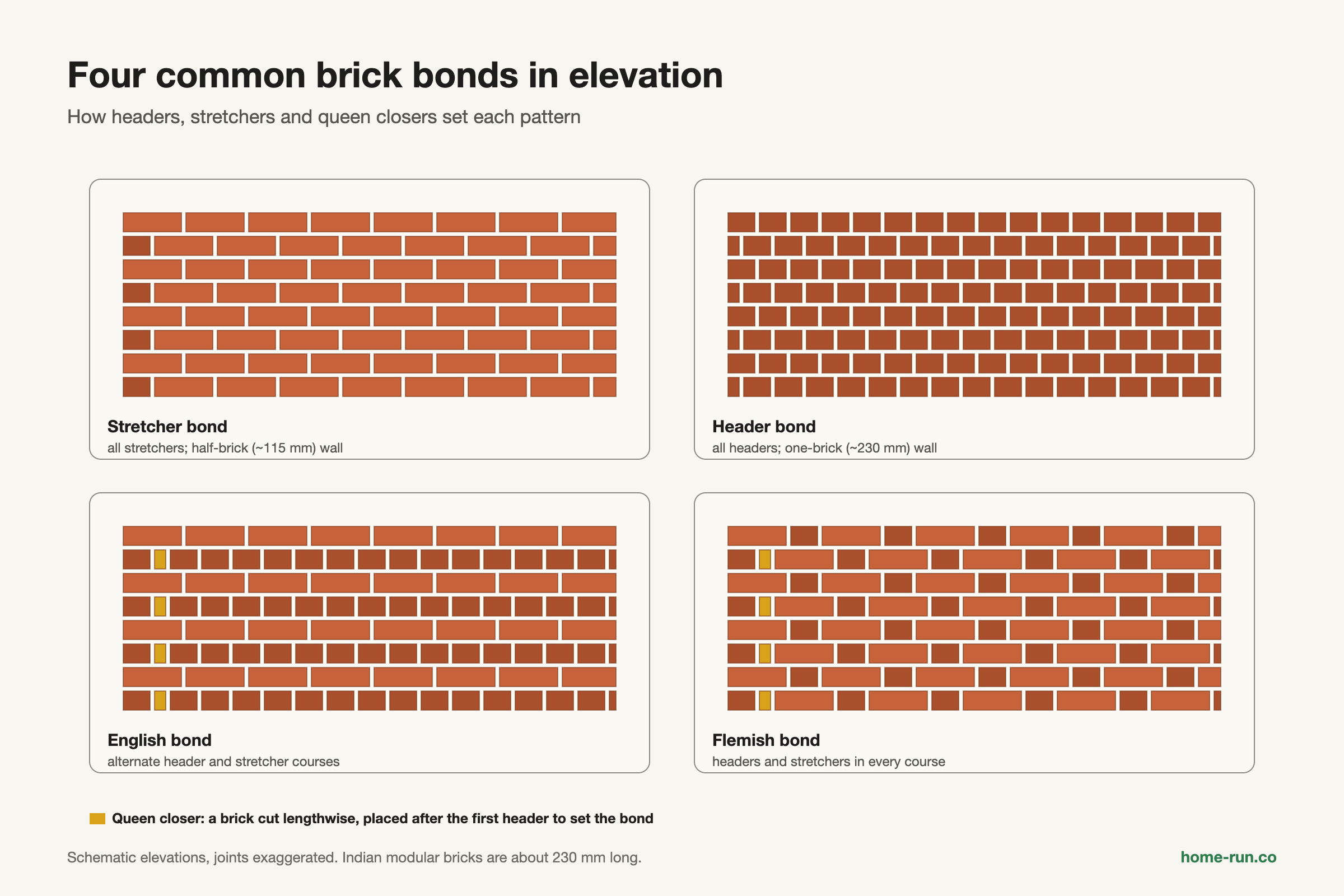
Stretcher bond lays every brick lengthwise, with each course shifted by half a brick. It builds a wall only half a brick thick, about 115 mm with common 230 mm Indian bricks.
Use it for internal partitions, cavity wall leaves and most concrete block walls. It is quick to lay and uses the fewest bricks, but it cannot carry heavy loads on its own.
2. Header Bond
Header bond lays every brick with its short end on the face, and each course shifts by half a header. The wall comes out one brick thick, about 230 mm.
Header bond bends well around tight curves, so masons use it for curved walls, wells and footings. On a straight wall it gives poor strength along the length, so English bond is the better choice there.
3. English Bond
English bond alternates a full course of headers with a full course of stretchers. A queen closer goes next to the corner header in each header course, so the stretchers above lap correctly.
English bond is widely described as the strongest common bond. It is the standard choice for 230 mm external and load-bearing walls in Indian houses, and it needs less skill to keep right than Flemish bond.
4. Flemish Bond
Flemish bond alternates a header and a stretcher within every course. Each header sits centred over the stretcher below, giving a checkered face.
- Double Flemish bond: the pattern shows on both faces of the wall.
- Single Flemish bond: Flemish facing with English bond backing, for walls at least one and a half bricks thick.
Flemish bond looks better than English bond on exposed brick. It needs careful supervision and is less compact, so English bond still wins for heavy loads.
5. Rat Trap Bond
Rat trap bond lays bricks on edge instead of flat, leaving a hollow cavity inside a 230 mm wall. Architect Laurie Baker made it popular in Kerala for low-cost housing.
A study by A.R. Santhakumar and colleagues at Anna University, Chennai, reports about 25% saving in bricks and more than 30% saving in mortar. The study calls the hollow wall well suited to tropical humid climates, as the air cavity slows heat transfer. Keep it to low-rise, lightly loaded homes and get an engineer to confirm.
6. Garden Wall Bond
Garden wall bond uses more stretchers than headers, which saves facing bricks on thin, lightly loaded walls. It comes in two forms:
- English garden wall bond: one header course after every three to five stretcher courses.
- Flemish garden wall bond: one header after every three stretchers in each course, per BIA Technical Note 30.
Use it for compound and boundary walls one brick thick. Our boundary wall design guide covers heights and finishes.
7. Stack Bond
Stack bond stacks every brick directly over the one below, so all vertical joints line up. Nothing overlaps, which makes it the weakest bond here.
The BIA advises steel reinforcement in the bed joints for large wall areas and load-bearing use. Keep stack bond for feature panels, cladding and infill inside an RCC frame.
8. Dutch Bond
Dutch bond, also called English cross bond, is a variation of English bond. The stretcher courses shift by half a brick in alternate rows, so the joints form a diagonal cross pattern.
It keeps the strength of English bond and adds a decorative face. Masons use it mainly on exposed walls where the pattern will show.
9. Facing Bond
Facing bond ties a face of better-looking bricks to a backing of cheaper bricks of a different thickness. A header course is placed after several stretcher courses to lock the two layers.
Use it when you want a premium exposed face without paying for premium bricks right through the wall. Uneven loading between face and backing is its weak point.
10. Raking Bond
Raking bond lays bricks at an angle inside the core of a thick wall, between the two faces. It comes in diagonal and herringbone forms.
The angled bricks add lengthwise strength to walls two or more bricks thick, such as old retaining walls. It is rare in modern homes because RCC handles those loads.
11. Herringbone Bond
Herringbone bond sets bricks at 45 degrees in a V-shaped pattern, each brick butting into the side of the next. It is a pattern bond, chosen for looks.
Use it for paving, driveways, courtyard floors and decorative wall panels. It takes time to set out and creates many cut bricks at the edges.
12. Zigzag Bond
Zigzag bond lays bricks in a continuous zigzag line, much like herringbone but set out in longer runs. It is another decorative pattern.
Masons use it for brick paving and ornamental panels. Like herringbone, it adds no strength, so keep it away from load-bearing walls.
How Do the Types of Brick Bonds Compare?
English and Flemish bond lead on strength, stretcher and rat trap bond lead on brick saving, and the rest are mainly decorative. The table below sums up all 12.
Types of brick bonds compared
Qualitative guide for Indian homes| Bond | Face pattern | Typical wall | Strength | Best use |
|---|---|---|---|---|
| English Default pick | Header course, stretcher course | 230 mm and thicker | Highest | Load-bearing and external walls |
| Flemish | Header and stretcher in every course | 230 mm and thicker | High | Exposed brick facades |
| Stretcher | All stretchers, half-brick offset | 115 mm | Low alone | Partitions, block walls |
| Header | All headers | 230 mm | Medium | Curved walls, footings |
| Rat trap Brick saver | Bricks on edge, hollow core | 230 mm | Medium | Low-rise, low-cost homes |
| Garden wall | Mostly stretchers, few headers | 230 mm | Medium | Compound walls |
| Dutch | English bond with shifted stretchers | 230 mm and thicker | High | Decorative load-bearing walls |
| Facing | Stretchers with periodic header course | Two brick types | Medium | Premium face, cheaper backing |
| Raking | Angled bricks in the core | Two bricks or thicker | High along length | Thick and retaining walls |
| Herringbone | 45-degree V pattern | Paving, panels | Decorative | Floors, driveways |
| Zigzag | Continuous zigzag | Paving, panels | Decorative | Paving, feature panels |
| Stack Not for loads | Joints aligned, no overlap | Cladding, infill | Lowest | Feature panels in RCC frames |
English Bond vs Flemish Bond: Which Should You Pick?
Pick English bond for strength and Flemish bond for looks. Both suit a 230 mm wall.
English bond
StrengthAlternate courses of headers and stretchers.
- Strongest common bond
- Easier for masons to keep correct
- Plainer, striped face
- Best for plastered load-bearing walls
Flemish bond
AppearanceHeader and stretcher in every course.
- Slightly less compact
- Needs careful supervision
- Attractive checkered face
- Best for exposed brick walls
Building brick walls?
Get bricks, blocks, cement and sand delivered across Bengaluru with a GST invoice.
How Do You Choose the Right Brick Bond?
Choose a brick bond by wall thickness first, load second and looks third. Most Indian homes need only two: English bond for 230 mm walls and stretcher bond for 115 mm walls.
- Confirm the wall thickness on the drawing: 115 mm, 230 mm or thicker
- Check whether the wall carries a slab or only its own weight inside an RCC frame
- Decide if the brick face stays exposed or gets plaster
- Match the bond to the brick or block size you will actually buy
- Ask your engineer before using rat trap bond on a load-bearing wall
- Agree the bond and corner details with the mason before work starts
IS 1077 modular bricks measure 190 × 90 × 90 mm (200 × 100 × 100 mm nominal with mortar). Many Indian sites still use non-modular 230 × 110 × 70 mm or 230 × 115 × 75 mm bricks. Compare sizes and grades in our guide to clay bricks.
How Is a Brick Bond Laid on Site?
A mason lays a brick bond by setting out the first course dry, building the corners and then filling between them course by course. Follow these steps to supervise the work.
- Soak the bricks: keep burnt clay bricks in water until air bubbles stop rising, so they do not suck water from the mortar.
- Set out dry: lay the first course without mortar to check the bond and where closers fall.
- Build the corners: raise the quoins a few courses with closers in place, checked with a spirit level and plumb bob.
- Fill between corners: run a line between the quoins and lay each course to it with 10 mm joints.
- Limit the lift: raise no more than 1.5 m in a day, per IS 2212:1991.
- Cure: keep the mortar wet for at least 7 days.
What Are the Advantages and Limitations of Each Brick Bond?
Each brick bond trades strength, brick use, skill and looks against each other. The table lists the main gain and the main catch for each one.
Brick bond advantages and limitations
One main point each| Bond | Main advantage | Main limitation |
|---|---|---|
| English | Best strength for load-bearing walls | Plain look on exposed brick |
| Flemish | Attractive exposed face | Needs skilled, supervised masons |
| Stretcher | Fast and uses the fewest bricks | Only half a brick thick |
| Header | Follows tight curves | Weak along a straight wall |
| Rat trap | Saves about 25% bricks and over 30% mortar | Low-rise use; hollow core limits fixings |
| Garden wall | Saves facing bricks | Lighter walls only |
| Dutch | English bond strength with a pattern | Slower to set out |
| Facing | Premium face at lower cost | Uneven load between layers |
| Raking | Lengthwise strength in thick walls | Rarely needed in RCC homes |
| Herringbone and zigzag | Striking paving and panels | Many cuts, no structural gain |
| Stack | Clean modern grid | No overlap; needs reinforcement or a frame |
Which Brick Bond Mistakes Should You Avoid?
The costliest brick bond mistakes are using a decorative bond for a load-bearing wall and letting vertical joints line up.
Stack, herringbone and zigzag bonds look modern but add no strength. Use them only where an RCC frame or backing wall carries the load.
- Vertical joints lining up in two or more courses
- Header courses starting with a queen closer at the corner
- Dry bricks laid without soaking
- Walls raised more than 1.5 m in a day
- Mixed brick sizes in one wall, which breaks the bond
To judge brick quality before you lay any bond, read our guide to red brick characteristics.