On this page
- What Is a Terracotta Jali Brick?
- Which Terracotta Jali Brick Designs Can You Choose From?
- Where Do Jali Screen Walls Work Best?
- What Sizes and Specs Should You Check?
- Terracotta Jali vs Cement Jali: Which Should You Choose?
- How Many Jali Bricks Do You Need per Square Foot?
- How Are Terracotta Jali Bricks Installed?
- How Do You Maintain a Jali Wall?
- What Affects Terracotta Jali Brick Price?
- A terracotta jali brick is a fired-clay screen block that lets air and light through while giving privacy.
- The common size is 8 × 8 in, about 63 mm thick, but every maker differs, so confirm on the datasheet.
- Jali walls are non-load-bearing; tall or wide screens need RCC columns, bands or a steel frame.
- Plan on about 2.1 pieces per sq ft for a 200 mm block with a 10 mm joint, plus extra for breakage.
- Terracotta wins on weight and unpainted colour; cement jali wins on impact strength.
A terracotta jali brick is a fired-clay block with open patterns that you lay in courses to build a screen wall. The openings pass air and filtered light while blocking direct views.
What Is a Terracotta Jali Brick?
A terracotta jali brick is a kiln-fired clay screen block. "Jali" means net or lattice; "terracotta" means baked earth.
Ordinary bricks are also fired clay, but a solid brick builds a masonry wall that carries load, while a jali brick builds an open screen.
A jali brick or block is about 60–76 mm thick and stacks into a screen. A jali tile is thin, often around 10 mm, and is stuck onto a wall as cladding. Check thickness on the quote.
Which Terracotta Jali Brick Designs Can You Choose From?
Terracotta jali brick designs fall into five pattern families. Trade names such as Pearl, Amber and Zebra differ by maker.
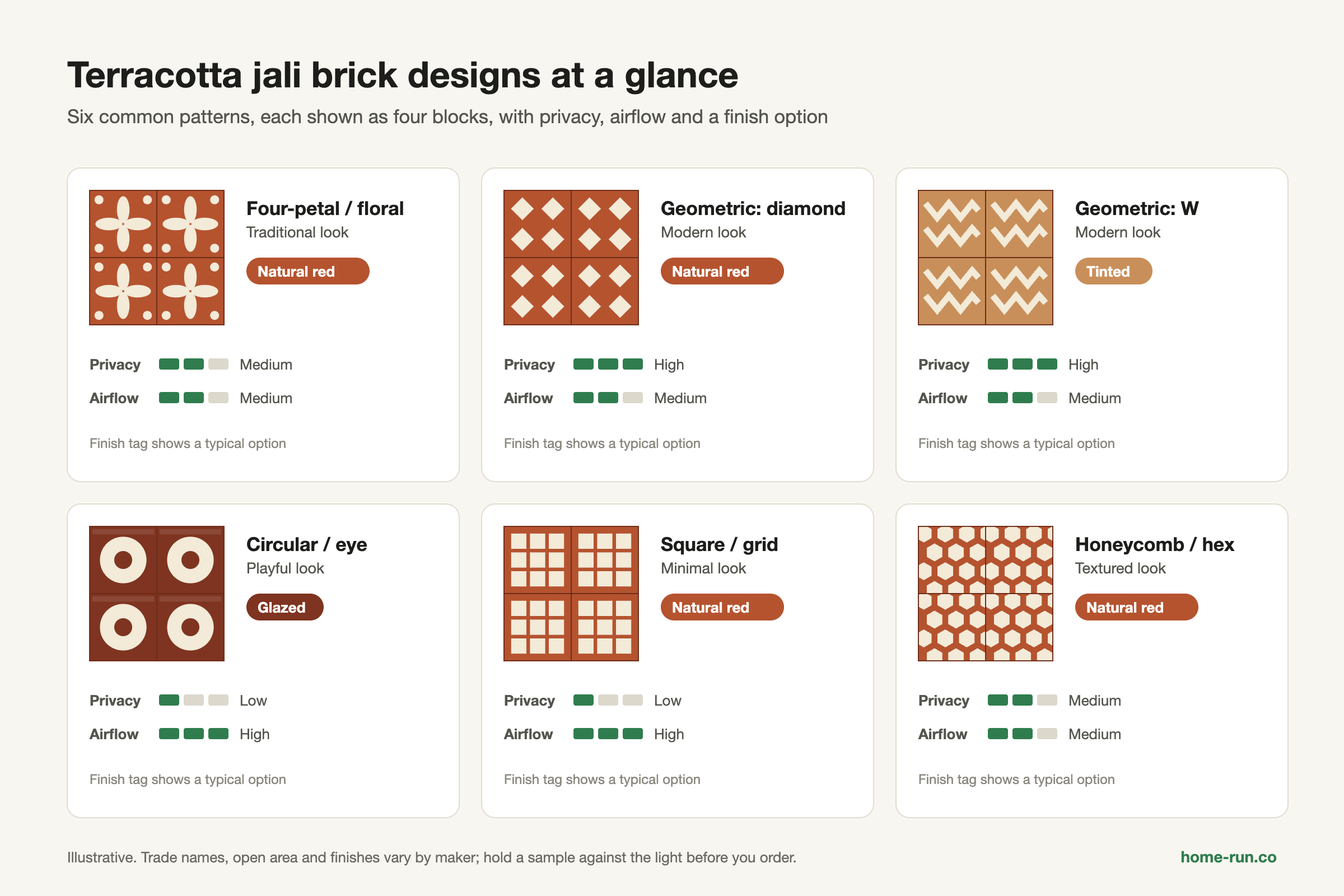
1. Four-petal and floral
Curved cut-outs give a traditional look for entrance walls and balconies.
2. Geometric lines, W and diamond
Angled bars look modern and block direct sightlines best.
3. Circular and eye shapes
Round openings cast bold shadows and pass more air, with less privacy.
4. Square, cube and plain grid
Square openings give the most open area and suit large facades.
5. Honeycomb and hexagonal
Hex cells form an even texture for courtyards and long boundaries.
Terracotta jali pattern families at a glance
Qualitative; open area varies by maker| Pattern family | Look | Privacy | Airflow | Good for |
|---|---|---|---|---|
| Four-petal / floral | Traditional | Medium | Medium | Entrances, balconies |
| Geometric / W / diamond Privacy pick | Modern | High | Medium | Bedrooms, street-facing sides |
| Circular / eye | Playful | Low | High | Staircases, utility areas |
| Square / grid | Minimal | Low | High | Facades, garden walls |
| Honeycomb / hex | Textured | Medium | Medium | Courtyards, boundaries |
Finishes: mostly natural red; some makers offer glazed or tinted blocks.
Where Do Jali Screen Walls Work Best?
Jali walls work best where you want privacy, shade and airflow together.
- Balcony and staircase screens: let breeze in while blocking glare.
- West-facing facades: a jali layer cuts afternoon sun. A 2026 Bengaluru showroom by AD Studio 9 used a full-height terracotta jali front for this.
- Boundary and parapet walls: lighter than concrete, which helps on terraces. See our parapet wall design guide for safe heights.
- Partitions and utility screens: divide rooms or hide tanks and ducts.
What Sizes and Specs Should You Check?
The most common terracotta jali brick size is 8 × 8 inches, about 63 mm thick. Sizes vary by maker, so get these in writing.
Specs to compare across quotes
Typical values from Indian supplier listings, Nov 2026| Spec | Typical in listings | What to ask |
|---|---|---|
| Face size | 200 × 200 mm to 208 × 208 mm | Size tolerance |
| Thickness | 60–76 mm (63 mm most common) | Fit with your frame |
| Weight | About 2.5 kg per piece (one maker) | Weight per piece |
| Water absorption | Rarely stated | Test report in % by weight |
| Compressive strength | Rarely stated | Test report in N/mm² |
As a benchmark, IS 3952 (the Bureau of Indian Standards code for burnt clay hollow bricks for partitions) asks for at least 3.5 N/mm² strength and at most 20% water absorption.
Terracotta Jali vs Cement Jali: Which Should You Choose?
Choose terracotta jali for a lighter screen that needs no paint. Choose cement jali when impact resistance or a pale colour matters more.
Terracotta jali
Default for homesPoints
- Lighter than dense concrete for the same shape
- Colour is fired in, so no repainting
- Brittle; corners chip if dropped
- Can grow moss in damp, shaded spots
Cement jali
TougherPoints
- Heavier, so adds more load to the frame
- Painted versions need repainting every few years
- Resists knocks and breakage better
- Can show white salt marks (efflorescence)
How Many Jali Bricks Do You Need per Square Foot?
You need about 2.1 terracotta jali bricks per square foot for a 200 × 200 mm block with a 10 mm joint.
The 5% wastage is an assumption; confirm it with your mason.
How Are Terracotta Jali Bricks Installed?
Terracotta jali bricks are installed like brickwork, on a level base with cement mortar and a supporting frame.
Prepare the base and supports
Level the sill or beam, mark plumb lines, fix columns or a steel frame.
Lay a level first course
Set damp blocks on a mortar bed along a string line.
Keep joints thin and even
Use the mix your engineer specifies; joints stay visible.
Clean smears while fresh
Sponge mortar off the face and openings before it sets.
Cure the joints
Keep joints damp for about 7 days, then point and seal.
A jali screen carries only its own weight. Set tall or wide panels between RCC columns or in a steel grid, spaced by a structural engineer.
How Do You Maintain a Jali Wall?
You maintain a terracotta jali wall by washing off dust, checking joints after the monsoon and resealing exposed faces.
- Moss and algae: grow on shaded, damp faces in the monsoon.
- Efflorescence: white salt patches mean water is moving through the wall.
- Chipping: clay is brittle; corners break in transit or from knocks.
- Rain entry: add a coping, overhang or drainage.
A clear sealer slows staining. For recurring damp, see water seepage causes and fixes.
What Affects Terracotta Jali Brick Price?
Terracotta jali brick price depends on size, pattern, finish, firing, freight and breakage. Many makers are in Gujarat, so freight to Bengaluru adds cost. Get a written quote.
- Approve a physical sample before a bulk order.
- Ask for one firing batch so the colour matches.
- Confirm the minimum order, packing and breakage terms.
Materials for your jali wall
Mortar and finishing materials, delivered across Bengaluru.