On this page
- What Is a Plumb Bob and How Does It Work?
- What Is a Plumb Bob Used For on Indian Sites?
- How Do You Check a Wall or Column with a Plumb Bob?
- Which Types and Weights Should You Buy?
- How Do You Test a Bob for Accuracy Before Buying?
- Plumb Bob vs Spirit Level vs Laser: Which Should You Use?
- How Much Does a Plumb Bob Cost in India?
- A plumb bob gives true vertical with no batteries.
- Check a wall or column by measuring the string-to-face gap at the top and bottom.
- IS 14687:1999 allows formwork to be off vertical by 6 mm per 3 m of height.
- Spin-test a bob before buying.
A plumb bob is a pointed weight hung from a string, so gravity pulls the string into a true vertical line. Masons, carpenters, engineers and surveyors use it to check walls, columns and frames.
What Is a Plumb Bob and How Does It Work?
A plumb bob works because gravity pulls a hanging weight straight down, towards the nadir (the point directly below). The string then marks true vertical.
Its parts are the bob, pointed tip, cord hole and string. The name comes from the Latin plumbum, lead; Indian masons say sahul.
The bob is the weight; the plumb line is the string and the vertical it shows. "Plumb" means vertical, "level" means horizontal.
What Is a Plumb Bob Used For on Indian Sites?
On Indian sites a plumb bob checks vertical alignment in masonry, concrete and woodwork.
- Brick and block walls
- RCC columns and shuttering (formwork) before the pour
- Door and window frames before fixing
- Lift shafts and staircase walls
- Centring a theodolite or total station over a survey marker
How Do You Check a Wall or Column with a Plumb Bob?
Hang the string a fixed distance off the top, then compare that gap with the bottom gap.
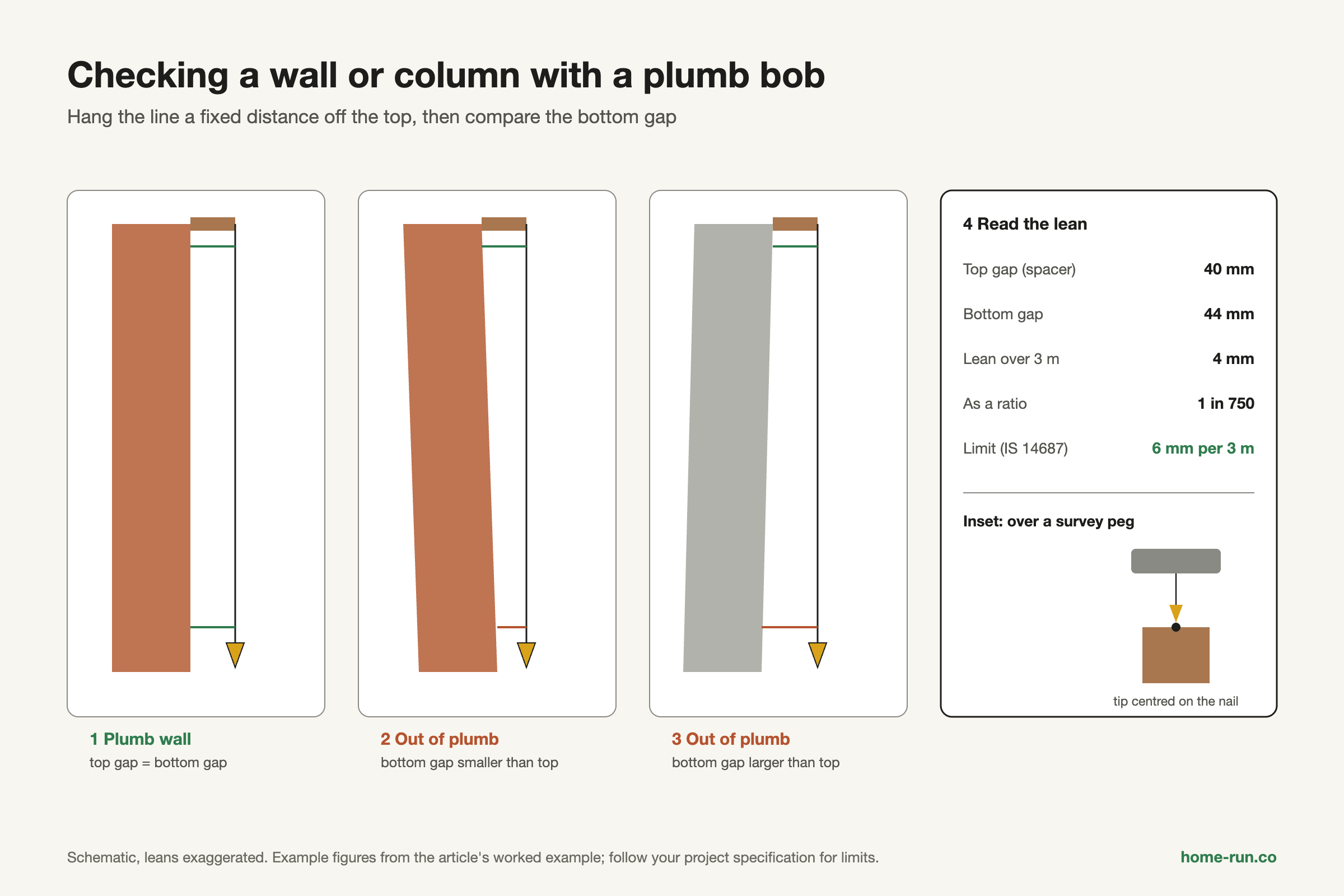
- Fix the string at the top with a nail or a spacer block, for example 40 mm thick.
- Lower the bob until the tip just clears the floor, and let it settle.
- Measure the string-to-face gap at the bottom with a steel tape.
- Equal gaps mean plumb; the difference is the lean.
Specifications often allow brickwork 6 mm per 3 m within a storey and 12.5 mm over the full height. One summary of IS 2212:1991 (load-bearing brickwork code) gives 12.5 mm per 3 m. Follow your project specification.
Which Types and Weights Should You Buy?
Bombay, Jodhpuri and Metro are trade names, not standards, so check the listed weight and material.
Plumb bob types seen in Indian listings
IndiaMART, checked 11 Nov 2026| Type | Material listed | Weights listed | Price tier |
|---|---|---|---|
| Jodhpuri Common | Mild steel or cast iron, conical or oval | 100–400 g | Budget |
| Bombay | Brass-plated | Varies by seller | Budget |
| Metro | Mild steel | 200 g and up | Budget |
| Solid brass Premium | Brass, rust-free | About 450 g (1 lb) | Premium |
| Magnetic | Steel with magnet and line reel | Varies | Mid |
Use a light bob for door frames and indoor checks. Use about 500 g to 1 kg for full-storey columns, shuttering, shafts or wind, with a strong nylon cord.
How Do You Test a Bob for Accuracy Before Buying?
Hang the bob and twist the string: a true tip spins on one point without circling.
- The tip draws a small circle when the bob spins
- Bent or chipped point, or an off-centre cord hole
- "Brass" that a magnet picks up (plated steel)
Plumb Bob vs Spirit Level vs Laser: Which Should You Use?
Use a plumb bob for long vertical runs on a budget and a laser plumb for fast, repeated set-outs. A spirit level suits short checks only.
Plumb bob
Cheap and reliableMasons and small sites.
- True vertical over any height
- No batteries or calibration
- Slow to settle in wind
Laser plumb
FastRepeated floor-to-floor work.
- Quick dot on the ceiling
- Needs charged batteries
- Costs far more
How Much Does a Plumb Bob Cost in India?
Most steel and brass-plated plumb bobs list at about ₹35–120 on IndiaMART; a 1 lb Stanley brass bob lists at about ₹1,537 (checked 11 Nov 2026). Check weight, tip and string on delivery. For daily use by your civil contractor, solid brass lasts longest.
Setting out walls or columns?
Hand tools and materials delivered across Bengaluru.