On this page
- What Is a Stretcher Bond in Brick Masonry?
- Where Is Stretcher Bond Used?
- What Are the Advantages and Disadvantages of Stretcher Bond?
- How Do You Construct a Stretcher Bond Wall?
- What Does IS 2212 Say About Brickwork Practice?
- How Many Bricks Does a Stretcher Bond Wall Need?
- Where Is Stretcher Bond Unsuitable?
- How Does Stretcher Bond Compare With Other Bonds?
- How Do You Maintain and Repair Stretcher Bond Walls?
- Stretcher bond lays only stretchers with a half-brick overlap, giving a 115 mm wall.
- Alternate courses start with a half bat at stopped ends to keep the overlap.
- A half-brick wall takes about 52 bricks per m² with 10 mm joints, plus wastage.
- Use it for partitions and infill, not for thick or load-bearing walls.
Stretcher bond is a brick masonry pattern in which every brick is laid with its long side facing out, and each course sits half a brick along from the one below. It is the bond used for most half-brick partition walls in Indian homes.
This page covers stretcher bond only. For all patterns side by side, see our guide to types of brick bonds.
What Is a Stretcher Bond in Brick Masonry?
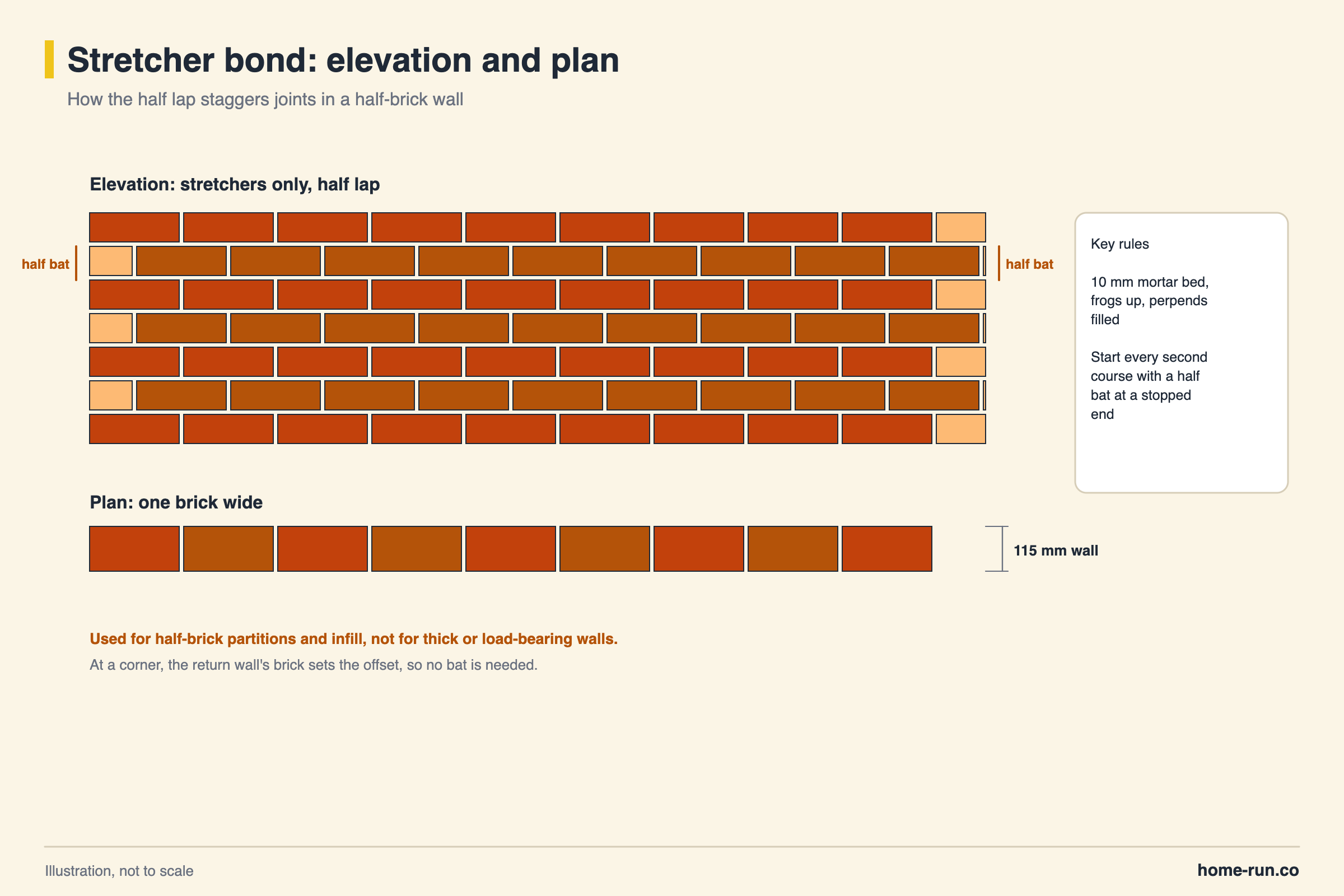
A stretcher bond is a bond made of stretchers only. A stretcher is a brick laid flat with its length along the wall face; a header shows its short end.
Each brick overlaps two bricks in the course below by half its length. This half lap staggers the vertical joints, called perpends, so no joint runs straight up the wall.
The face shows no short ends. With no headers to tie a second line of bricks, the wall is only one brick wide. Builders also call it running bond.
Where Is Stretcher Bond Used?
Stretcher bond is used wherever a wall only needs to be half a brick thick:
- Internal partitions between rooms, bathrooms and wardrobes.
- Infill walls in an RCC (reinforced cement concrete) frame.
- Cavity walls: two leaves joined with metal ties.
- Low garden walls and planters.
Bengaluru homes are mostly RCC-framed, so stretcher bond appears mainly in 4.5-inch partitions.
What Are the Advantages and Disadvantages of Stretcher Bond?
The main advantage of stretcher bond is speed; the main disadvantage is low strength.
Advantages
Partitions- Fast to lay: one repeating move
- Few cut bricks, only half bats at ends
- Saves floor area with a 115 mm wall
- Uses fewer bricks per m² than one-brick walls
Disadvantages
Limits- Only one brick thick, so low stiffness
- Not for heavy or load-bearing walls
- Needs piers, frames or reinforcement when long
- Weak against side loads such as wind
How Do You Construct a Stretcher Bond Wall?
You construct a stretcher bond wall by laying a level course of full stretchers, then starting every second course with a half bat. You need:
- Bricks of one size, such as burnt clay bricks to IS 1077
- Cement and sand mortar; CBRI suggests 1:3 for 115 mm walls
- Trowel, spirit level, plumb bob and mason's line
- 8 mm bars or hoop iron if the wall needs bed reinforcement
- Soak the bricks. CBRI advises watering clay bricks for about 4 hours.
- Lay the first course. Lay full stretchers end to end on a 10 mm mortar bed, frogs up, perpends filled.
- Start the second course with a half bat. At a stopped end, a half bat sets the offset. At a corner, the return wall's brick does this, so no bat is needed.
- Build the ends first. Raise the ends a few courses, racking back (stepping) them, then fill the middle to a line.
- Check every course for level and plumb. Keep bed joints within 12 mm.
- Add reinforcement where specified. CBRI recommends an 8 mm bar in 115 mm walls after every fourth course.
- Rake and cure. Rake joints for plaster, then cure for 7 days.
Dry bricks, hollow perpends, more than 1.2 m of height in a day and skipped curing all weaken a thin wall.
What Does IS 2212 Say About Brickwork Practice?
IS 2212:1991, the Bureau of Indian Standards code of practice for brickwork, sets joint and lap limits that apply to stretcher bond walls.
Brickwork rules relevant to stretcher bond
IS 2212:1991 and CBRI guidance| Item | Requirement | Source |
|---|---|---|
| Bed joint thickness | Not thicker than 12 mm; 10 mm is normal | IS 2212 cl. 6.4.1; CBRI |
| Lap between courses | Cross joints not nearer than ¼ brick length to joints above or below | IS 2212 cl. 6.3.2 |
| 4 courses + 3 joints | 4 × brick thickness + 30 mm (modular: 390 mm) | IS 2212 cl. 6.4.1 |
| Height per day Check | Maximum 1.2 m | CBRI good practice |
| Curing | 7 days | CBRI good practice |
How Many Bricks Does a Stretcher Bond Wall Need?
A stretcher bond wall needs about 52 bricks per m² with 230 mm bricks and 10 mm joints, or 50 with modular bricks.
Bricks per m² in stretcher bond
10 mm joints, before wastage| Brick size (IS 1077) | Face with joints | Wall thickness | Bricks per m² |
|---|---|---|---|
| Non-modular 230 × 110 × 70 mm Most common | 240 × 80 mm | 110 mm (115 mm nominal) | 52 |
| Modular 190 × 90 × 90 mm | 200 × 100 mm | 90 mm (100 mm nominal) | 50 |
A half-brick wall uses about half the bricks and mortar of a one-brick wall, so it also saves kiln energy and transport.
Where Is Stretcher Bond Unsuitable?
Stretcher bond is unsuitable for any wall that must be thicker than one brick or must carry floor and roof loads.
- Load-bearing walls: a 115 mm wall is slender and can buckle. Load-bearing walls are usually 230 mm or thicker, designed to IS 1905, the code for structural masonry.
- One-brick walls: two leaves of stretchers leave a continuous joint down the middle and act as two thin walls.
- Long or tall free-standing walls: CBRI advises keeping the length-to-thickness ratio within 20, or adding pilasters. For 115 mm, that is about 2.3 m between supports.
- Retaining walls: soil pressure needs thicker bonded masonry or RCC.
How Does Stretcher Bond Compare With Other Bonds?
Stretcher bond is the simplest and thinnest bond. English and Flemish bonds mix headers and stretchers to build stronger one-brick and thicker walls.
Stretcher bond vs other brick bonds
Typical Indian practice| Bond | Face pattern | Usual wall thickness | Best for |
|---|---|---|---|
| Stretcher bond This page | All stretchers, half lap | Half brick (115 mm) | Partitions, infill, cavity leaves |
| Header bond | All headers | One brick (230 mm) | Curved walls, footings |
| English bond | Alternate header and stretcher courses | One brick or more | Load-bearing walls |
| Flemish bond | Header and stretcher in each course | One brick or more | Load-bearing, exposed walls |
| Rat trap bond | Bricks on edge with a cavity | One brick (230 mm) | Low-rise walls that save bricks |
To save bricks in a one-brick wall, read about rat trap bond walls.
Half-brick, no load: stretcher bond. One brick or load-bearing: English or Flemish bond. One brick with fewer bricks: rat trap bond.
How Do You Maintain and Repair Stretcher Bond Walls?
You maintain a stretcher bond wall by checking for cracks and loose joints and fixing them early.
- Check for cracks where the wall meets columns and beams.
- Rake out and repoint crumbling joints with fresh cement mortar.
- Stitch wide cracks with mesh or bars across the joint before plastering.
For crack types and fixes, see our wall crack repair guide. Mortar choice is covered in cement mortar properties.
Building a half-brick partition?
Bricks, cement, sand and steel delivered across Bengaluru.