On this page
- What Is Cement Mortar?
- What Are the Properties of Cement Mortar?
- What Is the Right Cement Mortar Ratio for Different Works?
- What Are the Types of Mortar Used in Construction?
- How Do You Mix Mortar on Site, Step by Step?
- What Are the Newer Uses of Mortar in Modern Construction?
- What Are the Advantages and Disadvantages of Cement Mortar?
- How Do You Choose the Right Mortar for Your Project?
- Cement mortar is cement + sand + water. It has no coarse aggregate, which is what separates it from concrete.
- The cement:sand ratio sets strength: 1:3 to 1:4 for foundations and damp work, 1:6 for normal brickwork and internal plaster.
- IS 2250:1981 grades masonry mortar by 28-day compressive strength, from MM 0.7 to MM 7.5 N/mm².
- Mix only what you can use in 30 minutes, and never re-mix stiffened mortar with fresh water.
- Keep brickwork and plaster wet for at least 7 days so the cement can gain strength.
Cement mortar is a workable paste of cement, fine sand and water that hardens to bind bricks, blocks and stones and to form plaster. It is the default masonry and plastering material on Indian sites, including almost every house built in Bengaluru today.
This guide explains the properties of cement mortar, the standard mix ratios, the types of mortar you can choose from and how to prepare a good batch.
What Is Cement Mortar?
Cement mortar is a mix of a binder (cement), a fine aggregate (sand) and water, used to bed masonry units and to coat walls. Once water is added, the cement hydrates and the paste sets into a hard, stone-like layer.
- Cement: usually Ordinary Portland Cement (OPC) or Portland Pozzolana Cement (PPC). The cement is the binder.
- Sand: river sand or manufactured sand (M-sand) that gives bulk and reduces shrinkage. In Bengaluru, most sites now use M-sand, with a finer plastering grade often sold as P-sand.
- Water: clean, drinkable water that starts hydration and makes the mix workable.
Mortar joints between bricks are usually about 10 mm thick. For the bigger picture of how units and joints work together, read our guide to what masonry means.
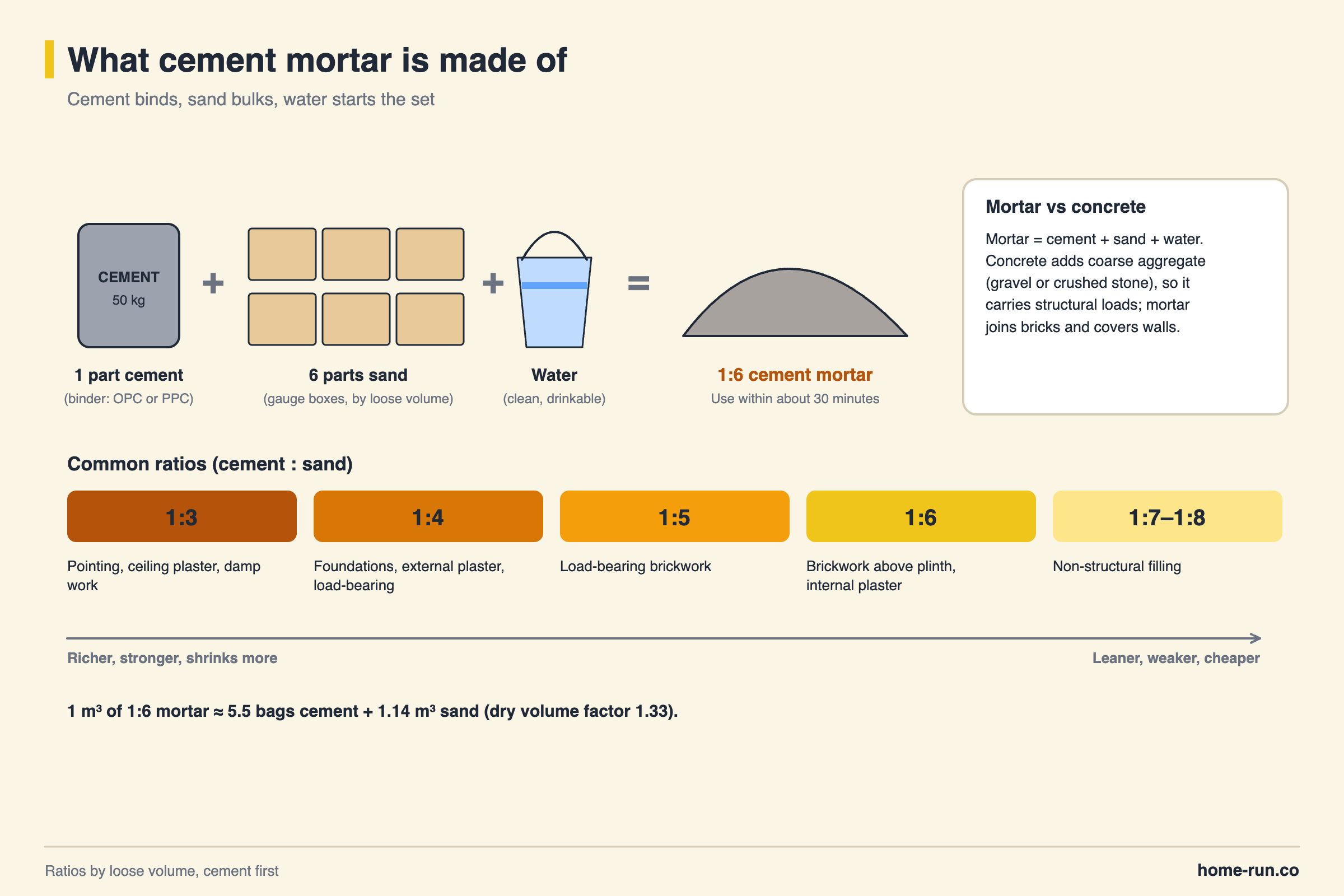
Cement is only the grey powder binder. Mortar is cement plus sand plus water. Concrete adds coarse aggregate (gravel or crushed stone) to that mix, so concrete carries structural loads while mortar joins and covers.
What Are the Properties of Cement Mortar?
The key properties of cement mortar are strength, workability, water retention, setting time and durability. Each one depends mainly on the cement:sand ratio, the sand quality and the water content.
- Compressive strength: the load per unit area mortar can take before crushing, measured on cubes at 28 days in N/mm². Richer mixes are stronger.
- Workability: how easily the mortar spreads and beds bricks. Fine, well-graded sand and the right water content improve workability.
- Water retention: the ability to hold water against absorbent bricks, so the cement does not dry out before it sets.
- Setting time: mortar starts stiffening once cement hydration begins, which is why IS 2250:1981 limits each batch to about 30 minutes of work.
- Bond: how well the mortar sticks to bricks, blocks or the wall. Wetting bricks before laying improves bond.
- Durability: resistance to rain, damp and salts. Cement mortar holds up well in damp conditions where lime mortar softens.
- Shrinkage: cement mortar shrinks as it dries. Very rich mixes shrink more and crack more.
Pick the leanest mortar that meets the strength needed. A joint slightly weaker than the brick lets small movement crack along the joint, which is easy to re-point. A mortar stronger than the brick pushes cracks through the bricks themselves.
What Is the Right Cement Mortar Ratio for Different Works?
The right cement mortar ratio is 1:6 for ordinary brickwork above plinth, 1:4 for external plaster and load-bearing work, and 1:3 for foundations, damp locations and pointing. Ratios are by loose volume, cement first.
IS 2250:1981, the Bureau of Indian Standards (BIS) code of practice for preparation and use of masonry mortars, grades mortar by its minimum 28-day compressive strength. IS 1905, the code for structural use of masonry, refers to IS 2250 for mortar and uses its own grade names.
Cement mortar ratio, grade and common use
Cement:sand by loose volume| Mix (cement:sand) | Typical IS 2250 grade | Min. 28-day strength (N/mm²) | Common use on site |
|---|---|---|---|
| 1:3 Rich | Above MM 7.5 (IS 1905 H1) | 10 | Pointing, ceiling plaster, damp and water-retaining work |
| 1:4 | MM 7.5 (IS 1905 H2) | 7.5 | Foundation and plinth brickwork, external plaster, half-brick walls |
| 1:5 | MM 5 (IS 1905 M1) | 5 | Load-bearing brickwork, internal plaster with coarse sand |
| 1:6 Default pick | MM 3 (IS 1905 M2) | 3 | Brickwork above plinth, internal plaster |
| 1:7 to 1:8 Lean | MM 1.5 to MM 0.7 | 0.7 to 1.5 | Non-structural filling, temporary work |
For the plaster side, our plastering work guide covers coat thickness, surface prep and finishing. Mortar richer than 1:3 is rarely used for normal work because it shrinks and cracks.
What Are the Types of Mortar Used in Construction?
The main types of mortar in construction are cement mortar, lime mortar, cement-lime (composite) mortar, pozzolanic or surkhi mortar, gypsum mortar and polymer-modified mortar. The binder decides how each one behaves.
Types of mortar and their uses
Binder drives strength and setting| Type of mortar | Binder and mix | Strengths | Typical uses in India |
|---|---|---|---|
| Cement mortar Most used | OPC or PPC with sand, 1:3 to 1:6 | High strength, sets fast, good in damp | Brickwork, block work, plaster, pointing |
| Lime mortar | Fat lime or hydraulic lime with sand | Flexible, breathable, slow setting | Heritage repair, lime plaster |
| Cement-lime mortar | Cement, lime and sand, e.g. 1:1:6 or 1:2:9 | Workable, less cracking, good bond | Exposed brickwork, plaster, seismic-zone masonry |
| Surkhi (pozzolanic) mortar | Lime with surkhi (burnt clay powder) or fly ash | Cheap, some water resistance | Older buildings, low-cost masonry |
| Gypsum mortar | Gypsum plaster with sand | Fast setting, smooth finish | Indoor plaster only, never wet areas |
| Polymer-modified mortar Specialist | Cement mortar with SBR or acrylic polymer | Better bond, lower water absorption | Concrete repair, waterproof plaster, tile bedding |
How Do You Mix Mortar on Site, Step by Step?
You prepare cement mortar by measuring cement and sand by volume, mixing them dry until the colour is even, then adding water slowly until the paste is workable. IS 2250:1981 asks for at least 3 minutes of mixing after water is added in a machine.
Tools you need
- Gauge box (measuring box) sized to one 50 kg cement bag, about 0.035 m³
- Clean, hard mixing platform or a mortar pan, or a drum mixer for larger jobs
- Shovel, trowel and a sieve for the sand
- Clean water in a marked bucket so every batch gets the same amount
Mixing steps
- Sieve the sand. Remove clay lumps, roots and oversize stones. Use finer sand for plaster than for brickwork.
- Measure by volume. For a 1:6 mix, use one bag of cement to six gauge boxes of dry sand. Do not measure sand by shovelfuls.
- Dry mix. Turn the cement and sand together on the platform until the colour is uniform, with no grey or brown streaks.
- Add water gradually. Make a hollow in the heap, pour in part of the water and fold the dry mix in. Add more water only as needed.
- Check consistency. Good mortar holds its shape on a trowel, spreads smoothly and does not bleed water. A trowel cut should stay clean-edged.
- Use it quickly. Mix only what the mason can lay in about 30 minutes. Keep the heap covered in hot weather.
Never add water to mortar that has started to stiffen and re-mix it. Discard it instead. Extra water also raises the water-cement ratio and cuts strength, as our water-cement ratio guide explains for concrete.
How much cement and sand does 1 m³ of mortar need?
One cubic metre of 1:6 cement mortar needs about 274 kg of cement (5.5 bags) and 1.14 m³ of sand. The calculation uses a dry volume factor of 1.33, because dry materials shrink in volume once water is added.
Add a wastage allowance on top, typically more for plaster than for brickwork. Some estimators use a factor of 1.27 or 1.30 instead of 1.33, which gives slightly less cement.
What Are the Newer Uses of Mortar in Modern Construction?
Modern construction uses cement mortar in factory-made forms that cut waste and site variation. Bengaluru sites now see these products alongside traditional site-mixed mortar.
- Ready-mix dry mortar: pre-blended cement, graded sand and additives in bags. You add only water, so every batch matches.
- Thin-bed block jointing mortar: used with AAC (autoclaved aerated concrete) blocks. Manufacturers such as Sika specify joints of about 2 to 4 mm instead of the usual 10 mm.
- Polymer-modified cement mortar: adds SBR (styrene-butadiene rubber) or acrylic polymer for repairs, waterproof plaster and bonding coats.
- Sprayed plaster: mortar spraying machines apply plaster faster on large walls and high-rise work.
- Greener mixes: PPC, fly ash and M-sand lower the use of clinker and river sand.
What Are the Advantages and Disadvantages of Cement Mortar?
Cement mortar is strong, quick to set and durable in damp conditions, but it is more rigid, shrinks more and carries a higher carbon footprint than lime mortar.
Advantages
Why it is the defaultPoints
- High compressive strength for load-bearing walls
- Sets in hours, so work moves faster
- Holds up in damp foundations and wet areas
- Cement and sand are easy to buy everywhere
- Ratio can be tuned from 1:3 to 1:8 for each job
Disadvantages
Plan for thesePoints
- Rigid, so cracks appear with wall movement
- Rich mixes shrink and craze as they dry
- Needs 7 or more days of wet curing
- Must be used within about 30 minutes
- Cement production has a high carbon footprint
Signs of a poor mortar batch
- Mortar crumbles or powders when scratched with a key after curing
- Hairline cracks across plaster within the first few weeks
- Hollow sound when you tap plaster, a sign of poor bond
- White salt deposits (efflorescence) from dirty sand or water
- Mortar left over from the morning being re-mixed with water after lunch
Starting brickwork or plaster?
Cement, sand, bricks and blocks delivered across Bengaluru.
How Do You Choose the Right Mortar for Your Project?
You choose the right mortar by matching its strength to the masonry unit, its type to the exposure, and its ratio to the specific work. Use this checklist before you order cement and sand.
- Load: load-bearing walls and plinths need 1:4 or richer; partitions and infill walls work with 1:6.
- Exposure: foundations, parapets and wet areas need cement mortar at 1:3 to 1:4, not lime or gypsum.
- Masonry unit: clay and fly ash bricks take conventional mortar; AAC blocks take thin-bed jointing mortar.
- Bond pattern: the brick bond sets joint layout and mortar use, see our guide to types of brick bonds.
- Finish: 1:4 for external plaster, 1:6 for internal plaster, 1:3 for ceiling plaster and pointing.
- Heritage or lime walls: use lime or cement-lime mortar so the new joint stays softer than the old brick.