On this page
- What Is Rat Trap Bond?
- Who Brought It to India, and Where Is It Used?
- How Is a Rat Trap Bond Wall Built?
- How Much Brick and Mortar Does It Save?
- What Are the Advantages of Rat Trap Bond?
- What Are the Disadvantages and Structural Limits?
- How Does It Compare With English Bond?
- How Do You Maintain a Rat Trap Bond Wall?
- Rat trap bond lays bricks on edge, so a 230 mm wall has an air cavity inside.
- Published studies report 20–25% fewer bricks and about 30% less mortar than a solid wall.
- Laurie Baker made it popular in Kerala; Bengaluru architects still use it for exposed brick.
- Use it for load-bearing homes of up to two storeys, or as infill in an RCC frame.
Rat trap bond is a brick masonry method that lays bricks on edge to leave a hollow cavity inside a 230 mm wall. It uses fewer bricks and less mortar than a solid wall of the same thickness.
Our guide to brick bonds introduces it; this page goes deeper.
What Is Rat Trap Bond?
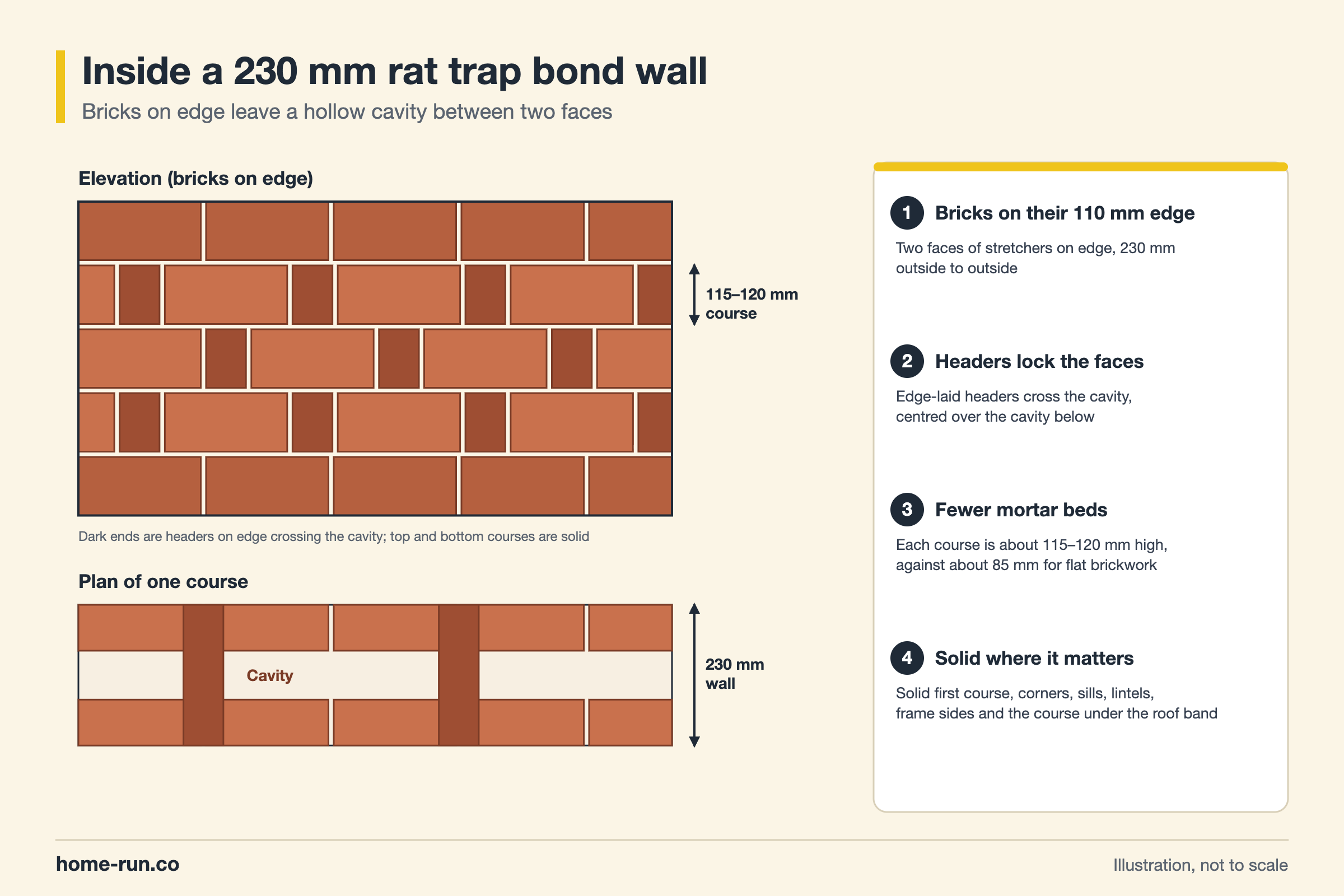
Rat trap bond is a cavity wall built from bricks set on their 110 mm edge instead of flat. Edge-laid headers cross the cavity to lock the two faces.
Each course is about 115–120 mm high, against about 85 mm for flat brickwork, so there are fewer mortar beds.
Who Brought It to India, and Where Is It Used?
Laurie Baker, the British-born architect who settled in Thiruvananthapuram, Kerala, popularised rat trap bond in India. He used it in low-cost homes and received the Padma Shri in 1990.
- Kerala: COSTFORD (Centre of Science and Technology for Rural Development), which Baker directed, carries on his methods.
- Bengaluru: the Brick House by ShoulderTap (2023) uses a rat trap bonded brick jali on its south facade, which its architects say cuts direct sun.
For a pierced-brick look without the cavity, compare terracotta jali bricks.
How Is a Rat Trap Bond Wall Built?
A rat trap bond wall is built from a solid first course, then courses of edge-laid stretchers and headers, with solid sections at openings and junctions.
Materials checklist
- Wire-cut clay or fly ash bricks with straight edges and a strength above 4 N/mm².
- Cement and coarse sand for 1:6 cement mortar, or the mix your engineer specifies.
- Steel and concrete for plinth, lintel and roof bands.
Step-by-step laying guide
- Soak the bricks. Soak clay bricks fully before laying.
- Lay a solid first course. Start above the plinth with a course that has no cavity.
- Set the faces on edge. Lay two rows of stretchers on edge, 230 mm apart outside to outside.
- Lock with headers. Place a header on edge across the wall, centred over the cavity below.
- Keep the cavity clean. Slide a wooden strip along the cavity so no mortar drops in.
- Make junctions solid. Fill corners, T-junctions, sills, lintels and frame sides with bricks on edge.
- Plan services early. Run conduits through the cavity as you build.
- Close the top and cure. Finish with a solid course under the roof band, and cure for 7 days.
Build solid masonry below plinth level. Bricks in the ground draw up water.
How Much Brick and Mortar Does It Save?
Rat trap bond saves about 20–25% of bricks and 30% of mortar in most published figures. Solid courses and junctions reduce this, so sources differ.
Reported rat trap bond savings
Against a solid 230 mm wall| Source | Bricks saved | Mortar saved |
|---|---|---|
| Santhakumar et al., Anna University | 25% | Over 30% |
| BMTPC (central government body) | 1 in every 3 | 1 bed per 230 mm height |
| Practitioner estimates | 20–25% | Not given |
| HomeRun geometry check Plain wall | ≈ 18% | Not calculated |
Prices are InfraLens Bengaluru rates for 9 × 4 × 3 in red clay bricks, May 2026. Solid courses will cut this saving.
What Are the Advantages of Rat Trap Bond?
The main advantages of rat trap bond are lower material cost, a lighter wall and a cooler interior in warm, humid climates.
- Less material: fewer bricks and mortar beds per square metre of wall.
- Lighter wall: the Anna University study reports 20% less dead load and foundation cost.
- Better insulation: one design simulation found a 15% lower U-value (heat flow through the wall) and 8% lower cooling energy.
- Fair faces: both faces can stay exposed, so plaster can be skipped.
What Are the Disadvantages and Structural Limits?
Rat trap bond walls are weaker than solid walls, so they suit low-rise buildings with short spans. In Anna University tests, rat trap specimens failed at 1.21 N/mm² against 1.56 N/mm² for English bond, and carried about half the load.
- Height: BMTPC advises no more than two floors; some designers allow three with full engineering.
- Span: the study recommends wall spans under 3.5 m between cross walls.
- Skill: uneven bricks or careless masons leave weak headers and mortar-filled cavities.
- Earthquakes: plinth, lintel and roof bands are needed, detailed to IS 4326, the Indian code for earthquake-resistant buildings.
How Does It Compare With English Bond?
English bond is stronger, while rat trap bond is cheaper and cooler at the same 230 mm thickness.
Rat trap bond
Low-rise, budgetPoint
- About 20–25% fewer bricks
- Air cavity improves insulation
- Exposed faces, little plaster
- Up to two storeys load-bearing
English bond
Heavy loadsPoint
- Full brick count, solid wall
- No cavity, more heat gain
- Usually plastered both sides
- Higher strength for taller walls
Planning a rat trap bond wall?
Bricks, cement and sand delivered across Bengaluru.
How Do You Maintain a Rat Trap Bond Wall?
A rat trap bond wall needs dry feet, sealed joints and a protected top to last. Repoint open joints and cap the wall top before the monsoon, and use deep eaves to keep rain off exposed brick.
Have an engineer who knows rat trap bond confirm storeys, spans and bands. Our clay bricks guide explains how to check bricks.