On this page
- What Is a Concrete Mix Ratio and What Do the Numbers Mean?
- What Do Concrete Grades Like M10, M15 and M20 Mean?
- Nominal Mix vs Design Mix: Which One Do You Need?
- Concrete Mix Ratio Chart: M5 to M40 by Volume
- Which Concrete Mix Ratio Should You Use for Slabs, Columns, Footings and Floors?
- Why Does the Water-Cement Ratio Decide Concrete Strength?
- How Do You Calculate Cement, Sand and Aggregate for a Mix?
- How Should Concrete Be Mixed, Placed and Cured on Site?
- What Mixing Mistakes Weaken Concrete on Site?
- How Can You Check Your Contractor Is Using the Right Mix?
- A concrete mix ratio lists cement : sand : coarse aggregate, usually by volume.
- The M grade is a strength target in N/mm² at 28 days, not the ratio itself.
- IS 456 allows fixed (nominal) ratios only up to M20; higher grades need a design mix.
- Reinforced members in a house need at least M20 under IS 456.
- Water is controlled separately: extra water weakens any ratio.
A concrete mix ratio is the proportion of cement, sand and coarse aggregate in a batch of concrete. A 1:2:4 mix, for example, uses 1 part cement, 2 parts sand and 4 parts stone chips by volume.
This guide explains the standard concrete mix ratio for each grade, where each one is used in a house, and how to calculate materials.
What Is a Concrete Mix Ratio and What Do the Numbers Mean?
A concrete mix ratio is a recipe for the dry ingredients of concrete. The three numbers always follow the same order.
- First number, cement: the binder that hardens with water.
- Second number, sand: fine aggregate, river sand or manufactured sand (M-sand).
- Third number, coarse aggregate: crushed stone, called jelly in Bengaluru, usually 20 mm.
Water is not part of the written ratio. It is set separately as the water-cement ratio, covered below.
A 1:2:4 mix measured in boxes is not 1:2:4 in kilograms. Cement, sand and stone have different densities. Damp sand also swells, so a box of wet sand holds less sand than it seems.
What Do Concrete Grades Like M10, M15 and M20 Mean?
A concrete grade is the strength the mix must reach. In M20, "M" stands for mix and "20" is the characteristic compressive strength of 20 N/mm² (newtons per square millimetre, the same as MPa).
- Characteristic strength (fck): the value below which no more than 5% of test results may fall.
- Test specimen: a 150 mm cube, crushed after 28 days of curing.
- Why 28 days: concrete keeps gaining strength for weeks, and 28 days is the agreed benchmark.
IS 456:2000, the Bureau of Indian Standards code for plain and reinforced concrete, sets the minimum grades. Reinforced cement concrete (RCC, concrete with steel bars) needs at least M20 even in mild exposure.
OPC 43 and OPC 53 describe the strength of the cement itself. They are not concrete grades. You can make M20 concrete with either.
Nominal Mix vs Design Mix: Which One Do You Need?
A nominal mix uses a fixed volume ratio such as 1:1.5:3. A design mix is proportioned by weight from lab tests on your actual cement, sand and aggregate, following IS 10262, the Indian guideline for concrete mix proportioning.
Nominal mix
Small house jobsFixed ratio, batched by volume on site.
- Allowed up to M20 under IS 456
- No lab trials needed
- Uses more cement to cover variation
- Quality depends on site discipline
Design mix
M25 and aboveLab-proportioned, batched by weight.
- Required for M25, M30, M40
- Trial batches set the recipe
- Often less cement for the same strength
- Usually supplied as ready-mix concrete
If your drawing says M25 or higher, do not mix by boxes. Order ready-mix concrete (RMC) by grade from a plant.
Concrete Mix Ratio Chart: M5 to M40 by Volume
The standard concrete mix ratio chart below covers nominal mixes from M5 to M20. M25 and above are design mixes, so they have no fixed ratio.
Concrete mix ratio table by grade
Cement : sand : aggregate, by volume| Grade | Ratio | Cement bags / m³ | Typical use |
|---|---|---|---|
| M5 | 1 : 5 : 10 | 2.8 | Lean filling, mass work |
| M7.5 | 1 : 4 : 8 | 3.4 | PCC bed under footings |
| M10 | 1 : 3 : 6 | 4.4 | PCC levelling, floor base |
| M15 | 1 : 2 : 4 | 6.3 | Floors, paths, plain concrete |
| M20 House RCC | 1 : 1.5 : 3 | 8.1 | Slabs, beams, columns, footings |
| M25 Design mix | 1 : 1 : 2 (indicative only) | Per mix design | RCC in moderate exposure |
| M30 to M40 Design mix | No fixed ratio | Per mix design | Severe exposure, tanks, larger buildings |
As the grade rises, the ratio holds less sand and stone per part of cement. Cement per cubic metre nearly triples from M5 to M20.
A 1:2:3 mix is not one of the IS 456 nominal ratios, so it has no fixed M grade. It holds about 7.4 bags of cement per m³, between M15 and M20.
For grade-specific quantities, see the M20 concrete ratio guide and the M15 concrete mix ratio and quantities.
Which Concrete Mix Ratio Should You Use for Slabs, Columns, Footings and Floors?
Use M20 (1:1.5:3) or higher for every reinforced part of a house, and leaner mixes only for plain concrete beds and floors. Your structural engineer's drawing always overrides a general table.
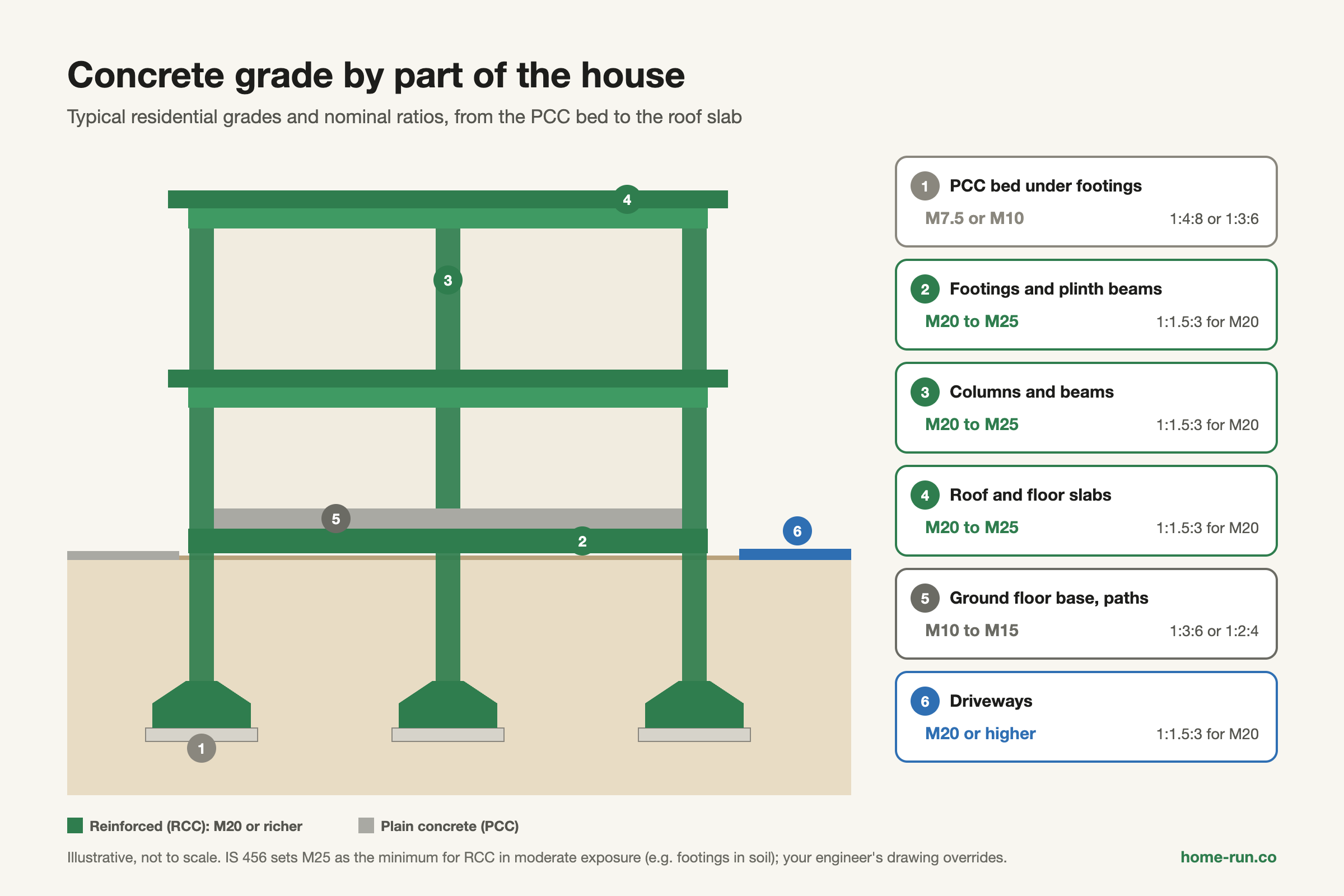
Concrete mix ratio by part of the house
Typical residential practice| Element | Typical grade | Nominal ratio | Why |
|---|---|---|---|
| PCC bed under footings | M7.5 or M10 | 1:4:8 or 1:3:6 | Clean, level base for steel; carries little load |
| Footings and plinth beams | M20 to M25 | 1:1.5:3 for M20 | RCC buried in soil; IS 456 rates this moderate exposure |
| Columns and beams M20 minimum | M20 to M25 | 1:1.5:3 for M20 | Main load path of the building |
| Roof and floor slabs | M20 to M25 | 1:1.5:3 for M20 | Thin RCC members that must resist cracking |
| Ground floor base, paths | M10 to M15 | 1:3:6 or 1:2:4 | Plain concrete under tiles or for light foot traffic |
| Driveways | M20 or higher | 1:1.5:3 for M20 | Vehicle loads and weather |
Brickwork mortar and wall plaster use only cement and sand, with no coarse aggregate. A two-number ratio such as 1:6 is a mortar mix, not a concrete mix ratio.
Steel matters as much as the mix in RCC. Read our guide to TMT bars for house construction before you buy reinforcement.
Casting a slab or footing in Bengaluru?
Order concrete materials with a GST invoice and delivery across Bengaluru.
Why Does the Water-Cement Ratio Decide Concrete Strength?
The water-cement ratio (w/c) decides strength because surplus water leaves pores when it dries out. Lower w/c gives denser, stronger and more durable concrete, as long as the mix can still be compacted.
IS 456 limits for reinforced concrete
Table 5, 20 mm aggregate| Exposure | Max free w/c | Min cement (kg/m³) | Min grade |
|---|---|---|---|
| Mild (indoor, protected) | 0.55 | 300 | M20 |
| Moderate (buried in soil, sheltered from rain) | 0.50 | 300 | M25 |
| Severe (heavy rain, wet and dry cycles) | 0.45 | 320 | M30 |
A stiff mix tempts workers to add a bucket of water. Ask for a plasticiser or superplasticiser admixture instead. These chemicals improve flow without raising the water-cement ratio.
How Do You Calculate Cement, Sand and Aggregate for a Mix?
Multiply the wet concrete volume by 1.54 to get dry volume, then split it by the ratio. The factor covers voids between dry particles that close up once water is added.
Volume batching uses gauge boxes; weight batching uses scales and is more accurate. Damp sand can bulk by 20 to 40%, so volume batching with wet sand gives a leaner mix than planned.
How Should Concrete Be Mixed, Placed and Cured on Site?
Batch with the same measures every time, mix until the colour is even, compact well and keep the concrete wet for at least 7 days.
- Measure: use a gauge box sized to one 50 kg bag, about 35 litres, never shovel counts.
- Mix dry, then wet: blend cement, sand and aggregate first, then add measured water.
- Place quickly: pour before the mix starts to stiffen, and avoid dropping concrete from height.
- Compact: use a needle vibrator to remove trapped air around the steel.
- Cure: start once the surface has set, by ponding, wet hessian or sprinkling.
Pour and compact
Cast test cubes from the same batch.
Start curing
Keep the surface wet; do not load the slab.
OPC minimum curing
Well-cured concrete is at roughly 70% of its 28-day strength.
PPC or hot weather
IS 456 asks for at least 10 days with blended cement; extend to 14 in dry heat.
Grade strength
Cubes are crushed to confirm the M grade.
What Mixing Mistakes Weaken Concrete on Site?
Most weak concrete on house sites comes from a few repeat errors, each with a visible sign.
- Eyeballed batching: shovel counts instead of boxes give uneven strength from batch to batch.
- Too much water: the mix bleeds, the surface dusts and fine cracks appear.
- Dirty sand or silty aggregate: weak bond between paste and stone.
- Oversized stone in thin sections: honeycombing around steel bars.
- Poor compaction: voids and exposed aggregate after formwork removal.
- Skipping curing: surface cracks and low cube results.
How Can You Check Your Contractor Is Using the Right Mix?
Ask for a slump test on the day of the pour and cube tests at 7 and 28 days. Both are simple and cheap compared with repairing a slab.
- Slump test: fresh concrete fills a 300 mm cone (200 mm base, 100 mm top) in layers, each rodded 25 times with a 16 mm rod. The drop after lifting the cone is the slump.
- Typical slump: about 25 to 75 mm for slabs, beams, columns and footings; 50 to 100 mm for heavily reinforced sections.
- Cube test: 150 mm cubes, cured in water and crushed at an accredited lab under IS 516.
- Which grade does the structural drawing specify for each member?
- What size are the gauge boxes, and is one box equal to one bag?
- Is the sand washed and the aggregate 20 mm graded?
- Who casts the cubes, and which lab will test them?
- How many days of curing are planned, and who will do it?
Next step: confirm the grade with your engineer, then get quantities and a price list for cement, sand and aggregate.