On this page
- What Is the M30 Concrete Ratio, and Why Isn't It a Fixed 1:1:2?
- M30 vs M20, M25 and M35: How Do the Grades Compare?
- How Is an M30 Mix Designed Under IS 10262?
- M30 Concrete Ratio per m³: How Much Cement, Sand and Aggregate?
- How Do You Convert the M30 Concrete Ratio to Site Batching?
- Which Cement, Sand and Aggregate Suit an M30 Mix?
- What Water-Cement Ratio, Cement Content and Slump Does M30 Need?
- Where Is M30 Concrete Used, and Does Your House Need It?
- What Does M30 Concrete Cost per m³ in Bengaluru?
- Ready-Mix or Site-Mixed: How Do You Place and Check M30?
- How Do You Test and Cure M30 So It Reaches 30 N/mm²?
- What Mistakes Stop M30 From Reaching Its Grade?
- M30 is a design mix. IS 456 allows fixed nominal ratios only up to M20.
- Quoted ratios like 1:1:2 are indicative only.
- Our IS 10262 worked mix needs 395 kg cement (7.9 bags), 671 kg sand and 1,203 kg aggregate per m³.
- Keep the water-cement ratio at 0.45 or lower; use a superplasticiser for flow, not water.
- Confirm every M30 mix with trial cubes before the first pour.
The M30 concrete ratio is not one fixed recipe. M30 is a design mix, so its cement, sand and aggregate quantities are worked out by weight under IS 10262 from your actual materials, then confirmed with trial cubes.
What Is the M30 Concrete Ratio, and Why Isn't It a Fixed 1:1:2?
M30 is a concrete grade whose 150 mm test cubes must reach a characteristic compressive strength of 30 N/mm² (30 MPa) after 28 days. "M" stands for mix.
Characteristic strength (fck) is the value below which no more than 5% of cube results should fall.
- Nominal mix: fixed volume proportions, such as 1:1.5:3 for M20.
- Design mix: quantities by weight, calculated from tested materials to hit a target strength.
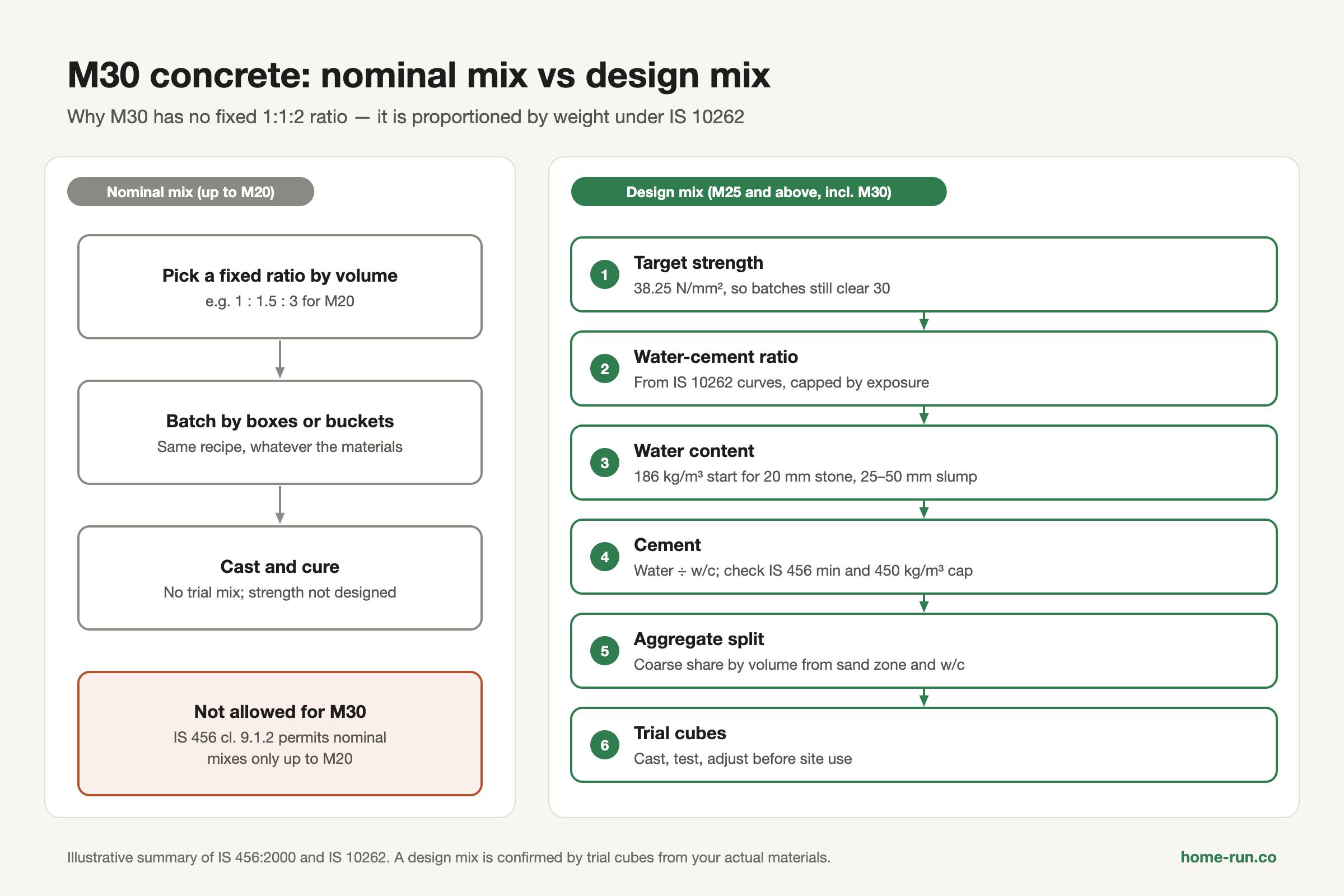
IS 456:2000, the Indian code for plain and reinforced concrete, permits nominal mixes only for grades up to M20 (clause 9.1.2). M30 must be a design mix, proportioned to IS 10262, the Bureau of Indian Standards (BIS) guideline for concrete mix design.
Run 1:1:2 through the dry-volume method used in our M20 concrete ratio guide and it needs 554 kg of cement per m³ (11.1 bags). 1:0.75:1.5 needs 682 kg. Both exceed the 450 kg/m³ cement cap in IS 456, which is set to limit shrinkage cracking.
M30 vs M20, M25 and M35: How Do the Grades Compare?
M30 sits above the common house grades. Grades up to M20 can use nominal ratios; M25 and above are designed mixes.
Concrete grades from M10 to M35
Ratios by volume where nominal| Grade | Mix type and ratio | Cement (bags/m³) | Minimum RCC grade for | Typical use |
|---|---|---|---|---|
| M10 | Nominal 1:3:6 | 4.44 | Plain concrete only | Levelling, bed concrete |
| M15 | Nominal 1:2:4 | 6.34 | Plain concrete only | PCC under footings, floors |
| M20 | Nominal 1:1.5:3 | 8.06 | Mild exposure | Low-rise house slabs, beams, columns |
| M25 | Design mix (1:1:2 often quoted) | Varies | Moderate exposure | Multi-storey frames, buried RCC |
| M30 This guide | Design mix (1:1:2 or 1:0.75:1.5 quoted) | 7.9 (example) | Severe exposure | Columns, rafts, tanks, coastal RCC |
| M35 | Design mix | Varies | Very severe exposure | Marine and aggressive conditions |
How Is an M30 Mix Designed Under IS 10262?
An M30 mix is designed by setting a target strength above 30 N/mm², choosing a water-cement ratio, then calculating water, cement and aggregate by absolute volume.
- Set the target strength: 38.25 N/mm², so normal batch variation still clears 30.
- Choose the water-cement ratio (w/c): water weight ÷ cement weight, read from IS 10262 strength curves and capped by the IS 456 exposure limit.
- Estimate water: IS 10262 starts at 186 kg/m³ for 20 mm angular aggregate at 25–50 mm slump. Add 3% for every extra 25 mm of slump.
- Calculate cement: water ÷ w/c. Check it against the IS 456 minimum and the 450 kg/m³ maximum.
- Split the aggregates: IS 10262 gives the coarse aggregate share by volume for the sand zone and w/c. For 20 mm stone with Zone II sand it is 0.62 at w/c 0.50, plus 0.01 for every 0.05 drop in w/c.
- Trial and adjust: cast trial cubes, test them and adjust before site use.
M30 Concrete Ratio per m³: How Much Cement, Sand and Aggregate?
Our worked M30 design needs about 395 kg of cement (7.9 bags), 671 kg of sand, 1,203 kg of 20 mm aggregate, 158 litres of water and 3.2 kg of superplasticiser per m³.
A superplasticiser is a chemical admixture (IS 9103) that makes concrete flow with less water.
Without the admixture, the same 197 kg of water at w/c 0.40 would need 493 kg of cement, above the 450 kg cap. That is why most M30 mixes use a superplasticiser.
M30 quantities from the worked design
Saturated surface-dry aggregate, before wastage| Material | Per m³ | Per cubic foot | Per 50 kg cement bag |
|---|---|---|---|
| Cement (OPC 53) | 395 kg | 11.2 kg | 50 kg |
| Sand (Zone II) | 671 kg | 19.0 kg | 85 kg |
| 20 mm aggregate | 1,203 kg | 34.1 kg | 152 kg |
| Water | 158 L | 4.5 L | 20 L |
| Superplasticiser | 3.16 kg | 0.09 kg | 0.4 kg |
How Do You Convert the M30 Concrete Ratio to Site Batching?
Weigh-batch M30 wherever you can, because volume boxes cannot hold a design mix accurately. If you must batch by volume, convert each kilogram figure using the loose bulk density of your own materials.
- Take the per-bag weights: 50 kg cement, 85 kg sand, 152 kg aggregate, 20 L water.
- Weigh one level 35-litre gauge box of your sand and of your aggregate.
- Divide the per-bag weight by the box weight to get boxes per bag.
- Example at an assumed 1,600 kg/m³ sand and 1,500 kg/m³ aggregate: about 1.5 boxes of sand and 2.9 boxes of aggregate per bag.
The box count can look like M20's 1:1.5:3. The difference is 20 litres of water per bag instead of 25–27.5, made workable by the admixture.
Damp sand can take up 20–40% more volume than dry sand, so a box of wet sand holds less sand. Test bulking each morning (IS 2386 Part 3) and cut the added water for the moisture the sand already carries.
Which Cement, Sand and Aggregate Suit an M30 Mix?
OPC 53, clean graded M-sand or river sand, and 20 mm crushed angular stone suit most M30 mixes. Any change in material means a change in the mix design.
Material choices for M30
What each choice changes| Material | Option | Effect on the M30 mix |
|---|---|---|
| Cement Common pick | OPC 53 (IS 12269) | Faster early strength; standard for design mixes |
| Cement | PPC (IS 1489) or fly ash / GGBS blends | Slower strength gain, longer curing; GGBS is slag powder that replaces part of the cement |
| Fine aggregate | M-sand vs river sand | Different grading and water demand; test against IS 383 |
| Coarse aggregate | 20 mm crushed angular stone | Rounded gravel needs less water; flaky or dusty stone needs more |
What Water-Cement Ratio, Cement Content and Slump Does M30 Need?
M30 used in severe exposure needs a water-cement ratio of 0.45 or lower and at least 320 kg of cement per m³, as per IS 456 Table 5. In practice, M30 mixes run at about 0.38–0.45.
IS 456 Table 5 limits for reinforced concrete
20 mm aggregate| Exposure | Min. cement (kg/m³) | Max. w/c | Min. grade |
|---|---|---|---|
| Mild | 300 | 0.55 | M20 |
| Moderate | 300 | 0.50 | M25 |
| Severe M30 | 320 | 0.45 | M30 |
| Very severe | 340 | 0.45 | M35 |
| Extreme | 360 | 0.40 | M40 |
IS 456 suggests these slumps (cone test) for workability:
- 25–75 mm: lightly reinforced slabs, beams, footings and floors.
- 50–100 mm: heavily reinforced slabs, beams, walls and columns.
- 75–100 mm: pumped concrete.
Need more flow? Raise the superplasticiser dose with the supplier, never the water.
Where Is M30 Concrete Used, and Does Your House Need It?
M30 is used where exposure, loads or water contact need more than M20 or M25. Most low-rise homes in mild exposure are fine with M20 or M25, unless the structural drawing says otherwise.
- Columns and transfer beams in taller frames
- Rafts and footings in aggressive soil or high groundwater
- Water tanks and sumps (IS 3370 sets M30 as the minimum for reinforced liquid-retaining work)
- RCC exposed to coastal air or wetting and drying
M20 or M25 is usually enough
Typical houseInland, low-rise, mild exposure.
- G+1 or G+2 slabs, beams and columns
- Normal spans
- Interior RCC away from water
- Small site-mixed pours
Choose M30
Engineer specifiesHarsher exposure or heavier loads.
- Severe exposure under IS 456
- Water tanks, sumps and basements
- Taller frames or long spans
- Ready-mix pours with cube records
M30 RCC is usually paired with Fe500 or Fe500D TMT bars. Fe500D has higher ductility for earthquake zones. In severe exposure, IS 456 asks for 45 mm of nominal cover, held with cover blocks.
What Does M30 Concrete Cost per m³ in Bengaluru?
Ready-mix M30 cost about ₹6,380–7,040 per m³ in Bengaluru in May 2026, according to InfraLens. That is roughly 15% above M20 at the midpoints.
M30 cost signals, Bengaluru
Check live quotes before ordering| Item | Price | Basis |
|---|---|---|
| RMC M20 | ₹5,500–6,160 / m³ | InfraLens, 22 May 2026 |
| RMC M30 This grade | ₹6,380–7,040 / m³ | InfraLens, 22 May 2026 |
| Cement for site-mixed M30 | ₹3,040–3,360 / m³ | 7.9 bags × ₹385–425 (OPC 43, Apr–May 2026) |
| Superplasticiser | ₹380–705 / m³ | 3.16 kg × ₹121–223/kg (InfraLens) |
Buy materials against your M30 mix design
Cement, M-sand, 20 mm aggregate and TMT bars delivered across Bengaluru with a GST invoice.
Ready-Mix or Site-Mixed: How Do You Place and Check M30?
Use ready-mix concrete (RMC) or a mechanical mixer for M30. Hand mixing cannot hold a low water-cement ratio and an admixture dose consistently.
When an RMC truck arrives, check:
- The delivery ticket shows grade M30, quantity and batching time
- The slump at the truck matches the order
- No water is added at site without the supplier's approval
- Cubes are cast from this load for testing
Place without dropping from a height, then compact with a needle vibrator to avoid honeycombing.
How Do You Test and Cure M30 So It Reaches 30 N/mm²?
You test M30 by crushing 150 mm cubes at 7 and 28 days (IS 516). The 28-day result decides acceptance.
Cast cubes
Take samples at the pour: one sample of 3 cubes for 1–5 m³, two for 6–15 m³, three for 16–30 m³.
Demould and cure
Move cubes to water curing. Start curing the structure once the surface has set.
Early check
Indicative only. Cubes often reach about 65–70% of 28-day strength with OPC.
Minimum curing ends
7 days for OPC, 10 days for PPC or mineral admixtures, as per IS 456. Extend in hot, dry weather.
Acceptance test
Each sample ≥ 26 N/mm² (fck − 4). Mean of four ≥ 34 N/mm² or 30 + 0.825 × standard deviation, whichever is higher.
In Bengaluru's March to May heat, pour early and shade fresh concrete. In the monsoon, cover fresh slabs against rain.
If cubes fail, ask your structural engineer about core tests before breaking anything out.
What Mistakes Stop M30 From Reaching Its Grade?
Extra water, skipped trials and poor curing cause most M30 failures. Watch for:
- Water added at the mixer or truck to "help it flow"
- Volume ratios used with no mix design sheet
- Muddy sand or flaky aggregate
- Honeycombing, segregation or bleeding after placing
- Surface dusting or low 7-day cube results
Your next step: get an M30 design mix from a lab or RMC plant, then buy cement, sand and aggregate that match it.