On this page
- What Is a Hoe Tool and What Is It Used For?
- What Are the Main Types of Hoe Blade Shapes?
- Draw Hoe vs Push Hoe: Which Weeds Faster?
- How Do You Mix Mortar with a Mortar Hoe?
- What Are the Indian Equivalents of a Hoe Tool?
- Which Hoe Tool Should You Choose for Your Garden?
- How Do You Use a Hoe Garden Tool Without Back Strain?
- How Do You Buy a Good Hoe in India?
- How Do You Maintain a Hoe Tool?
- Manual Hoe or Power Weeder: When Should You Upgrade?
- A hoe tool is a long-handled tool with a thin, flat blade, used to weed, loosen soil, make furrows, earth up plants and dig root crops.
- Blade shape and motion decide the job: draw hoes chop and pull, push and stirrup hoes slice weeds just under the surface.
- A mortar hoe is a square draw hoe with large holes in the blade, made for hand-mixing mortar and concrete.
- The khurpi is India's short-handled weeding tool; the kudal or guddali is the heavy digging hoe.
- Work soil when it is moist but not sticky, keep the blade sharp and oil it in Bengaluru's monsoon months.
A hoe tool is a long-handled hand tool with a thin, flat blade set at an angle to the handle. You use it to cut weeds, loosen soil and shape the ground for planting.
On a building site, one hoe does a different job: the mortar hoe mixes cement, sand and water by hand. This guide covers both uses, blade by blade.
What Is a Hoe Tool and What Is It Used For?
A hoe tool is used for five main jobs in the garden and field:
- Weeding: cutting weeds off at the root, or stirring the soil surface so seedlings die.
- Loosening soil: breaking the crust on beds so water soaks in.
- Making furrows: drawing narrow drills (shallow planting lines) for seeds.
- Earthing up: pulling soil around the base of plants such as potatoes.
- Digging root crops: lifting potatoes and similar crops.
Every hoe has three parts: the blade, the neck or socket that joins it to the handle, and the handle (shaft). The angle between blade and handle sets how deep the blade bites.
Why is it called a hoe? The word comes from Middle English howe and Anglo-French houe, of Germanic origin. Merriam-Webster dates the noun to the 14th century.
Hoes are older than the plough. Wikipedia notes they may have been preceded only by the digging stick.
What Are the Main Types of Hoe Blade Shapes?
The main hoe types are draw, push (Dutch), stirrup, collinear, digging (grub) and ridging hoes, plus the mortar hoe for site work. Each blade shape suits one motion.
Hoe types and blade shapes at a glance
Names overlap by region; check the picture before you buy| Hoe type | Blade shape | Motion | Best job |
|---|---|---|---|
| Draw hoe Default pick | Flat, set at roughly a right angle to the handle | Chop and pull | Chopping weeds, moving and shaping soil |
| Dutch (push) hoe | Flat, sharp on every side | Push and pull just under the surface | Fast weeding between rows, standing upright |
| Stirrup / hoop hoe | Double-edged loop, 8–18 cm wide | Push-pull, often oscillating | Young weeds in loose, friable soil |
| Collinear hoe | Narrow, razor-sharp strip | Sweeping slice | Precise weeding close to crops |
| Digging / grub hoe Heavy duty | Heavy, broad, straight edge | Chop downward | Breaking hard ground, cutting roots |
| Warren (ridging) hoe | Pointed or heart-shaped | Draw along a line | Seed furrows and shallow trenches |
| Mortar hoe Site work | Square draw blade with large holes | Push, pull and chop through the mix | Hand-mixing mortar and concrete |
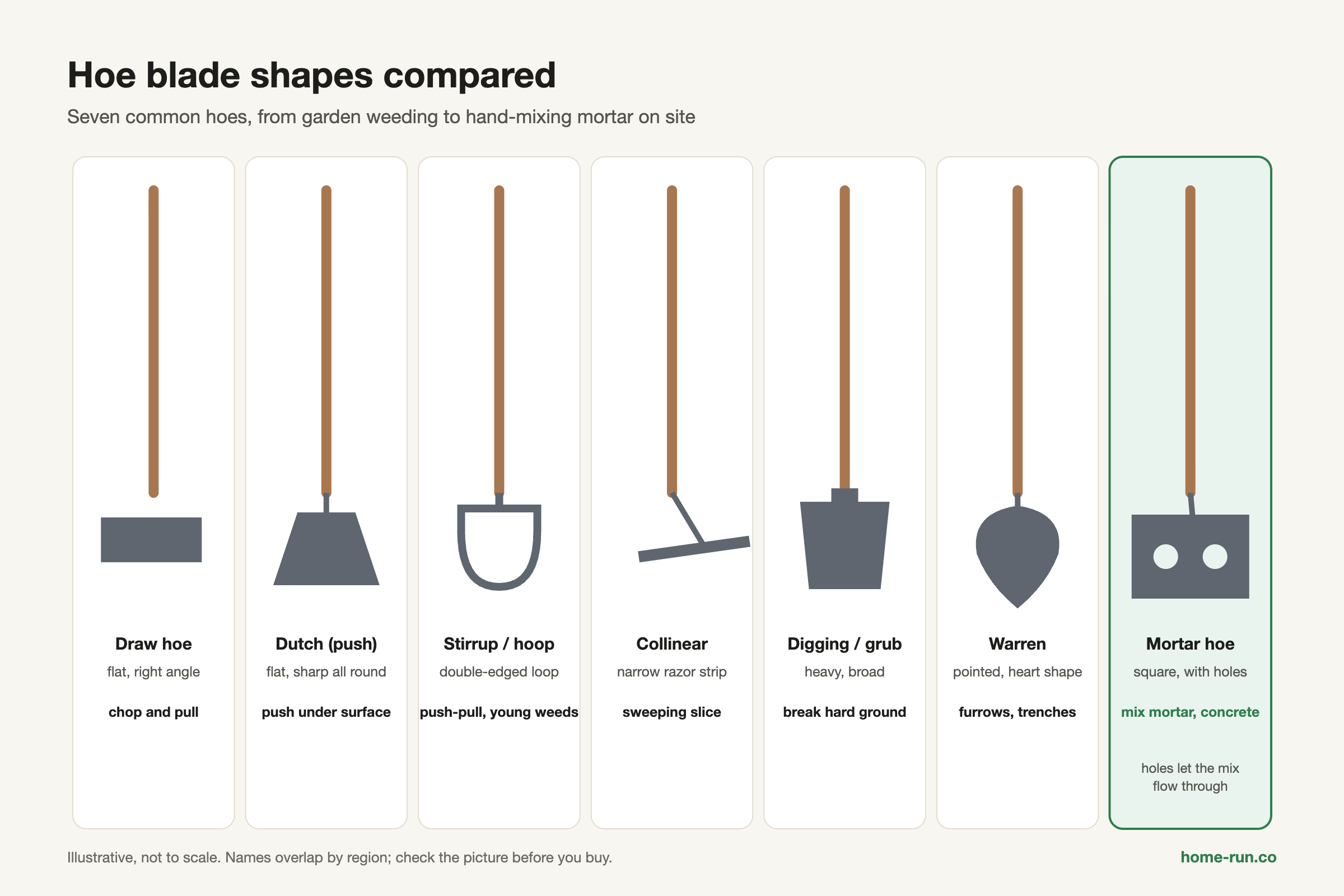
A weeding hoe is light and thin-bladed. A grub hoe (also sold as an azada or Italian hoe) is heavy and broad. A mattock is heavier again and usually carries a second axe or pick edge. Buy by weight and blade, not by name.
Draw Hoe vs Push Hoe: Which Weeds Faster?
A push (Dutch) hoe weeds faster on loose, lightly weeded beds. A draw hoe is better when weeds are bigger or the soil needs moving.
Draw hoe
All-rounderPoints
- Chops into the soil and pulls toward you
- Moves soil for earthing up and furrows
- Handles bigger weeds and firmer ground
- You walk forward onto the hoed soil
Push (Dutch) or stirrup hoe
Fast weedingPoints
- Glides just under the surface, both directions
- Poor at moving soil
- Best on young weeds in loose soil
- You walk backward, off the cleared soil
How Do You Mix Mortar with a Mortar Hoe?
You mix mortar with a mortar hoe by dry-blending cement and sand first, then adding water and working the batch with push-pull strokes. The holes in the blade let the mix flow through, so it blends with less effort.
A typical long-handled model, the Kraft Tool BC228, has a 10 × 6 inch blade with two holes on a 66 inch wooden handle.
- Set up on a clean, non-absorbent surface: a steel tray, mortar tub or a wheelbarrow. Never mix straight on soil.
- Measure cement and sand in the ratio your mason or engineer specifies, by volume with the same box or pan.
- Dry-mix with the hoe, pulling and pushing until the colour is even with no streaks.
- Make a hollow in the middle and add water a little at a time.
- Chop and pull from the edges into the centre until the mortar is smooth and holds its shape on a trowel.
- Mix only what the team can lay before the mortar starts to stiffen.
Wet cement is alkaline and can burn skin. Wear gloves, boots and eye protection, and wash splashes off with clean water. Do not add extra water later to loosen stiffening mortar; it weakens the joint.
Hand-mixed mortar goes into brick and block walls, plaster and small repairs. Our guide to masonry and its types explains where each mortar is used.
Cement and site supplies for your mortar job
Order cement, blocks and hardware with a GST invoice and delivery across Bengaluru.
What Are the Indian Equivalents of a Hoe Tool?
The Indian equivalents of a hoe tool are the khurpi for close weeding and the kudal (guddali in Kannada) for heavy digging. Local names vary by state, so one word can mean different tools.
Indian tools mapped to hoe types
Regional names overlap; confirm locally| Indian tool | Closest hoe type | Handle and posture | Main job |
|---|---|---|---|
| Khurpi / khurpa | Hand hoe (short) | Short handle, used squatting | Weeding along ridges and vegetable rows |
| Kudal / kodali (Hindi) | Digging or grub hoe | Long handle, stooping or standing | Digging, earthing up, breaking hard soil |
| Phawda (Hindi) | Spade-like hoe | Long handle, standing | Moving soil and cutting channels |
| Guddali (Kannada) | Heavy digging hoe | Long handle, standing | Loosening soil, gathering mud, weeding |
Is a hoe the same as a spade? No. A spade blade runs in line with the handle and is pushed into the soil with your foot. A hoe blade sits across the handle and is swung or pulled.
Which Hoe Tool Should You Choose for Your Garden?
Choose a hoe tool by setting first, then by soil. Your local Krishi Vigyan Kendra (KVK, the district farm advisory centre) can fine-tune this.
- Terrace and pot gardens: a khurpi or small hand hoe.
- Vegetable beds and row crops: a push, stirrup or collinear hoe for weekly weeding.
- Hard red soil or black cotton clay: a heavier draw hoe or kudal, worked when the soil is just moist.
- Sandy soil: a light push hoe; heavy blades sink and waste effort.
- Construction site: a mortar hoe, kept only for mixing.
Hoe a day or two after rain or watering, when a handful of soil crumbles instead of smearing. Wet clay sticks to the blade; dry clay bounces it off.
How Do You Use a Hoe Garden Tool Without Back Strain?
Use a hoe garden tool with your back straight, hands spread along the handle and the blade kept shallow.
- Pick a handle long enough to stand upright; a short handle forces you to stoop.
- Stand with feet shoulder-width apart and hold the handle with your thumbs up, hands well apart.
- Keep the blade just below the surface for weeding. Deeper cuts damage crop roots and bring up new weed seed.
- Draw hoe: chop and pull toward you. Push or stirrup hoe: glide back and forth while stepping backward.
- Leave cut weeds on the surface to dry on a sunny day, and take short breaks on long sessions.
How Do You Buy a Good Hoe in India?
Buy a hoe with a forged steel blade, a tight socket and a handle that suits your height.
- Blade: forged or heat-treated steel with an even edge; avoid thin pressed sheet.
- Joint: a socket or tang that does not wobble when you twist the blade.
- Handle: straight-grained wood, fibreglass or steel, with no cracks.
- Balance: lift it like you would use it; a weeding hoe should feel light.
- Finish: a rust-resistant coating or paint on the blade.
Skip a listing that shows these warning signs:
- No blade material or dimensions given
- Huge "MRP" discounts on a very low price
- Photos that do not match the hoe type in the title
Prices range widely. One Indian store listed a Falcon FGHS-10 hand hoe at ₹210, while Moglix listed a Wolf Garten HU-M10 10 cm hoe at ₹2,323 including GST (both checked November 2026).
How Do You Maintain a Hoe Tool?
Maintain a hoe tool by cleaning, drying, sharpening and oiling it after use.
- Scrape off soil and wash off mortar the same day, before cement sets on the blade.
- Dry the blade and wipe on a thin coat of oil, especially in Bengaluru's humid monsoon months.
- Touch up the cutting edge with a flat file, filing the bevelled side only.
- Tighten or replace a loose or cracked handle before it gives way.
- Hang tools in a dry place, away from damp walls and cement bags, with other site tools like your spirit level.
Manual Hoe or Power Weeder: When Should You Upgrade?
A manual hoe is enough for home gardens and small plots. Larger rows justify a wheel hoe, and field-scale weeding a power weeder or mini tiller.
A wheel hoe is a hand-pushed frame with one or more wheels and a blade, so you weed standing up with less effort. Power weeders are engine-driven and cost far more to buy and run.
The central Sub-Mission on Agricultural Mechanization (SMAM) and Karnataka's Krishi Yantra Dhare custom hiring centres help farmers buy or rent machines. Confirm current eligibility and support with your Raitha Samparka Kendra or KVK.