On this page
- What Is a Jackhammer and How Does It Work?
- Where Does the Name Come From, and Who Invented It?
- Which Power Types Can You Choose From?
- What Is a Jackhammer Used For?
- How Do You Pick the Right Weight Class and Bit?
- What Does a Breaker Machine Cost in India: Rent or Buy?
- How Do You Operate a Breaker Safely?
- What Upkeep and Quieter Alternatives Are There?
- A jackhammer breaks material by repeated blows, not by spinning like a drill.
- It runs on compressed air, mains power, hydraulic oil or petrol.
- Light 5 kg electric breakers suit tiles and plaster; slabs and roads need 16 kg and heavier.
- Pneumatic models need a compressor sized to the tool's air use in cfm.
- Noise, vibration and silica dust are the main risks.
A jackhammer is a power tool that drives a steel bit up and down very fast to break concrete, asphalt, masonry or rock. On Indian sites, people also call the jackhammer a breaker machine, demolition hammer or pneumatic hammer.
What Is a Jackhammer and How Does It Work?
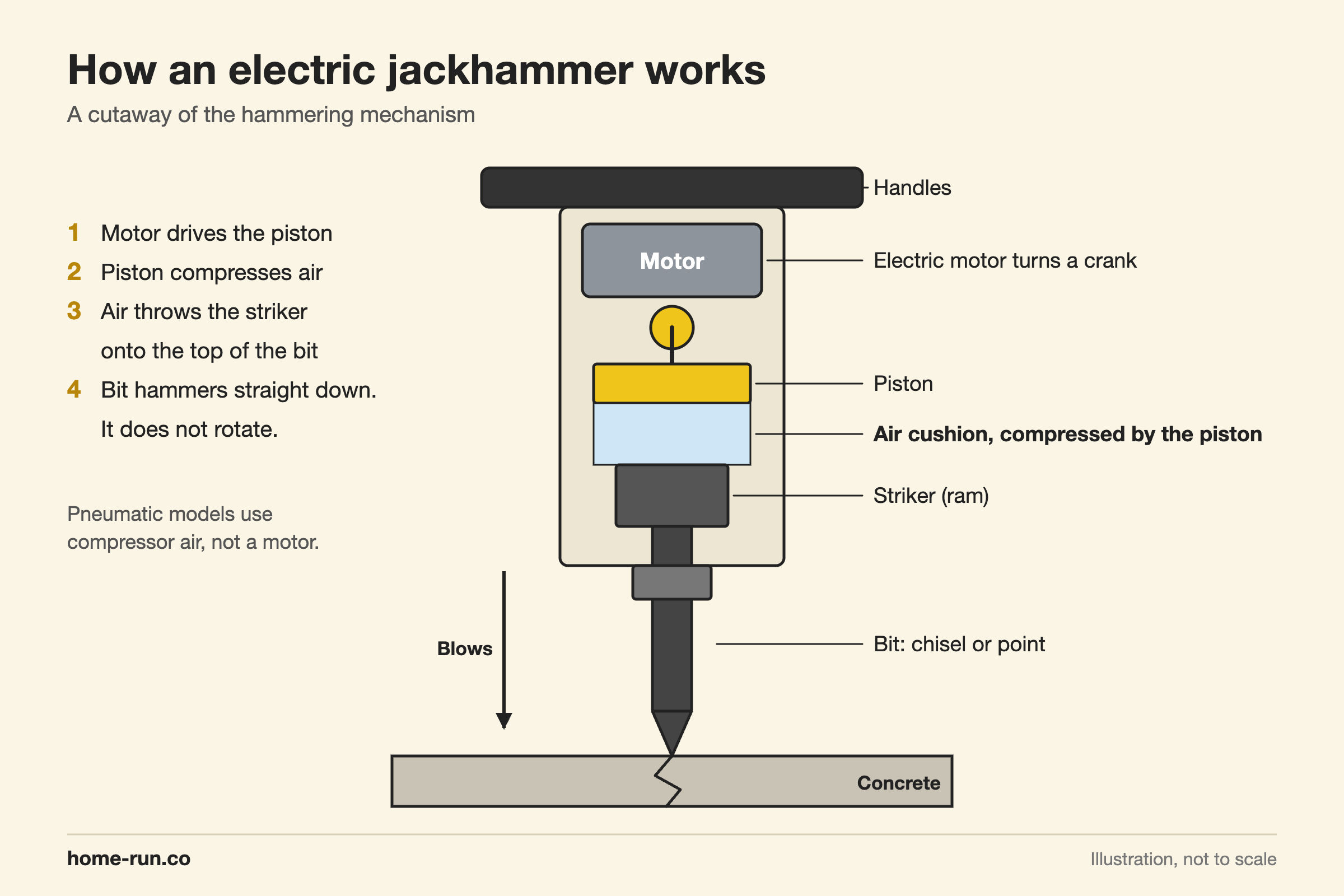
A jackhammer works by slamming a piston onto the top of a chisel or bit hundreds or thousands of times a minute. Each blow cracks the surface a little, and repeated blows break the material apart.
In an electric model, a motor-driven piston compresses air that throws a striker onto the bit. A pneumatic model runs on compressor air.
The bit hammers straight down and does not rotate, so a jackhammer is not a drill.
A pavement breaker smashes roads and slabs. A demolition hammer is an electric breaker. A rotary hammer drills holes and is too light for thick concrete. A rock drill bores holes in rock.
Where Does the Name Come From, and Who Invented It?
"Jackhammer" is the North American and Australian name for a hand-held breaker; British English says pneumatic drill. The tool grew out of 19th-century rock drills built for mining and tunnelling.
Steam drill patent
Samuel Miller patents a steam-powered drill.
Percussion drill
Jonathan J. Couch patents the first American percussion drill.
Compressed air
Joseph W. Fowle runs his percussion drill on compressed air.
Tunnel-ready rock drill
Germain Sommeiller refines Thomas Bartlett's 1855 rock drill.
Which Power Types Can You Choose From?
Jackhammers run on four power types. Pick the one your site can supply.
Jackhammer types compared
Check specs on the maker's sheet| Type | Needs on site | Best job | Main drawback |
|---|---|---|---|
| Electric Most homes | Mains socket or generator | Tile, plaster, floor and wall breaking | Weaker than heavy air tools on thick concrete |
| Pneumatic | Air compressor, hose, fittings | Roads, trenches, thick slabs | Compressor cost; very loud |
| Hydraulic breaker | Excavator, backhoe or skid steer loader | Heavy demolition, rock, quarries | Machine attachment, not a hand tool |
| Petrol | Fuel only | Remote sites without power | Exhaust fumes; not for indoor use |
What Is a Jackhammer Used For?
A jackhammer breaks hard material that hand tools cannot shift quickly.
- Breaking concrete slabs, beams and columns during renovation
- Cutting trenches for pipes and cables
- Lifting asphalt and road surfaces
- Breaking rock in quarries, mines and tunnels
Higher concrete grades take longer to break; our concrete mix ratio guide explains grades.
How Do You Pick the Right Weight Class and Bit?
Choose a jackhammer by matching its weight and impact energy to the material.
Jackhammer class by job
Example specs from maker listings| Job | Class | Example weight | Example impact |
|---|---|---|---|
| Tile, plaster, light chipping | Light electric | 5.6 kg | 7.5 J, 2,850 bpm |
| Floor slab, wall Default pick | Heavy electric | 16.9 kg | 41 J, 1,300 bpm |
| Road, trench, thick concrete | Pneumatic breaker | 20–29 kg | 48–63 cfm air |
Use a pointed moil point for concrete and rock, a flat chisel for channels, a wide spade for tiles and an asphalt cutter for tarmac. The bit's shank must fit the chuck, such as SDS-max or hex.
Blows per minute (BPM) is speed; joules measure how hard each blow lands. For thick concrete, compare joules first.
Breaking out a floor or slab?
Tools, safety gear and rebuild materials delivered across Bengaluru.
What Does a Breaker Machine Cost in India: Rent or Buy?
A 5 kg electric jackhammer costs about ₹3,200 to ₹10,800 in Bengaluru, and a 16 kg model about ₹15,300 to ₹38,500. Ranges are from IndiaMART listings checked on 10 Nov 2026.
Rent or hire
One-off jobsRemoving one floor or patio.
- No upfront purchase
- Right class for each job
- Operator can come with the tool
Buy
Frequent useContractors breaking out every week.
- Upfront cost, then free use
- Bits and servicing are on you
- You need a trained operator
Breaking rates vary by slab thickness, so get two quotes from a civil contractor.
How Do You Operate a Breaker Safely?
Use a jackhammer safely by preparing the area, wearing protective gear and breaking in small sections.
- Inspect: check the tool, cable or hose, then lock in the bit.
- Survey: find buried pipes, cables and steel rebar before you start. Slabs hide TMT bars.
- Stance: feet apart, both hands on the grips, and let the tool's weight do the work.
- Break: start near an edge and take small bites.
- Shut down: disconnect power or air before changing bits.
- Ear defenders or plugs
- Goggles or a face shield
- Respirator rated for fine dust, not a cloth mask
- Anti-vibration gloves, safety shoes and a helmet
Breaking concrete releases respirable crystalline silica, which causes silicosis. Wet the surface or use dust extraction, and rotate operators to limit vibration white finger.
India's Noise Pollution Rules, 2000 cap residential areas at 55 dB(A) by day and 45 dB(A) from 10 pm to 6 am.
What Upkeep and Quieter Alternatives Are There?
Maintain a jackhammer by lubricating it as the maker specifies, replacing blunt bits and checking hoses or cables before each shift. Weak blows usually mean a blunt bit or low air pressure.
Near homes or hospitals, quieter options include diamond concrete saws, hydraulic crushers and chemical (silent) demolition.