On this page
- Is Plywood Engineered Wood?
- What Types of Engineered Wood Are Sold in India?
- Engineered Wood vs Plywood: Which Is Better?
- How Do Durability, Strength and Moisture Resistance Compare?
- What Does Each Board Cost in India?
- Which Is Best for Wardrobes, Kitchens, Beds and TV Units?
- Engineered Wood vs Solid Wood: Should You Consider It?
- How Do You Spot Good-Quality Plywood and Engineered Wood?
- How Do You Choose the Right Board and Look After It?
- Plywood is a type of engineered wood. In shops, "engineered wood" usually means MDF or particle board.
- Plywood holds screws and loads best, so it suits beds, shelves and kitchens.
- The grade matters more than the label: MR for dry rooms, BWR or BWP for damp ones.
- MDF is best for painted, routed or carved finishes in dry rooms.
- Particle board is the cheapest but swells when wet; keep it away from sinks and floors.
Engineered wood vs plywood is a slightly misleading question, because plywood is one kind of engineered wood. The real choice is between plywood and the other engineered boards: MDF, HDHMR and particle board.
Plywood is stronger and handles damp better. MDF and particle board cost less and give a smoother surface. The right pick depends on the room, the load and your budget.
Is Plywood Engineered Wood?
Yes, plywood is engineered wood. Engineered wood is any board made by bonding wood veneers, strips, chips or fibres with adhesive under heat and pressure, instead of using one solid piece of timber.
Plywood is made by gluing thin wood sheets called veneers on top of each other. The grain of each veneer runs at right angles to the one below. This cross-layering makes plywood strong in both directions and resistant to splitting.
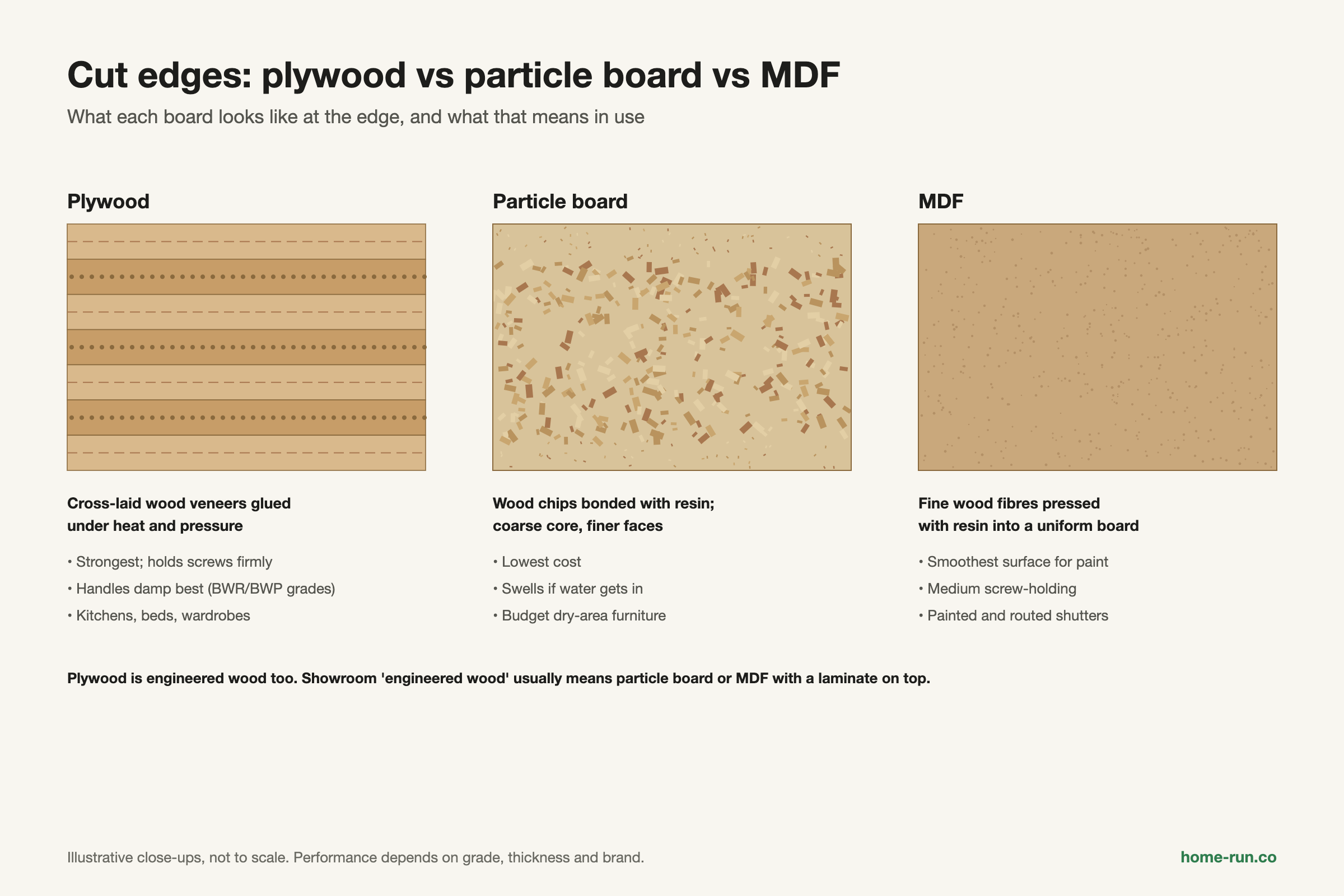
When a furniture showroom says "engineered wood", it almost always means particle board or MDF, often with a laminate on top. So "engineered wood vs plywood" in a quote really asks: particle board or MDF, or plywood?
What Types of Engineered Wood Are Sold in India?
Six engineered boards are common in Indian homes: plywood, blockboard, particle board, MDF, HDF and HDHMR. Each is made differently, and the Bureau of Indian Standards (BIS) covers most of them with a separate IS code.
Engineered wood boards at a glance
Construction, standard and typical use| Board | How it is made | Indian Standard | Typical home use |
|---|---|---|---|
| Plywood | Cross-laid wood veneers glued under pressure | IS 303 (general), IS 710 (marine) | Kitchens, beds, wardrobes, shelves |
| Blockboard | Core of wooden strips between two veneers | IS 1659 | Long shelves, doors, tabletops |
| Particle board | Wood chips and sawdust pressed with resin | IS 3087; pre-laminated IS 12823 | Budget wardrobes, office and flat-pack furniture |
| MDF | Fine wood fibres pressed with resin | IS 12406 | Painted shutters, CNC-routed panels, wall cladding |
| HDF and HDHMR | Denser fibreboard; HDHMR adds moisture resistance | Check the maker's test data | Kitchen shutters, wardrobe carcasses |
OSB (oriented strand board), LVL (laminated veneer lumber) and CLT (cross-laminated timber) are structural products. You will rarely meet them in home interiors.
For a closer look at two of these boards, read our guides on MDF board types and prices and how particle board is made.
Engineered Wood vs Plywood: Which Is Better?
Plywood is the better all-round board for strength, screw-holding and damp. MDF wins on finish, and particle board wins on price.
Plywood vs MDF vs HDHMR vs particle board
Qualitative ratings| Board | Strength and screw-holding | Moisture resistance | Surface finish | Relative cost |
|---|---|---|---|---|
| Plywood (BWR/BWP) Default pick | High | High, grade-dependent | Good with laminate or veneer | High |
| HDHMR | Medium to high | Medium to high | Smooth | Medium |
| MDF Best finish | Medium | Low (MR grade: medium) | Very smooth, paints well | Medium |
| Particle board Budget | Low | Low; edges swell | Good when pre-laminated | Low |
How Do Durability, Strength and Moisture Resistance Compare?
Plywood lasts longest under load and in damp, because its cross-laid veneers resist bending and hold screws firmly. Fibre and chip boards rely on resin alone, so they weaken faster when screws are reworked or water gets in.
Screw-holding and load-bearing
Screws grip plywood's continuous wood layers well, even after hinges are refitted. Particle board crumbles around a screw that is driven twice. MDF holds better than particle board but can split at the edges.
Monsoon humidity and kitchens
Bengaluru's June to September monsoon keeps indoor air damp for weeks. Particle board and standard MDF absorb moisture at unsealed edges and swell. The swelling does not reverse when the board dries.
MR vs BWR vs BWP plywood grades
- MR (moisture resistant): urea-formaldehyde glue; handles humid air in dry rooms.
- BWR (boiling water resistant): phenol-formaldehyde glue; suits utility areas and occasional damp.
- BWP (boiling water proof): the highest grade; suits sinks, vanities and balconies. Marine plywood under IS 710 is BWP grade.
IS 303 traditionally covered MR and BWR grades. A 2024 BIS amendment added a BWP-property grade for interior use under IS 303.
HDHMR and MR-grade MDF resist damp air. Neither is meant for standing water. Even BWP plywood needs sealed edges and a laminate face near a sink.
Termite and borer resistance
Termite resistance comes from chemical treatment of the veneers or resin, not from the board type. Ask the dealer whether the board is treated, and get the claim in writing on the bill.
What Does Each Board Cost in India?
Particle board is usually the cheapest, followed by MDF, HDF and then plywood. Within plywood, the grade and brand can move the price by more than the material type.
Indicative price ladder
₹ per sq ft, one 2026 online listing| Board | Low (₹/sq ft) | High (₹/sq ft) |
|---|---|---|
| Particle board | 30 | 55 |
| MDF | 40 | 80 |
| HDF | 55 | 110 |
| Plywood, MR grade | 70 | 150 |
| Plywood, BWR grade | 90 | 180 |
| Plywood, BWP or marine | 120 | 250 |
Thickness, grade, brand and finish drive most of the gap. A pre-laminated board saves the cost of a separate laminate and labour.
Compare quotes only for the same thickness, grade and brand. A cheaper plywood quote is often a lower grade, not a better deal. Spend more on the kitchen and bed; save on dry wardrobe shelves.
Building wardrobes or a kitchen?
Get plywood, boards, laminates and hardware delivered across Bengaluru with a GST invoice.
Which Is Best for Wardrobes, Kitchens, Beds and TV Units?
Use plywood wherever there is water, weight or frequent movement. Use MDF or particle board only in dry rooms with light loads.
Which board for which furniture
Recommended and budget picks| Furniture | Recommended board | Budget alternative | Why |
|---|---|---|---|
| Kitchen cabinets | BWP plywood Default pick | HDHMR away from the sink | Steam, spills and sink leaks |
| Wardrobes | MR or BWR plywood | Pre-laminated particle board | Dry room; hinges get heavy use |
| Beds | BWR plywood | HDHMR | Body weight and frequent movement |
| TV units and bookshelves | Plywood or blockboard | MDF with short shelf spans | Long shelves sag under books |
| Study tables | Plywood | Pre-laminated particle board | Light load; flat-pack is fine |
Kitchen base cabinet
BWP plywoodWet zone: sink, steam and floor mopping.
- BWP plywood carcass, especially under the sink
- Laminate on both faces to block steam
- Edge-band every cut edge
- Raise the cabinet on legs or a plinth
Bedroom wardrobe
MR plywood or boardDry zone: light shelves, frequent hinge use.
- MR plywood carcass for long life
- Pre-laminated particle board if budget is tight
- MDF shutters for a painted or carved look
- Keep it off a damp external wall
Planning a full kitchen? Our modular kitchen design guide covers layouts and cabinet sizes.
Engineered Wood vs Solid Wood: Should You Consider It?
Solid wood such as teak or sheesham costs more and can warp or crack as humidity changes. Engineered boards stay flatter and more consistent, and they cost less.
Solid wood can be sanded and re-polished many times. An engineered board is hard to repair once its core is damaged. To get a wood look on an engineered board, use a real wood veneer or a wood-grain laminate.
How Do You Spot Good-Quality Plywood and Engineered Wood?
Check the board's edge, surface and markings before you pay. Most bad boards give themselves away at the edge.
- Edge shows even, gap-free layers (plywood) or a dense, uniform core (MDF)
- Sheet lies flat with no warp, bubbles or patched veneer
- Thickness matches the label when measured
- Board carries the ISI mark, IS number, grade and brand stamp
- Bill lists brand, grade, thickness and IS code
- Ask for the formaldehyde emission class (E0 is the lowest)
- Gaps, overlaps or hollow sounds when you tap the sheet
- Board feels too light for its stated thickness
- ISI sticker without a licence number you can check
- Dealer says "waterproof" but cannot name the grade
You can verify an ISI licence number on the BIS website or the BIS Care app.
How Do You Choose the Right Board and Look After It?
Answer three questions in order, and the board choice follows.
- Is the spot wet or dry? Wet or near a sink: BWP plywood. Dry: any board.
- Will it carry weight or move often? Yes: plywood or blockboard. No: MDF or particle board works.
- Do you want a painted or carved finish? Yes: MDF shutters on a plywood carcass.
Then protect the board with a few habits:
- Seal or edge-band every exposed edge.
- Keep furniture off wet floors and damp walls.
- Wipe spills at once, especially on laminate joints.
- Ventilate wardrobes and kitchens during the monsoon.
Your next step: get two or three quotes with the grade, thickness and brand written for each part, then compare them line by line.