On this page
- What Is an HDHMR Board?
- What Are the Key Specifications of HDHMR Boards?
- Where Are HDHMR Boards Used in Furniture and Interiors?
- How Does HDHMR Compare With Plywood, BWP and WPC?
- What Affects the Cost of HDHMR Boards?
- Are HDHMR Boards Eco-Friendly?
- How Do You Choose HDHMR Boards for Furniture and Interiors?
- What Are the Red Flags When Buying HDHMR?
- HDHMR is a dense, moisture-resistant fibreboard made from hardwood fibres pressed with resin.
- Action TESA rates its HDHMR at over 850 kg/m³ and screw withdrawal of up to 2,200 N.
- India's MDF code, IS 12406:2025, has a High Moisture Resistance (HMR) grade, but no grade named "HDHMR".
- HDHMR suits kitchen carcasses, shutters and wardrobes. Keep it away from standing water.
- For sink bases and wet utility areas, BWP plywood or WPC is the safer pick.
HDHMR boards for furniture and interiors are high density, high moisture resistant fibreboards used for modular kitchens, wardrobes, TV units and wall panels. They give a smooth, even surface for laminates and hold screws better than standard MDF.
This guide covers specs, uses and buying checks. For the wider family of boards, see our explainer on engineered wood vs plywood.
What Is an HDHMR Board?
An HDHMR board is a high density, high moisture resistant fibreboard. Makers break hardwood into fine fibres, mix them with resin and press them into flat sheets under heat.
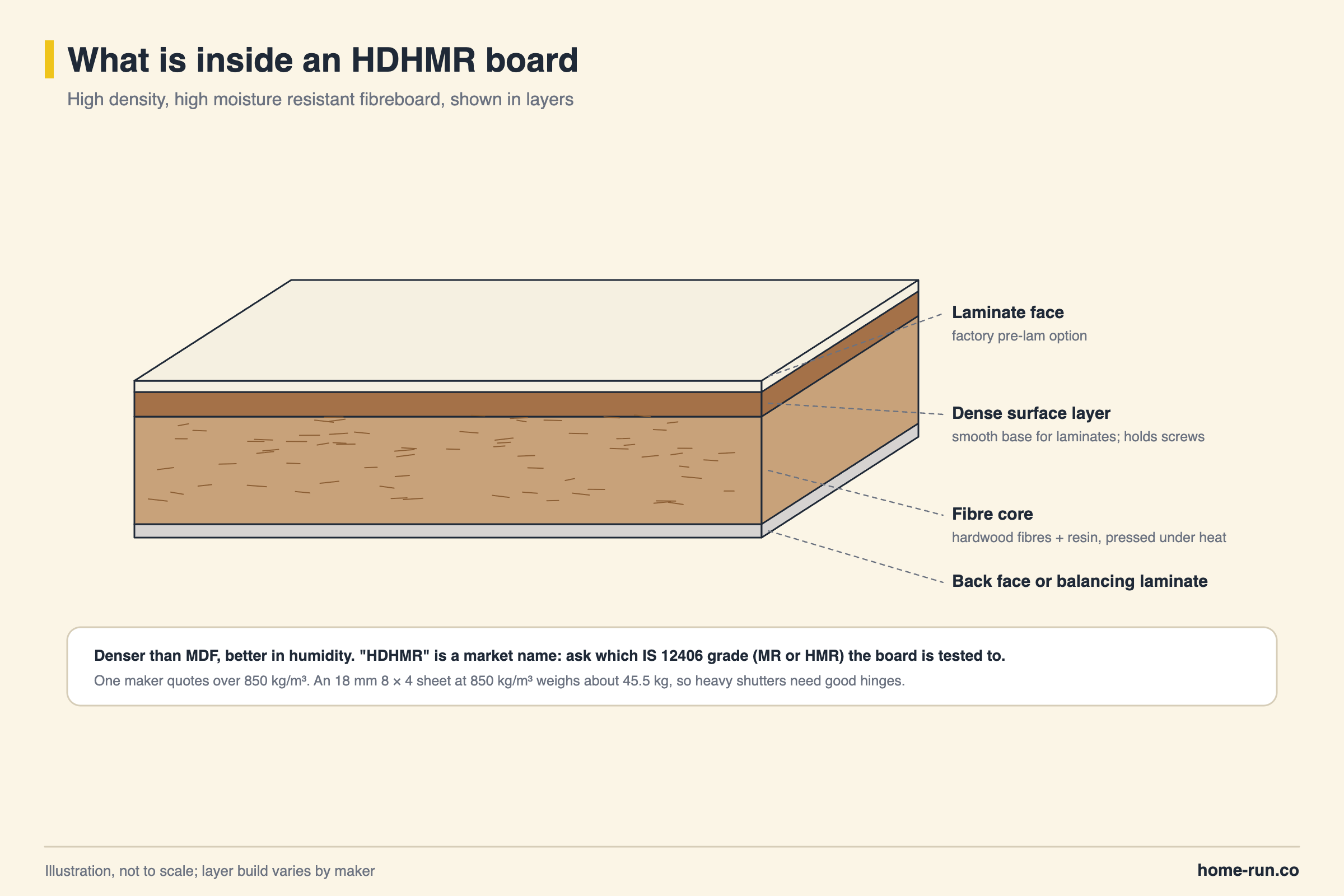
The result looks like MDF (medium density fibreboard) but is denser and handles humidity better. HDF (high density fibreboard) is a close cousin, usually sold in thinner sheets.
IS 12406:2025, the Bureau of Indian Standards (BIS) code for medium density fibre boards, defines Regular, Moisture Resistant (MR) and High Moisture Resistance (HMR) grades. "HDHMR" is a market name. Ask which IS 12406 grade a board is tested to.
What Are the Key Specifications of HDHMR Boards?
The key specifications of an HDHMR board are density, modulus of rupture (MOR, the bending strength), screw withdrawal and thickness swelling after 24 hours in water. Makers publish some of these. IS 12406 sets minimums.
HDHMR specifications vs the IS 12406 benchmark
18 mm board, 12–19 mm band| Property | Action TESA HDHMR (maker) | IS 12406:2025 HMR-FN minimum |
|---|---|---|
| Density Key figure | Over 850 kg/m³ | 600–900 kg/m³ (all grades) |
| Bending strength (MOR) | Not published | 26 N/mm² |
| 24 h thickness swelling | Not published | 5% max |
| Screw withdrawal, face | Up to 2,200 N | 1,250 N |
| Screw withdrawal, edge | Not published | 850 N |
| Thicknesses sold | 3, 5.5, 8, 12, 16, 16.75, 18, 25 mm | — |
Other makers publish fuller data. Infra.market's HDEMR-grade sheet, for example, lists 815–825 kg/m³, MOR of at least 40 N/mm² and 8% maximum swelling for 12–19 mm boards.
Weight follows density. One 18 mm 8 × 4 sheet at 850 kg/m³ weighs about 45.5 kg, so heavy shutters need good hinges.
Where Are HDHMR Boards Used in Furniture and Interiors?
HDHMR boards are used mainly for modular kitchen carcasses and shutters, wardrobes, TV units, study tables and wall panelling.
- Kitchen cabinets: wall units and base carcasses away from the sink, where steam and splashes are common.
- Wardrobes and lofts: large flat shutters stay straight and take hinges and channels well.
- Bathroom vanities (dry side): only above the splash zone, with all edges sealed.
- CNC-cut panels: the even core routes cleanly into jaali screens, fluted panels and shaped shutters.
- Pre-laminated furniture: pre-lam HDHMR comes with a factory laminate, so it needs no extra finishing.
In Bengaluru, humid monsoon months make moisture resistance worth having for kitchens. See our modular kitchen design guide for layouts and carcass materials.
Use HDHMR where the air is damp, not where the board will sit in water.
HomeRun Team
How Does HDHMR Compare With Plywood, BWP and WPC?
HDHMR gives a smoother, more uniform surface than plywood, while BWP plywood and WPC handle direct water better. The right choice depends on how wet the spot gets.
HDHMR board
Dry to humid areasPoints
- Uniform fibre core, no voids
- Smooth face for laminate and paint
- Clean CNC routing and shaping
- Moisture resistant, not waterproof
BWP plywood
Wet areasPoints
- Cross-laminated wood veneers
- Face shows grain, may need putty
- Strong edges for screws and joints
- Made to resist boiling water
HDHMR vs other furniture boards
Where each one fits| Material | What it is | Water exposure | Best for |
|---|---|---|---|
| HDHMR Smooth finish | Dense fibreboard | Humidity and splashes | Shutters, carcasses, CNC panels |
| MR plywood | Veneer plywood, IS 303 MR grade | Dry interiors | Bedroom and living furniture |
| BWP plywood | Veneer plywood, IS 303 BWP or IS 710 marine | Direct water contact | Sink bases, utility areas |
| WPC board Wettest spots | Wood-plastic composite | Wet areas | Bathroom cabinets, outdoor units |
For a side-by-side with MDF grades, read our guide to MDF board types and grades.
What Affects the Cost of HDHMR Boards?
The cost of an HDHMR board depends mainly on its thickness, finish, brand and certification. Thicker and pre-laminated boards cost more per sheet than thin plain boards.
- Thickness: an 18 mm sheet uses far more fibre and resin than a 6 mm sheet.
- Finish: plain, one-side laminated and both-side laminated boards each cost a different amount.
- Brand and tests: Action TESA, Greenply, Century and others publish different specs and warranty terms.
- Emission class: IS 12406 classes boards as E1 or E2 for formaldehyde.
Are HDHMR Boards Eco-Friendly?
HDHMR boards make use of wood fibre instead of whole logs, but the resin binder releases formaldehyde. Emission class is the main thing to check.
IS 12406:2025 grades each board as E1 or E2. E1 is the lower-emission class. Ask for the class in writing, and prefer E1 for bedrooms and closed kitchens.
How Do You Choose HDHMR Boards for Furniture and Interiors?
Choose HDHMR boards by matching thickness to the job, the grade to the room's moisture, and the finish to the look you want.
- 18 mm or 16.75 mm for carcasses, shelves and wardrobe shutters.
- 12 mm for drawer sides and light partitions, if your carpenter agrees.
- 3 mm to 8 mm for back panels, wall cladding and curved work.
- 25 mm for long shelves and heavy tabletops.
- An IS 12406 HMR grade test report and the emission class (E1 or E2).
- The written warranty, since terms differ by brand and product line.
- Pre-laminated or plain: pre-lam saves finishing time; plain suits paint, veneer or your own laminate.
For drilling and joinery, see our guide to dowel joints in woodworking.
What Are the Red Flags When Buying HDHMR?
The main red flags are missing test data, uneven thickness and boards that feel light for their size.
- No test report: the seller cannot show density, MOR or swelling values.
- Light sheets: an 18 mm 8 × 4 sheet far below about 45 kg is unlikely to reach 850 kg/m³.
- Uneven thickness: measure at several points along the edges.
- Soft or crumbly edges: a good core is tight and even when cut.
- "Waterproof" claims: makers themselves call HDHMR moisture resistant, not waterproof.
Action TESA says long contact with standing water can make HDHMR swell. Greenply advises against it for wet utility areas. Use BWP plywood or WPC under sinks.
Building kitchen or wardrobe units?
Boards, laminates and hardware delivered across Bengaluru.