On this page
- What Is a Door Jamb, and Why Is It Called That?
- What Are the Parts of a Door Jamb?
- Door Jamb vs Door Frame vs Casing: What Is the Difference?
- What Are the Types of Door Jambs Used in India?
- What Size Should a Door Jamb Be?
- How Is a Door Jamb Installed?
- Should You Repair or Replace a Damaged Door Jamb?
- How Do You Pick the Right Door Jamb?
- A door jamb carries the hinges, holds the door square and receives the latch.
- The jamb is part of the chaukhat; the casing is trim on the wall face.
- Use WPC, PVC or steel in wet areas; treated hardwood elsewhere.
- Most site-built frames are fixed with holdfasts while the wall goes up.
A door jamb is the vertical side piece of a door opening. Together with the head jamb across the top, the side jambs carry the hinges and the latch.
What Is a Door Jamb, and Why Is It Called That?
A door jamb is the lining of the opening that the door closes against. Indian carpenters call the whole assembly the chaukhat.
The word comes from Old French jambe, meaning "leg" or "side post". The spelling is jamb, not jam.
What Are the Parts of a Door Jamb?
A door jamb has five parts.
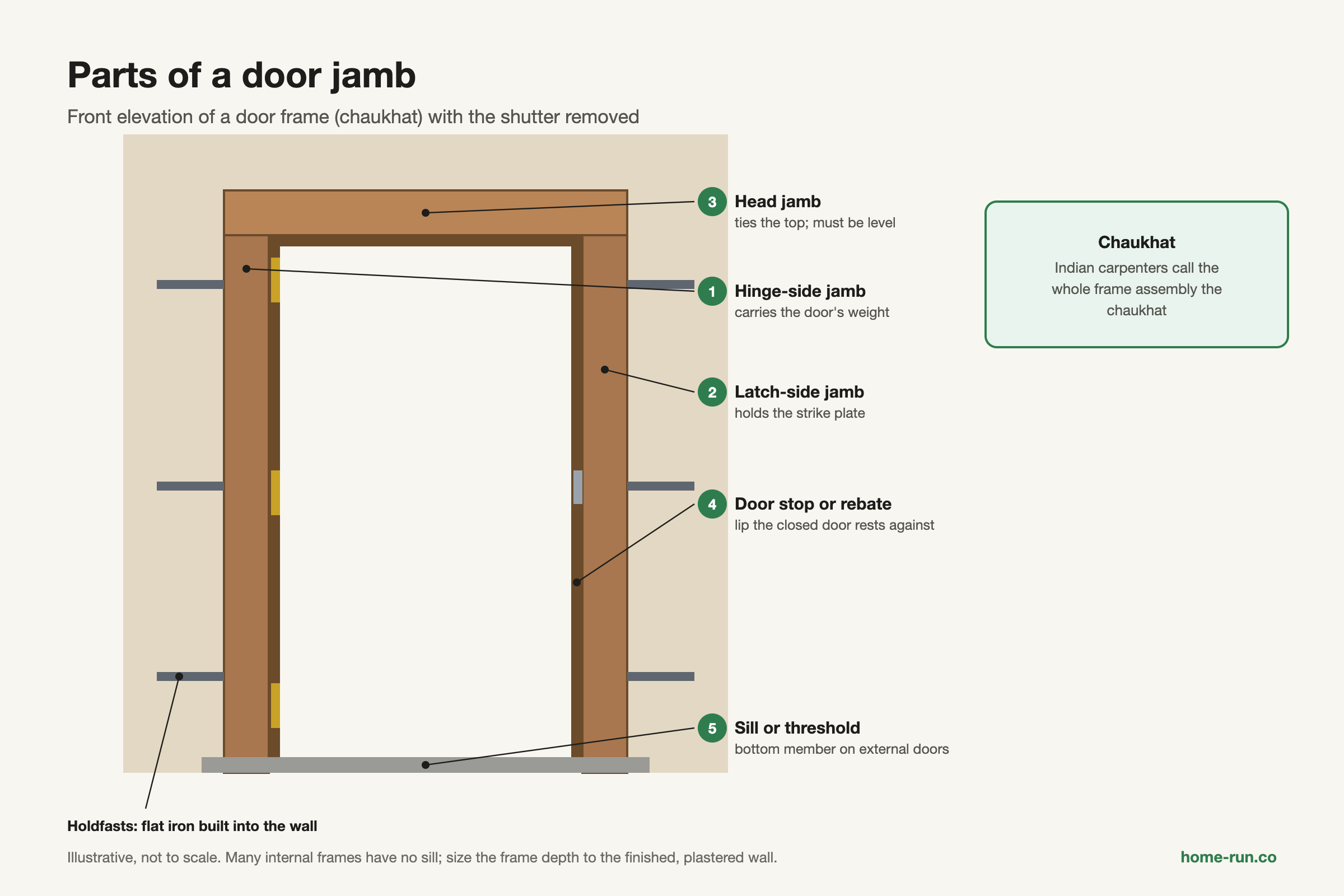
Door jamb parts and functions
Single door| Part | What it does |
|---|---|
| Hinge-side jamb | Carries the door's weight |
| Latch-side jamb | Holds the strike plate |
| Head jamb | Ties the top; must be level |
| Door stop or rebate | Lip the closed door rests against |
| Sill or threshold | Bottom member on external doors |
Door Jamb vs Door Frame vs Casing: What Is the Difference?
The jamb is one part of the frame. The casing covers the joint between frame and wall.
Three terms for one opening
In India, chaukhat means the frame| Term | What it is |
|---|---|
| Door jamb | Side and head members |
| Door frame | Full assembly fixed into the wall |
| Casing (architrave) | Trim moulding on the wall face |
What Are the Types of Door Jambs Used in India?
Door jambs differ by profile and material. A flat jamb takes a separate stop strip; a rebated jamb has the stop cut in; a kerfed jamb has a seal slot.
Door jamb materials compared
Qualitative; get local quotes| Material | Strength | Weak point | Best for |
|---|---|---|---|
| Solid wood (teak, sal) Default pick | Best screw grip | Needs termite treatment | Main and bedroom doors |
| Pressed steel | Termite-proof, secure | Rusts if primer is damaged | Main, utility doors |
| WPC | Water and termite resistant | Lower screw grip | Bathrooms, kitchens |
| PVC Budget | Light, waterproof | Low strength | Bathroom doors |
| RCC or precast | Termite-proof, durable | Heavy, plain finish | Utility, outdoor openings |
Use WPC, PVC or steel jambs in bathrooms, paired with PVC doors.
What Size Should a Door Jamb Be?
A door jamb should suit the finished wall thickness, including plaster on both faces. Measure after plastering, not on bare brickwork.
How Is a Door Jamb Installed?
On most Indian sites, the door jamb goes in while the wall is built.
- Treat timber faces that touch masonry with preservative.
- Bolt holdfasts, such as 40 × 5 mm flat iron, 40 cm long, to each side jamb.
- Brace the frame at finished floor level with a temporary bottom tie.
- Check plumb with a spirit level and match the diagonals.
- Build in the holdfasts with mortar or concrete; let them cure.
- Hang the shutter after plastering, then fit the strike plate.
Should You Repair or Replace a Damaged Door Jamb?
Repair a door jamb with local damage such as a split or loose hinge. Replace it when rot or termites reach the core.
- Soft or rotted wood at the base
- Split near the strike plate
- Gap that varies along the door edge
- Latch that no longer catches
How Do You Pick the Right Door Jamb?
Pick a door jamb by location, moisture and wall thickness.
- Door location: main, bedroom, bathroom or balcony
- Moisture and termite exposure
- Finished wall thickness
- Readymade frame or carpenter-made fit
Fixing a new door frame?
Delivered across Bengaluru.