On this page
- What Is Seasoning of Timber?
- Why Is Seasoning of Timber Necessary?
- What Are the Methods of Seasoning Timber?
- How Is Air Seasoning Done, Step by Step?
- How Does Kiln Seasoning Work?
- What Is the Difference Between Natural and Artificial Seasoning?
- What Moisture Content Should Seasoned Timber Have?
- What Causes Seasoning Defects in Timber?
- How Do You Choose the Right Seasoning Method?
- Seasoning of timber removes water from green wood so it stops shrinking, warping and rotting after it is fixed.
- The two families are natural (air) and artificial seasoning, led by kiln drying.
- Air seasoning is cheap but slow; IS 1141 says timber is not fully air seasoned in under 6 months.
- Kiln seasoning reaches a set moisture in 4–30 days.
- Ask for timber dried to the IS 287 limit for its use, such as 14% for doors and windows in Zone III.
Seasoning of timber is the controlled drying of sawn wood until its moisture content suits the place where it will be used. Freshly felled timber can hold about 100% moisture by oven-dry weight; well-seasoned wood averages 10–12%.
In India the process is set out in IS 1141:1993, the Bureau of Indian Standards (BIS) code of practice for seasoning of timber.
What Is Seasoning of Timber?
Seasoning of timber means drying wood slowly and evenly, without splitting it, to a moisture level close to the air around the finished piece.
Wood holds free water in its cell cavities and bound water in its cell walls. Below the fibre saturation point (FSP), about 30% moisture, bound water leaves and wood starts to shrink.
Seasoning dries the wood. Preservation treats wood with chemicals against termites and fungi. Most joinery timber needs both.
Why Is Seasoning of Timber Necessary?
Seasoning of timber is necessary because wet wood keeps shrinking after fixing, which opens joints and jams shutters.
- Stability: dry wood holds its size, so doors and window shutters stay square.
- Durability: drier wood resists the decay fungi and many insects that attack wet timber.
- Strength: wood is stiffer and stronger below the FSP than when green.
- Finish: seasoned wood planes, glues, holds screws and takes paint better.
Plywood, MDF and blockboard use veneers or fibres dried in the factory, so they move less than solid wood. Compare them in our guide to engineered wood vs plywood.
What Are the Methods of Seasoning Timber?
The two methods of seasoning timber are natural seasoning in open air and artificial seasoning, which uses heat, chemicals or electricity.
Types of seasoning of timber
As described in IS 1141:1993 and standard texts| Method | Type | How it works | Typical time |
|---|---|---|---|
| Air seasoning Budget | Natural | Stacked on raised pillars with spacers under a shed | 6 months or more |
| Water seasoning | Natural (pre-treatment) | Logs kept submerged to wash out sap, then air dried | 2–4 weeks in water |
| Kiln seasoning Default pick | Artificial | Heated, humidified air circulated by fans in a chamber | 4–30 days |
| Solar kiln | Artificial | Greenhouse-style chamber heated by the sun | Weather-dependent |
| Chemical (salt) seasoning | Artificial | PEG, urea or salt solution slows surface drying to cut cracking | Used with air or kiln drying |
| Electrical seasoning Costly | Artificial | High-frequency current heats the wood from inside | Fastest, rarely used |
| Steaming (presteaming) | Artificial (pre-treatment) | Green timber steamed at about 100°C before drying | 2–4 hours |
How Is Air Seasoning Done, Step by Step?
Air seasoning of timber is done by stacking sawn wood off the ground, with spacers between layers, under a roof. IS 1141 sets these rules:
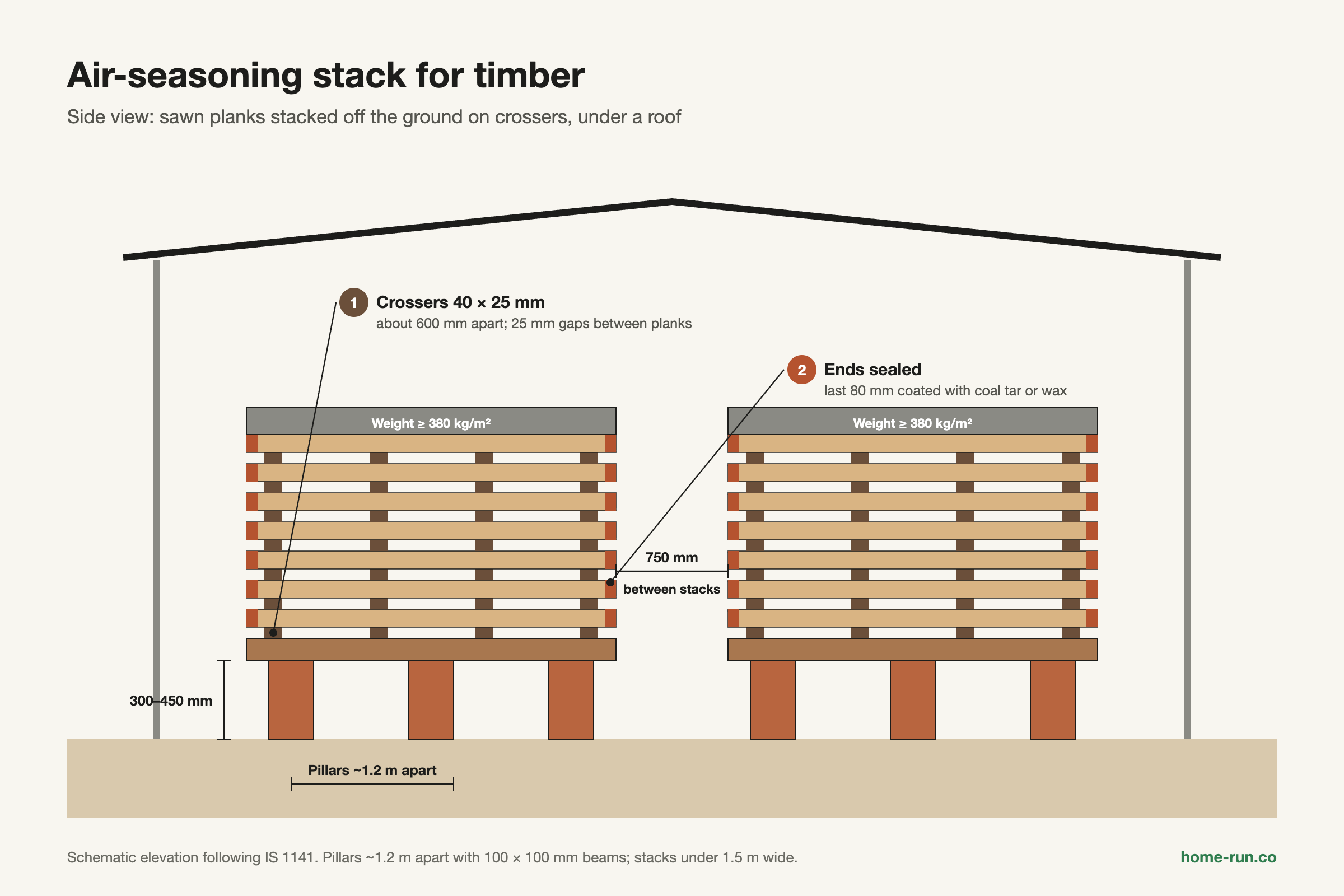
- Coat the ends. Seal the last 80 mm of each end with coal tar or paraffin wax to stop end splits.
- Build the base. Set pillars of brick, concrete or treated wood 300–450 mm high, about 1.2 m apart, with 100 × 100 mm beams on top.
- Lay crossers. Place 40 × 25 mm spacers about 600 mm apart for 25 mm planks, leaving 25 mm gaps between planks. Keep stacks under 1.5 m wide.
- Weight the top. Load the top with at least 380 kg/m² to hold planks flat.
- Roof it. Use a shed whose overhang blocks rain, with stacks 750 mm apart.
How Does Kiln Seasoning Work?
Kiln seasoning of timber dries wood in a closed chamber where steam, heaters and fans control heat and humidity. IS 1141 sets seven schedules, from 4–5 days to 24–30 days.
Load and steam
Warm the stacked charge at about 55°C and 100% humidity for 2 hours.
Run the schedule
Raise heat and lower humidity as sample boards dry.
Condition
At 1% below target, raise humidity to even out moisture.
Cool and check
Cool to within 15–20°C of outside air; average must be within 1% of target.
What Is the Difference Between Natural and Artificial Seasoning?
Natural seasoning dries timber in free air over months; artificial seasoning takes days under control, at a higher cost.
Natural (air) seasoning
Low costPoint
- Takes 6 months or more; 25 mm hardwood planks need 3–4 months
- Needs only a shed, pillars and spacers
- Moisture follows local air and stalls in humid months
- Higher risk of end splits, stain and insects
Artificial (kiln) seasoning
Better controlPoint
- Takes 4–30 days, depending on species and thickness
- Needs a kiln, steam or heat supply and power
- Reaches a set moisture, even below outdoor levels
- Steaming sterilises; wrong schedules cause case hardening
Starting woodwork this week?
Plywood, hardware and wood finishes delivered across Bengaluru.
What Moisture Content Should Seasoned Timber Have?
Seasoned timber should meet the maximum moisture in IS 287, the BIS recommendation for permissible moisture in timber, set by use and climate zone.
Maximum moisture content by use (IS 287:1993)
Zone by average annual humidity| Use | Zone I (<40%) | Zone II (40–50%) | Zone III (50–67%) | Zone IV (>67%) |
|---|---|---|---|---|
| Beams and rafters | 12% | 14% | 17% | 20% |
| Doors and windows (50 mm+) | 10% | 12% | 14% | 16% |
| Furniture and cabinets | 12% | 12% | 14% | 16% |
| Flooring strips | 8% | 10% | 10% | 12% |
Bengaluru averages about 85% humidity in the morning and 48% in the afternoon (UAS GKVK normals), near the Zone III limit. Ask for door and window timber at 14% or lower, and check it with a moisture meter.
What Causes Seasoning Defects in Timber?
The seasoning of timber is affected by species, thickness, humidity, temperature and airflow. Drying too fast or unevenly causes these defects.
- End splits and surface cracks: ends or faces dried faster than the core.
- Warping: bow, cup or twist from poor stacking or missing top weight.
- Case hardening: a dry, stressed shell over a wet core.
- Collapse: cells flatten when wet wood is heated too early.
- Monsoon regain: air-dried stock picks up moisture again from June to December, when Bengaluru's afternoon humidity stays above 50%.
How Do You Choose the Right Seasoning Method?
Choose kiln-seasoned timber for doors, windows and furniture; keep air-seasoned timber for rough or outdoor work, where IS 1141 accepts 15–25% moisture. Before you buy, check:
- The invoice states kiln-dried or air-seasoned, and the species.
- Moisture meter readings are at or below the IS 287 limit.
- Ends show no splits; faces show no stain or borer holes.
- Boards lie flat, with no bow, cup or twist.
Bengaluru hosts IPIRTI (Indian Plywood Industries Research & Training Institute) and the Institute of Wood Science and Technology (IWST), which advises on kilns and solar kilns. For frame details, see our door jamb guide.