On this page
- What Is a Butt Joint?
- What Are the Types of Butt Joints?
- How Strong Is a Welded Joint Under IS 800?
- What Are the Pros and Cons of This Joint?
- How Do You Reinforce Wooden Joints?
- How Do You Make One Step by Step?
- What Mistakes Make the Joint Fail?
- A butt joint joins two members that simply meet, with no shaped interlock.
- In woodwork it is the simplest and weakest joint, because glue grips end grain poorly.
- Reinforce wooden butt joints with screws, pocket screws, dowels, biscuits or metal brackets.
- A complete penetration butt weld has a throat equal to the thinner plate.
- IS 800:2007 applies γmw of 1.25 for shop welds and 1.50 for site welds.
A butt joint is a joint where two pieces of wood or metal are placed end to end, or end to face, and fixed without any notch, groove or overlap. Carpenters use it for boxes and frames; fabricators use it to weld plates and sections in one plane.
What Is a Butt Joint?
A butt joint is the simplest way to connect two members: their square-cut ends or edges meet. Nothing is cut into either piece, so glue, fasteners or weld metal do all the holding.
- In woodwork: the end of one board meets the face or end of another, as in a plywood box or door frame.
- In steel: two plates sit edge to edge in the same plane and a butt weld fills the gap between them.
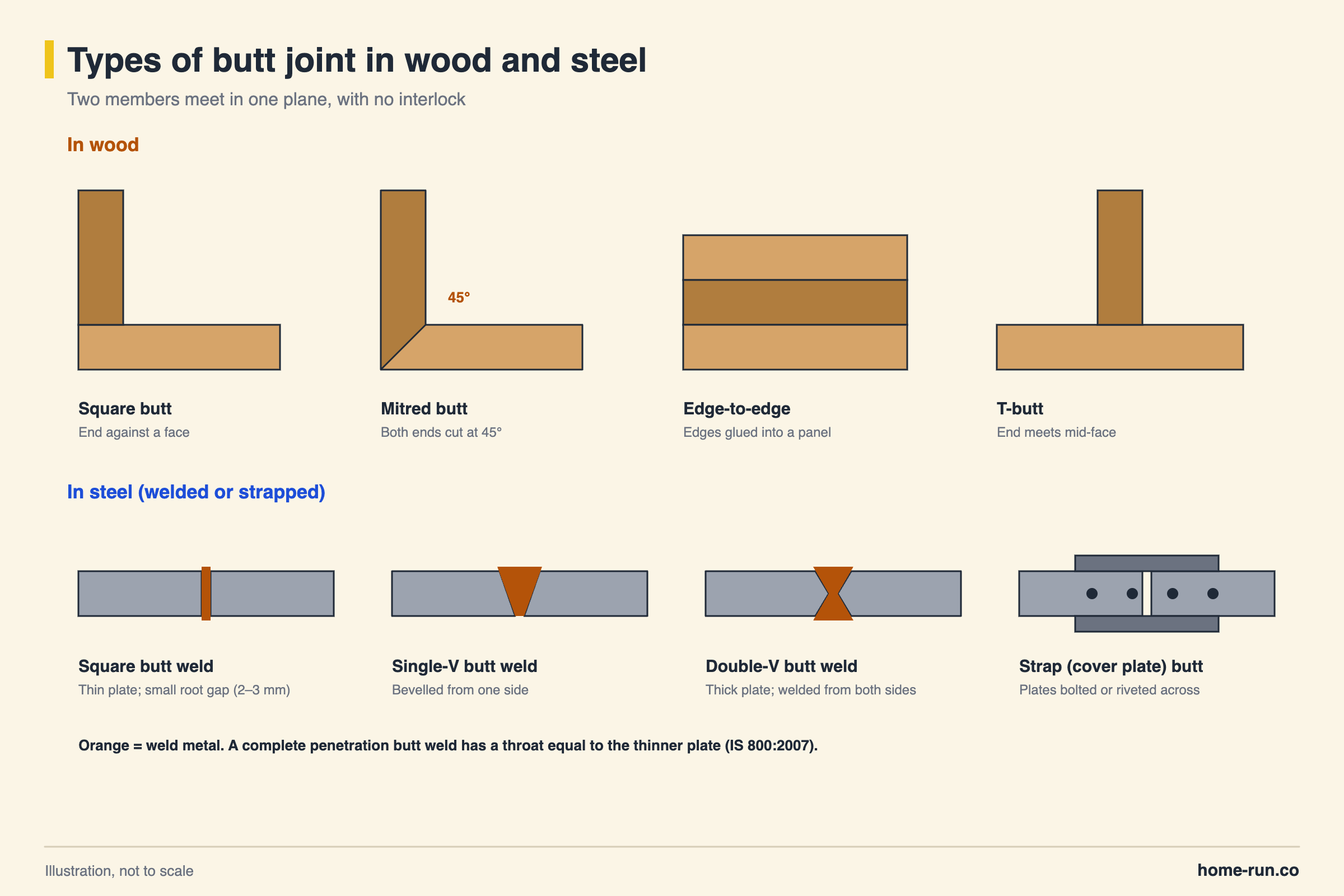
A butt joint describes how the parts are arranged. A butt weld (or groove weld) is the weld that fills a prepared gap. Butt welds usually sit in butt joints, but the terms differ.
What Are the Types of Butt Joints?
The types of butt joints differ by the end cut in wood and the edge preparation in steel. Thicker plates need a groove so weld metal reaches full depth.
Types of butt joint and where each is used
Woodwork and welded steel| Type | How it is made | Typical use |
|---|---|---|
| Square butt (wood) Most common | Square-cut end against a face or end | Plywood boxes, carcasses, frames |
| Mitred butt | Both ends cut at 45° to make a 90° corner | Picture frames, door casings, beading |
| Edge-to-edge butt | Long edges glued side by side | Wide solid-wood panels and table tops |
| T-butt | End of one member meets mid-face of another | Shelves, partitions, stiffeners |
| Square butt weld | Plate edges left square, small gap | Thin sheet and light plate |
| Single-V butt weld Steel default | Both edges bevelled from one side | Medium plates welded from one side |
| Double-V, U or J butt weld | Grooves from both sides, or curved grooves | Thick plates; less distortion and filler |
| Strap (cover plate) butt | Single or double cover plates riveted or bolted across | Older riveted and bolted steelwork |
In a lap joint the parts overlap and join on their faces, usually with fillet welds. In a butt joint they meet in one plane. Our guide to types of welding covers the welding processes used for both.
How Strong Is a Welded Joint Under IS 800?
A complete penetration butt weld is as strong as the thinner plate it joins. IS 800:2007, the Indian code for general construction in steel, treats butt welds as parent metal with a thickness equal to the weld's effective throat.
- Complete penetration: effective throat = thickness of the thinner part joined (clause 10.5.3.3).
- Incomplete penetration: effective throat = the minimum depth of weld metal common to both parts, excluding the raised reinforcement.
- Safety factor: γmw (partial safety factor for welds) is 1.25 for shop welds and 1.50 for site welds.
- Seismic frames: IS 800 requires complete penetration butt welds in frames designed to resist earthquake loads.
Welding practice follows IS 816:1969, the BIS (Bureau of Indian Standards) code for metal arc welding in mild steel, reaffirmed in 2023, and IS 9595 for edge preparation.
A butt weld that does not fuse through the full plate carries load only on the depth it reaches. For gates, staircases and frames, ask the fabricator if joints are full penetration.
What Are the Pros and Cons of This Joint?
The main butt joint advantage is speed: it needs only straight cuts and basic tools. The main disadvantage in wood is low strength without reinforcement.
Advantages
Why people use itPoints
- Quick to cut and assemble with a hand saw or circular saw
- Uses the least material and no special jigs
- Welded version gives a flush, in-plane connection
- Full-penetration weld matches parent plate strength
Disadvantages
Watch forPoints
- Glue alone grips end grain poorly in wood
- No interlock to resist racking or pull-out
- End grain stays visible unless mitred or edged
- Thick steel needs edge preparation and skilled welders
How Do You Reinforce Wooden Joints?
You reinforce a wooden butt joint by adding a mechanical fixing across the glue line. End-grain glue alone cannot give that strength.
Butt joint reinforcement options compared
Wood, plywood and board furniture| Method | What it adds | Tools needed |
|---|---|---|
| Nails | Fast hold; skew-nail to resist pulling apart | Hammer, nail punch |
| Screws | Clamping force and hold; can be plugged | Power drill, pilot and countersink bits |
| Pocket screws Strong, quick | Angled screws from the hidden face | Pocket-hole jig, drill |
| Dowels | Hidden pins that resist pull-out and shear | Drill, dowel jig, dowel pins |
| Biscuits | Alignment plus extra long-grain glue area | Biscuit joiner |
| Splines | Thin strip in matching grooves; good on mitres | Table saw or router |
| Metal brackets | Visible steel corner support | Drill, screwdriver |
For hidden, aligned joints in solid wood or plywood, see our dowel joint guide. Board choice matters too, as explained in engineered wood vs plywood.
How Do You Make One Step by Step?
You make a basic butt joint by cutting both ends perfectly square, gluing and clamping them, then adding a fixing. Gather the tools first.
- Tape, try square, and a hand saw, circular saw, table saw or miter saw
- Power drill with pilot, countersink or dowel bits
- Wood glue (PVA), clamps and a damp cloth
- Screws, nails, dowels or biscuits to reinforce
- Measure and allow for thickness. In a 600 mm square box of 19 mm board, two sides are 600 mm and the other two are 600 − 19 − 19 = 562 mm.
- Cut square. Use a table saw or miter saw where possible; check every end with a try square.
- Dry-fit and drill. Clamp the parts without glue, check for a true 90° corner, then drill pilot holes, dowel holes or biscuit slots.
- Glue and assemble. Spread a thin, even coat on both faces, insert dowels or biscuits and bring the joint together.
- Clamp and fix. Drive screws or nails, check square again and wipe off squeeze-out.
- Leave to cure. Keep clamps on for the time the glue maker states before loading the joint.
What Mistakes Make the Joint Fail?
Most weak butt joints fail from poor cuts, missing reinforcement or, in steel, poor fusion.
- Ends not square: gaps leave little contact area and the joint racks.
- Relying on glue alone: end grain soaks up glue and bonds weakly.
- No pilot holes: screws split solid wood and plywood edges.
- Wrong root gap in welding: a gap that is too small or too large causes lack of fusion or burn-through.
Building frames or furniture?
Boards, fasteners and adhesives delivered across Bengaluru.