On this page
- What Is a Dowel Joint in Woodworking?
- Which Types of Dowel Joint Are Most Common?
- What Are the Advantages and Disadvantages of a Dowel Joint?
- What Tools Do You Need to Make a Dowel Joint?
- How Do You Make a Dowel Joint Step by Step?
- Is a Dowel Joint Stronger Than Screws, Biscuits or Mortise and Tenon?
- Where Are Dowel Joints Used in Indian Homes?
- A dowel joint uses glued wooden pins to align and hold two pieces.
- Pick a dowel about one-third of the board thickness.
- A dowel jig and a drill depth stop decide whether the joint lines up.
- Put glue in the holes, then clamp for about 24 hours.
- Dowels beat biscuits and come close to mortise and tenon in a shop test.
A dowel joint is a wood joint in which round pins, called dowels, are glued into matching holes in two pieces. The dowels align the parts and carry the load across the joint.
What Is a Dowel Joint in Woodworking?
A dowel joint is a butt joint reinforced with short hardwood pins, each sitting half in each piece.
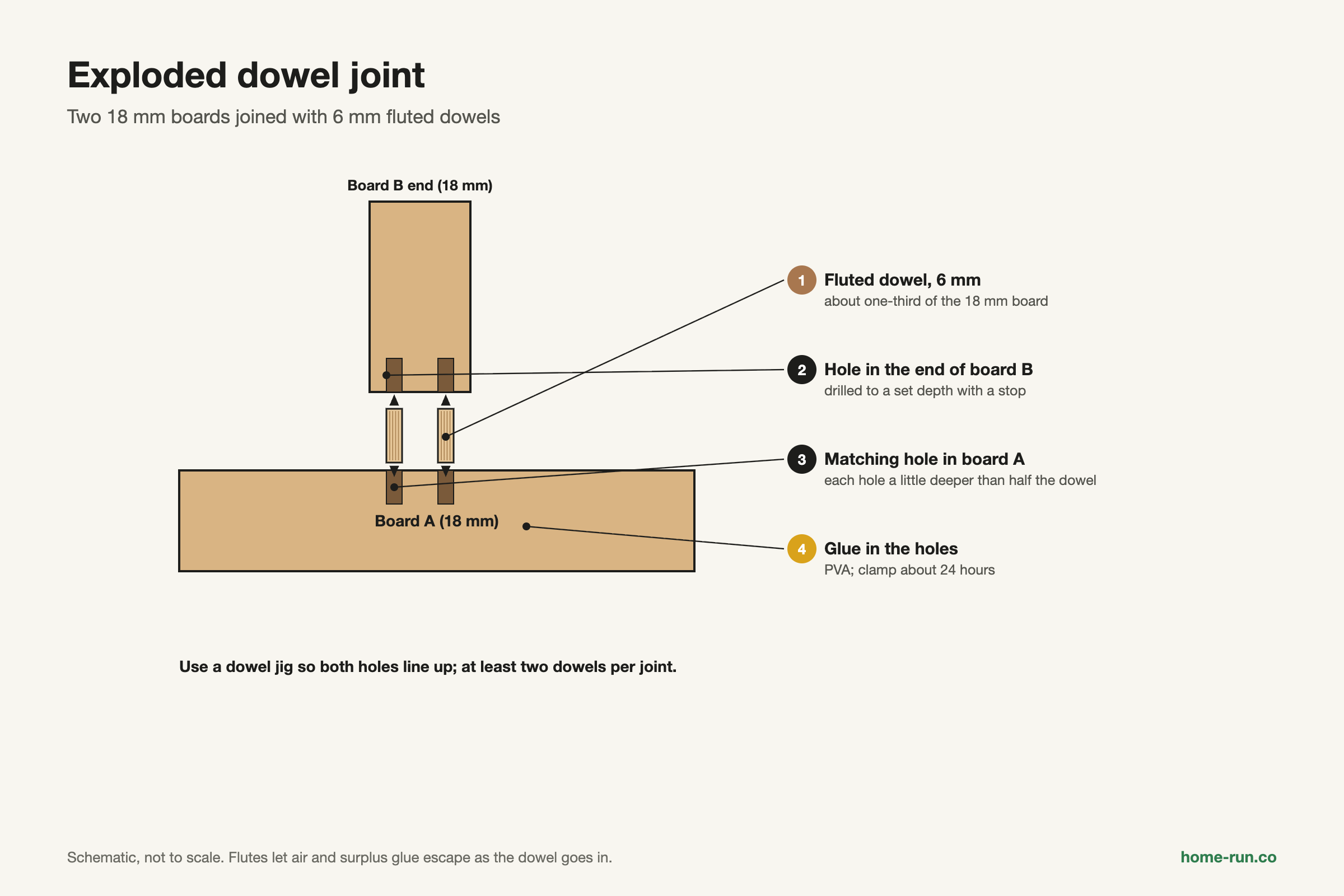
Most dowels are fluted (grooved along their length) so air and extra glue can escape.
In concrete roads and floors, a "dowel joint" means steel bars placed across a slab joint to transfer load. This guide covers the wood joint only.
Which Types of Dowel Joint Are Most Common?
Most dowel joints fall into six layouts, named by how the two pieces meet.
Common dowel joint layouts
Typical uses| Joint | How the pieces meet | Typical use |
|---|---|---|
| Edge-to-edge Common | Two boards side by side | Table tops, wide panels |
| Butt or T-joint | End of one piece into the face of another | Shelves, cabinet sides |
| Corner (frame) | Rail end into a leg or stile | Chairs, door frames |
| Mitre | Two 45° cuts | Picture and mirror frames |
| Through (exposed) Visible | Dowel passes right through and shows | Rustic or decorative work |
| Cross dowel | Metal barrel nut meets a bolt at 90° | Flat-pack beds and cots |
What Are the Advantages and Disadvantages of a Dowel Joint?
A dowel joint is cheap, strong and hidden, but it leaves little room for drilling errors.
Advantages
Why use dowelsFurniture and cabinets.
- Strong in solid wood when glued well
- Hidden from view, or shown as a feature
- Low cost: a jig, a drill and pins
- Easy to repeat on many joints
Disadvantages
Watch forWhere dowels go wrong.
- Holes must line up exactly
- Slower than screws or biscuits
- Loose fit or poor glue weakens it
- Not meant for heavy structural loads
What Tools Do You Need to Make a Dowel Joint?
You need a way to drill straight, matching holes, plus dowels, glue and clamps.
- Dowel jig: guides the drill square to the face and on the mark
- Dowel centres: small metal pins that transfer hole positions
- Power drill with a brad-point bit and a depth stop
- Fluted dowels in 6, 8 or 10 mm diameter
- Wood glue (PVA, polyvinyl acetate) and a small brush
- Clamps, a try square and a pencil
In India, hardwood dowel pins sell in bulk on IndiaMART, and hardware brands such as Häfele list 6 × 32 mm and 8 × 32 mm wooden dowels.
How Do You Make a Dowel Joint Step by Step?
Mark both pieces together, drill to a set depth, glue the holes and clamp.
- Mark: clamp the parts together and square a line across both at each dowel.
- Set the depth: fit a depth stop so the two holes total about 3 mm more than the dowel length.
- Drill: use the jig on the reference face and clear chips as you go.
- Dry-fit: push the parts together without glue and check that faces sit flush.
- Glue: coat the hole walls, tap the dowels into one piece, then glue the edges.
- Clamp: apply even pressure, wipe squeeze-out and leave it about 24 hours.
Use a dowel about one-third of the board thickness. A hidden dowel should be 2 to 2.5 times the board thickness long. Without the exact size, go slightly thicker.
Signs of a poorly made dowel joint:
- Faces do not sit flush after clamping
- A gap stays open at one end of the joint
- The board split near a dowel during assembly
- Dowels turn freely or pull out by hand
Is a Dowel Joint Stronger Than Screws, Biscuits or Mortise and Tenon?
A dowel joint is stronger than a biscuit joint and close to a mortise and tenon in one published shop test.
Dowel joint vs other common joints
Qualitative, from the sources listed| Joint | Main job | Relative strength | Best for |
|---|---|---|---|
| Dowel This guide | Align and hold | High in solid wood | Frames, carcasses, panels |
| Biscuit | Mainly alignment | Low | Edge-gluing panels |
| Screw or pocket screw | Fast mechanical hold | Moderate, no glue area | Quick builds, hidden backs |
| Mortise and tenon Traditional | Interlocking hold | High, similar to dowels | Doors, chairs, heavy frames |
In one shop test in 18 mm red oak, four 3/8 in (about 9.5 mm) dowels split the wood at slightly higher force than a mortise and tenon, which held slightly longer afterwards. The tester called the gap not significant.
Where Are Dowel Joints Used in Indian Homes?
In Indian homes, dowel joints hold modular wardrobes, kitchen cabinets, beds, chairs and door frames.
Factory carcasses in particle board or MDF often pair 8 mm dowels with cam locks. Dowels also hold well in plywood edges; see engineered wood vs plywood to choose a board.
Traditional Kerala carpenters (taccans) built timber houses with wooden joinery and no nails, using wooden wedges (kīla) to tighten joints.
To build skill, practise edge joints on scrap pine, then try a corner frame with a self-centring dowel jig.
Building furniture with dowels?
Boards, adhesives and hardware delivered across Bengaluru.