On this page
- What Is Welding and How Do the Main Types of Welding Differ?
- What Are the Main Types of Welding Processes?
- What Is MIG Welding (GMAW) and When Should You Use It?
- What Is TIG Welding (GTAW) and How Is It Different From MIG?
- What Are Stick (SMAW) and Flux-Cored (FCAW) Welding?
- Where Does Gas (Oxy-Acetylene) Welding Still Fit?
- What Other Types of Welding Will You Come Across?
- What Do Welding Joints and Positions 1G to 6G Mean?
- Where Is Welding Used on a Home Construction Site?
- How Do You Choose the Right Type of Welding for Your Project?
- What Safety Checks Should You Do Before Welding?
- Which Type of Welding Should You Learn First?
- Welding fuses two metal parts into one using heat, and usually a filler metal.
- The four types of welding you will meet most are MIG, TIG, Stick and oxy-acetylene gas.
- Stick welding suits Indian site work: no gas cylinder, and it copes with wind and rust.
- MIG is fastest indoors; TIG is best for thin stainless steel and aluminium.
- Process, joint and position are three different things; 1G to 6G describes position only.
Welding is a way of joining metal parts by melting their edges so they fuse into one piece as they cool. Most of the types of welding used in workshops add a filler metal and protect the molten pool with a gas or flux. On a home build, welding makes gates, grilles, railings, steel staircases and roof trusses.
What Is Welding and How Do the Main Types of Welding Differ?
The main types of welding differ by their heat source and by how they shield the molten metal from air. There are dozens of named processes, but they fall into five families:
- Arc welding: an electric arc melts the metal. MIG, TIG, Stick, flux-cored and submerged arc belong here.
- Gas welding: a fuel-gas flame, usually oxygen with acetylene, melts the metal.
- Resistance welding: a large current squeezed through overlapping sheets heats one spot.
- Solid-state welding: friction or pressure joins metal without melting it.
- Beam welding: a laser or electron beam melts a very narrow seam.
Shielding matters because oxygen and nitrogen in air make a molten weld porous and brittle. MIG and TIG use a shielding gas. Stick and flux-cored welding use flux, a mineral coating that burns into gas and leaves a protective crust called slag.
The process is how the weld is made (MIG, Stick). The joint is how the parts meet (butt, T). The position is how the work is oriented (flat, overhead). Many "types of welding" lists mix all three.
What Are the Main Types of Welding Processes?
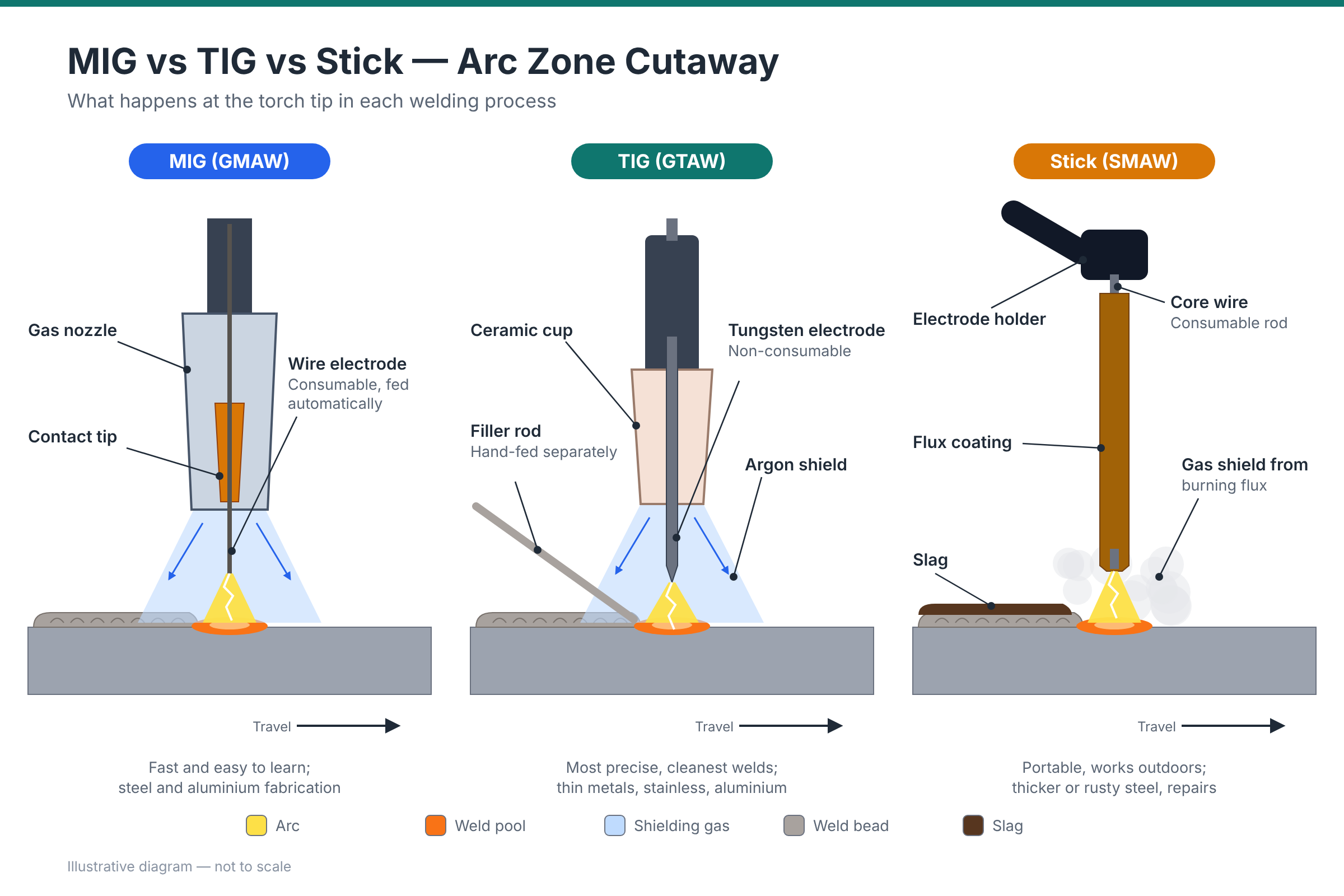
The main types of welding processes are MIG, TIG, Stick, flux-cored, oxy-acetylene gas, submerged arc and resistance spot welding. The table compares them in plain terms.
Types of welding at a glance
Qualitative comparison; ISO 4063 number in brackets| Process | Heat and shielding | Skill level | Best use | Main limitation |
|---|---|---|---|---|
| MIG / MAG, GMAW (131 / 135) Default pick | Arc from fed wire, gas cylinder | Easy to learn | Workshop fabrication, sheet metal | Wind blows the gas away |
| TIG, GTAW (141) | Arc from tungsten, argon gas | Hardest | Thin stainless steel, aluminium | Slow, needs clean metal |
| Stick, SMAW (111) Budget | Arc from coated rod, flux | Moderate | Site work, structural mild steel, repairs | Slag to chip, poor on thin sheet |
| Flux-cored, FCAW (114 / 136) | Arc from hollow flux-filled wire | Moderate | Thick sections, outdoor work | More fume and slag than MIG |
| Oxy-acetylene gas (311) | Flame, no electricity | Moderate | Cutting, brazing, thin repairs | Slow; rarely used for structural welds |
| Submerged arc, SAW (121) | Arc buried under granular flux | Machine-run | Long seams on thick plate and pipe | Flat positions, factory only |
| Resistance spot (21) | Current through clamped sheets | Machine-run | Car bodies, sheet-metal products | Thin overlapping sheet only |
What Is MIG Welding (GMAW) and When Should You Use It?
MIG welding is an arc process where a reel of wire feeds continuously through a hand-held gun while gas shields the weld. The full form of GMAW is Gas Metal Arc Welding, and MIG stands for Metal Inert Gas.
Strictly, MIG uses an inert gas such as argon. When the gas is active, such as carbon dioxide (CO₂), the process is MAG (Metal Active Gas). Most "CO₂ welding" of mild steel in Indian workshops is really MAG.
- Where MIG shines: fast, clean welds on sheet metal, furniture frames, gates and general fabrication.
- Where MIG struggles: outdoors in wind, on rusty or painted steel, and far from a gas supply.
If the job is indoors, the steel is clean and you weld every day, MIG is usually the fastest process to learn and run.
What Is TIG Welding (GTAW) and How Is It Different From MIG?
TIG welding is an arc process that uses a tungsten electrode that does not melt, with filler rod added by the welder's other hand. GTAW stands for Gas Tungsten Arc Welding, and the shielding gas is usually argon.
TIG gives the neatest, most controllable welds on stainless steel, aluminium and thin sections. The trade-off is speed and skill. Common TIG mistakes include:
- Touching the tungsten to the weld pool, which contaminates it
- Welding over oil, paint or oxide on the base metal
- Holding the torch at too steep an angle
MIG welding
SpeedWire electrode melts and becomes the filler.
- Fast and easy to learn
- One hand on the gun
- Good on mild steel sheet and plate
- Some spatter to clean
TIG welding
PrecisionTungsten makes the arc; filler is a separate rod.
- Slow and needs practice
- Both hands busy
- Best on stainless steel and aluminium
- Clean weld, little spatter
In short: choose MIG for output, TIG for appearance and thin or non-ferrous metal.
What Are Stick (SMAW) and Flux-Cored (FCAW) Welding?
Stick welding, or Shielded Metal Arc Welding (SMAW), uses a flux-coated rod as the electrode. The coating burns to make shielding gas and slag, so no gas cylinder is needed. Indian fabricators also call it MMA (manual metal arc) or simply "arc welding".
Stick is the process you will see on most Indian building sites. The machine is portable, the rods are cheap, and the flux copes with wind, dust and light rust.
Flux-cored arc welding (FCAW) feeds a hollow wire filled with flux through a MIG-style gun. Self-shielded wire needs no gas; gas-shielded wire uses gas as well. FCAW lays metal faster than Stick on thick sections.
How are stick electrodes classified?
Stick electrodes are classified by tensile strength, welding position and coating type. In India, IS 814:2004 covers covered electrodes for manual metal arc welding of carbon and carbon-manganese steel. Many packs also carry the American Welding Society (AWS) A5.1 code:
- E: arc welding electrode.
- First two digits: minimum tensile strength in thousands of psi (60 = 60,000 psi).
- Third digit: position; 1 means all positions.
- Fourth digit: coating and current. E6013 has a rutile (titania) coating for AC or DC; E7018 is low-hydrogen.
Low-hydrogen electrodes such as E7018 pick up moisture from humid air, which can cause cracking. Keep them sealed or in a rod oven, as the maker's instructions state.
Where Does Gas (Oxy-Acetylene) Welding Still Fit?
Gas welding melts metal with an oxygen and acetylene flame of about 3,200 °C, with filler rod added by hand. It needs no electricity. Today it is used mainly for cutting steel, brazing, heating and bending, and thin-sheet repairs, not structural welds.
A gas welder sets one of three flames by adjusting the gas flow:
- Neutral flame: equal oxygen and acetylene; used for most welding.
- Carburising flame: extra acetylene.
- Oxidising flame: extra oxygen.
Gas cylinders need careful handling; see the safety checks below.
What Other Types of Welding Will You Come Across?
Other types of welding are mostly factory or specialist processes. You are unlikely to use them on a house, but you will see the names:
- Submerged arc (SAW): the arc runs under a heap of flux; used for pressure vessels, large pipes and heavy plate.
- Plasma arc (PAW): a constricted, very hot arc for precise welding and plasma cutting.
- Electroslag: joins very thick plate in a single vertical pass.
- Resistance spot and seam welding: joins overlapping sheet with current and pressure, as in car bodies.
- Stud welding: fixes shear studs and bolts to steel beams and decking.
- Laser and electron beam: narrow, deep welds in precision manufacturing.
- Friction welding: a solid-state process that rubs parts together until they bond.
- Thermite welding: a chemical reaction pours molten steel to join rails.
What Do Welding Joints and Positions 1G to 6G Mean?
Welding positions describe how the work is oriented, and joints describe how the parts meet. The five basic joint types are:
- Butt joint: two parts edge to edge in the same plane.
- Lap joint: one part overlapping the other.
- T joint: one part standing square on the other.
- Corner joint: two parts meeting at an outside corner.
- Edge joint: two parallel parts welded along their edges.
In position codes, the number gives the orientation. G means a groove (butt) weld and F means a fillet weld, the triangular weld in a T or lap joint.
Types of welding positions
Plate and pipe codes| Code | Groove weld (G) | Fillet weld (F) |
|---|---|---|
| 1 Easiest | Flat plate; or pipe rolled horizontally | Flat |
| 2 | Horizontal plate; or pipe fixed vertically | Horizontal |
| 3 | Vertical plate | Vertical |
| 4 Hardest plate | Overhead plate | Overhead |
| 5G | Pipe fixed horizontally; welder works around it | — |
| 6G | Pipe fixed at 45°; covers every position | — |
Positions matter because welder qualification tests are done in a stated position. A welder who passes 6G pipe is usually trusted in easier positions too.
Where Is Welding Used on a Home Construction Site?
On a house in Bengaluru, welding is used mainly for mild-steel fabrication rather than the concrete frame. Typical jobs include:
- Main gates, window grilles and balcony or parapet railings
- MS staircases, sheet-roof trusses and purlins on the terrace
- Overhead water-tank stands and solar panel frames
- Embedded plates and brackets for later steel fixings
Stick welding with mild-steel electrodes is the usual choice for all of these. IS 816, the Indian code of practice for metal arc welding in general construction using mild steel, covers how such welds are made.
Do not tack-weld or splice TMT bars on site unless the structural engineer allows it. Welding heat can weaken a bar, and IS 456:2000, the Indian code for plain and reinforced concrete, expects bars to be lapped or joined as designed.
How Do You Choose the Right Type of Welding for Your Project?
Choose a welding process by answering five questions in this order:
- What metal? Mild steel suits any arc process. Stainless steel and aluminium point to TIG or MIG.
- How thick? Thin sheet needs MIG or TIG. Thick plate suits Stick or flux-cored.
- Indoors or outdoors? Wind rules out gas-shielded MIG and TIG; use Stick or self-shielded flux-cored.
- How neat must it look? Visible stainless railings justify TIG. Painted grilles do not.
- What power and budget? Many small inverter Stick machines run on single-phase supply. Check the machine's rating against your site connection.
Why heat input matters
Heat input is the energy put into each millimetre of weld. Too much causes distortion and burn-through on thin steel; too little causes poor fusion.
These numbers only show the arithmetic. Use the welding procedure or electrode maker's settings for real work.
Steel and hardware for your fabrication work
Order steel, hardware and metal primer with a GST invoice and delivery across Bengaluru.
What Safety Checks Should You Do Before Welding?
Every type of welding needs eye, skin, fume, fire and electrical protection. In India, IS 818:2019 sets the safety and health code for electric and gas welding and cutting. Check these before striking an arc:
- PPE: a welding helmet with the correct filter shade, leather gloves, full-sleeve cotton or flame-resistant clothing and safety boots.
- Ventilation: work in moving air or use fume extraction, especially indoors.
- Fire watch: clear paper, cloth, paint and fuel from the area; keep an extinguisher close.
- Electrical: dry hands and gloves, undamaged cables, and a proper earth clamp on the job.
- Cylinders: stand gas cylinders upright, chained, away from heat, with valves closed after work.
Welding galvanised pipe or GI sheet releases zinc oxide fume, which can cause metal fume fever. Grind the coating off near the weld, ventilate well, and repaint the joint with zinc-rich paint afterwards.
Which Type of Welding Should You Learn First?
Most welders learn Stick or gas welding first, then MIG, then TIG and pipe positions. The ITI Welder trade under the Directorate General of Training runs for one year and follows a similar path.
Gas and Stick basics
Safety, cutting, and flat and horizontal fillet welds on mild steel.
Stick in all positions
Vertical and overhead plate, up to 4G.
MIG/MAG
Wire-feed welding on mild-steel sheet and plate.
TIG
Stainless steel and aluminium, starting in the flat position.
Pipe qualification
5G and 6G pipe tests for industrial and pressure work.
Practise on offcuts of the same steel and thickness as the real job. Settings that work on 2 mm sheet will burn straight through thinner GI sheet.