On this page
- What Is the Meaning of a Title Deed?
- Why Does Proof of Ownership Matter in Property Deals?
- What Types of Deeds Prove Ownership in India?
- What Details Must the Deed Contain?
- How Do You Get the Title Deed of a Property in India?
- How Do You Check Ownership Before Buying?
- What Ownership Problems Come Up and How Are They Fixed?
- What Is the Difference Between a Title Deed and a Sale Deed?
- What Are the Next Steps Before You Buy?
- A title deed is the legal document that proves how you came to own a property, such as a registered sale deed or gift deed.
- Sales, gifts and mortgages of immovable property worth ₹100 or more must be registered at the Sub-Registrar office.
- An unregistered deed of this kind does not affect the property in law (Section 49, Registration Act).
- Registration alone does not cure a bad title: check the chain of deeds, EC, khata and tax records.
- In Karnataka, registration, EC and certified copies run through the Kaveri 2.0 portal.
The title deed meaning is simple: it is the legal document that shows a person owns a property and how that ownership reached them. In India, the title deed is usually the registered sale deed, gift deed, partition deed or similar deed in the owner's name.
Banks ask for it before a home loan and buyers check it before paying. Below: types, contents, Karnataka registration and verification.
What Is the Meaning of a Title Deed?
A title deed is a written, signed and registered document that transfers or declares ownership ("title") of land or a building. "Title" means the legal right to own, use and sell the property; the "deed" is the paper that records it.
Indian law does not define one document called a "title deed". The term covers whichever instrument gave the current owner their rights: for most Bengaluru flats and plots, the sale deed; for inherited land, often a partition deed or a will.
A title deed is evidence of title, not title itself. The owner's rights come from a valid transfer under the Transfer of Property Act, 1882, made by someone who had the right to transfer. The deed records that transfer, and registration under the Registration Act, 1908 makes it effective against the property.
Why Does Proof of Ownership Matter in Property Deals?
A title deed is important because it is the primary proof that you own a property and can sell, mortgage, gift or rebuild on it. Without a clear deed, you cannot safely sell the property or raise a loan against it.
- Proof of ownership: it names the owner and describes exactly what they own.
- Home loans: banks usually keep the original title deed while a loan is outstanding, through a mortgage by deposit of title deeds.
- Resale value: a clean chain of deeds makes a property easier to sell and finance than one with gaps or disputes.
- Approvals: civic bodies ask for the title deed before issuing khata, building plan sanction or an occupancy certificate.
A registered deed shows who bought the property. It does not prove that the seller had the right to sell it. That proof comes from the earlier deeds in the chain.
HomeRun Team
In 2025, the Supreme Court made the same point in Mahnoor Fatima Imran v. Viswesara Infrastructure. It held that registration is a procedural step and does not by itself cure defects in title.
What Types of Deeds Prove Ownership in India?
The main types of title deeds in India are the sale deed, gift deed, partition deed, settlement deed, release deed and will. A mortgage deed is related but does not transfer ownership.
Common title deed types and when they are used
Registration Act, 1908 and Transfer of Property Act, 1882| Deed | What it does | Typical use in India |
|---|---|---|
| Sale deed Most common | Transfers ownership for a price | Buying a flat, plot or house |
| Gift deed | Transfers ownership with no money paid | Parent gifting a plot to a child |
| Partition deed | Divides jointly owned property into shares | Family dividing ancestral land |
| Release (relinquishment) deed | One co-owner gives up their share to others | Sibling releasing a share in inherited home |
| Will | Passes property on the owner's death | Inheritance; registration is optional |
| Mortgage deed Not a transfer | Pledges property as loan security | Home or business loans |
Leases and rent agreements do not pass title; they only give a right of use, governed by state Rent Control Acts such as the Karnataka Rent Act, 1999.
Plots allotted by development authorities, such as the Bangalore Development Authority (BDA) or an Urban Improvement Trust (UIT) in Rajasthan, often start with an allotment letter or lease-cum-sale agreement. Full title passes only when the authority executes the final sale deed.
What Details Must the Deed Contain?
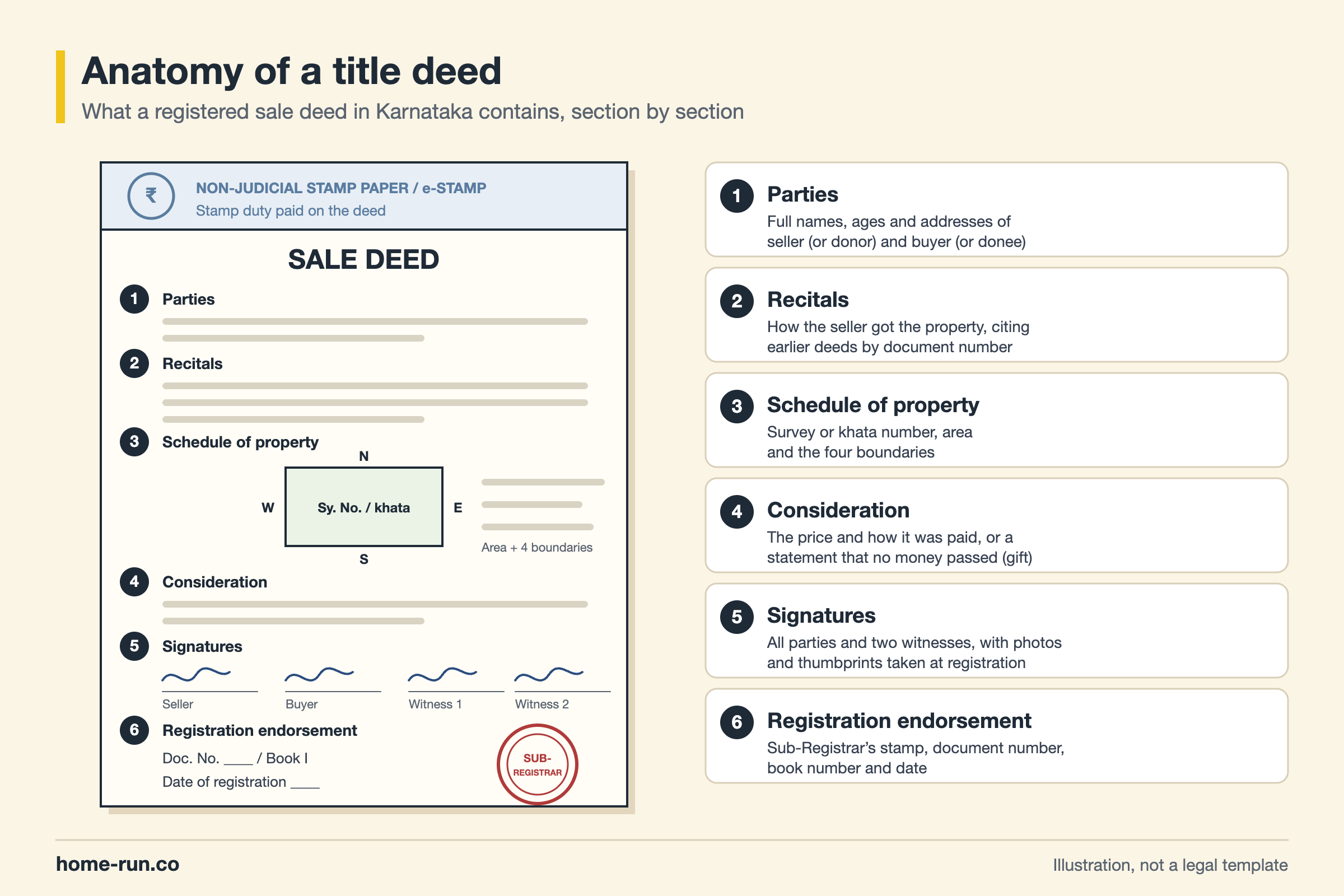
A title deed contains the names of the parties, an exact description of the property, the terms of transfer and the registration details. A standard title deed format in Karnataka covers the items below.
- Parties: full names, ages and addresses of the seller (or donor) and buyer (or donee).
- Recitals: how the seller got the property, citing earlier deeds by document number.
- Schedule of property: survey number or khata number, area, and the four boundaries. Our guide to land measurement units explains guntas, acres and sq ft.
- Consideration: the price and how it was paid, or a statement that no money passed (gift).
- Signatures: of all parties and two witnesses, with photographs and thumbprints taken at registration.
- Registration endorsement: the Sub-Registrar's stamp, document number, book number and date.
How Do You Get the Title Deed of a Property in India?
You get a title deed by having the sale, gift or other deed drafted, paying stamp duty, and registering it at the Sub-Registrar office within four months of signing. In Karnataka, most of this now runs through the Kaveri 2.0 portal (kaveri.karnataka.gov.in) of the Department of Stamps and Registration.
Check the title first
Collect the seller's deeds, EC, khata or RTC and tax receipts, and have a lawyer review them.
Draft the deed
A lawyer drafts the sale or gift deed with the property schedule and payment terms.
Enter details on Kaveri 2.0
Upload the draft, party and property details, and see the stamp duty and fee worked out on the guidance value or deal value.
Pay duty and fees
Pay stamp duty (5% above ₹45 lakh under the Karnataka Stamp Act, 1957) and the 2% registration fee online.
Book a slot and attend
Buyer, seller and two witnesses appear at the chosen Sub-Registrar office with originals and ID for photos and biometrics.
Collect the registered deed
Download or collect the registered deed, then apply to change the khata or RTC to your name.
Section 25 of the Registration Act allows up to four more months past the Section 23 deadline, on a fine of up to ten times the registration fee. Cheaper apartments sold for the first time pay a concessional 2% or 3% duty; above ₹45 lakh it is 5%. A 10% cess and a 2% urban surcharge are added on the duty, so check your exact slab on Kaveri.
Title clear? Start building.
Foundation and structure materials delivered across Bengaluru.
How Do You Check Ownership Before Buying?
You verify a title deed by matching it with government records and tracing the chain of ownership back at least 30 years. The best proof of ownership is a clean, registered chain of deeds backed by a matching EC, khata or RTC, and tax receipts.
- Get certified copies. Download certified copies of the deed and earlier deeds from Kaveri 2.0 and compare them with the seller's originals.
- Pull the EC. Search the EC on Kaveri for at least 30 years. Every sale, gift and mortgage should match the deeds you have.
- Check the khata. For Bengaluru urban property, confirm the e-khata is in the seller's name and note whether it is A-khata or B-khata.
- Check the RTC for land. For agricultural or converted land, the RTC (Record of Rights, Tenancy and Crops, also called Pahani) on the Bhoomi portal should show the seller as owner.
Red flags to watch for
- Gaps in the chain: an earlier owner appears in the EC but no deed explains how they got or passed the property.
- Mismatched details: survey number, area or boundaries differ between the deed, EC and khata.
- Power of attorney sales: the seller acts under a GPA (general power of attorney) instead of a registered deed in their own name.
- B-khata only: the property is recorded in Register-B, usually because of layout or building violations.
What Ownership Problems Come Up and How Are They Fixed?
The most common title deed problems are spelling or measurement errors, lost originals, missing links in the chain and ownership disputes. Most can be fixed, but each needs the right document and often a lawyer.
Title deed issues and usual fixes
Confirm the exact process with your lawyer| Problem | Usual fix |
|---|---|
| Wrong name, area or survey number | Register a rectification deed signed by all the original parties |
| Original deed lost | File a police complaint, publish a newspaper notice, and get a certified copy from the Sub-Registrar |
| Missing link in the chain | Trace and register the missing deed, or get legal heirs to sign a release deed |
| Rival claim or court case | Do not buy until the dispute is settled; the owner may need a court decree |
Section 49 of the Registration Act says a deed that must be registered, but is not, does not affect the property. A notarised sale agreement or GPA cannot make you the owner, however much you paid.
What Is the Difference Between a Title Deed and a Sale Deed?
A title deed is any document that proves ownership, while a sale deed is one specific deed that transfers ownership for a price. Once registered, your sale deed becomes your title deed, so for most buyers the two are the same document seen from different angles.
Title deed
Proof of ownershipPoint
- Broad term for any deed that shows title
- Can be a sale, gift, partition or release deed
- Read together with earlier deeds as a chain
- Kept by the owner or the lending bank
Sale deed
Record of a salePoint
- One deed for one sale between two parties
- Defined by Section 54, Transfer of Property Act
- Carries the price and stamp duty paid
- Becomes the buyer's title deed once registered
A patta is a revenue record issued in Tamil Nadu and some other states that names the person who holds and pays tax on land. Like Karnataka's RTC and khata, it supports a title deed but does not replace it.
What Are the Next Steps Before You Buy?
After checking the title deed, get a property lawyer's written title opinion, then move to agreement, payment and registration.
- Get a legal title report covering at least 30 years before paying a large advance.
- Apply for khata transfer (urban) or mutation in the RTC (land) right after registration.
- Before building, get plan sanction and a commencement certificate.
This guide explains general rules. Property law, stamp duty slabs and civic procedures change and differ by state, so consult a qualified property lawyer before you buy, sell or rectify a deed.