On this page
- What Is the Difference Between Carpet Area and Built-Up Area?
- What Is Carpet Area Under RERA?
- What Is Built-Up Area and How Is It Measured?
- What Do RERA and Karnataka RERA Require on Carpet Area?
- Where Does Super Built-Up Area Fit In?
- Carpet Area vs Built-Up Area vs Super Built-Up Area: Side by Side
- How Do You Calculate Carpet Area From Built-Up Area?
- How Does Carpet Area vs Built-Up Area Change the Price You Pay?
- What Mistakes Do Buyers Make When Comparing Areas?
- Which Area Should You Compare, and What Should You Check Before Booking?
- Carpet area is the floor you can actually use inside the flat's outer walls.
- Built-up area adds the outer walls and your exclusive balcony, so it is always larger.
- The RERA Act, 2016 defines carpet area in Section 2(k), and builders must sell on it.
- Super built-up area adds a share of lobbies, lifts and stairs; it is the biggest figure.
- Compare flats on price per carpet sq ft, never on headline rates.
In the carpet area vs built up area question, carpet area is the usable floor inside your flat's outer walls. Built-up area is carpet area plus the outer walls and any balcony that belongs only to you.
Two flats advertised at the same "sq ft" can therefore give you very different living space. This guide shows how each area is measured and how to check the numbers before you book.
What Is the Difference Between Carpet Area and Built-Up Area?
Carpet area measures the space you live on. Built-up area measures the space your flat occupies, walls and balcony included.
Carpet area
Compare on thisWhat you walk on and furnish.
- Rooms, kitchen and toilets
- Internal partition walls (RERA)
- Excludes outer walls and shafts
- Excludes exclusive balcony and terrace
- Legal basis for sale under RERA
Built-up area
Larger figureCarpet area plus what surrounds it.
- Everything in carpet area
- Thickness of the outer walls
- Exclusive balcony or verandah
- Usually excludes common areas
- Often quoted on older listings
What Is Carpet Area Under RERA?
Carpet area is the net usable floor area of an apartment, as defined in Section 2(k) of the Real Estate (Regulation and Development) Act, 2016 (RERA).
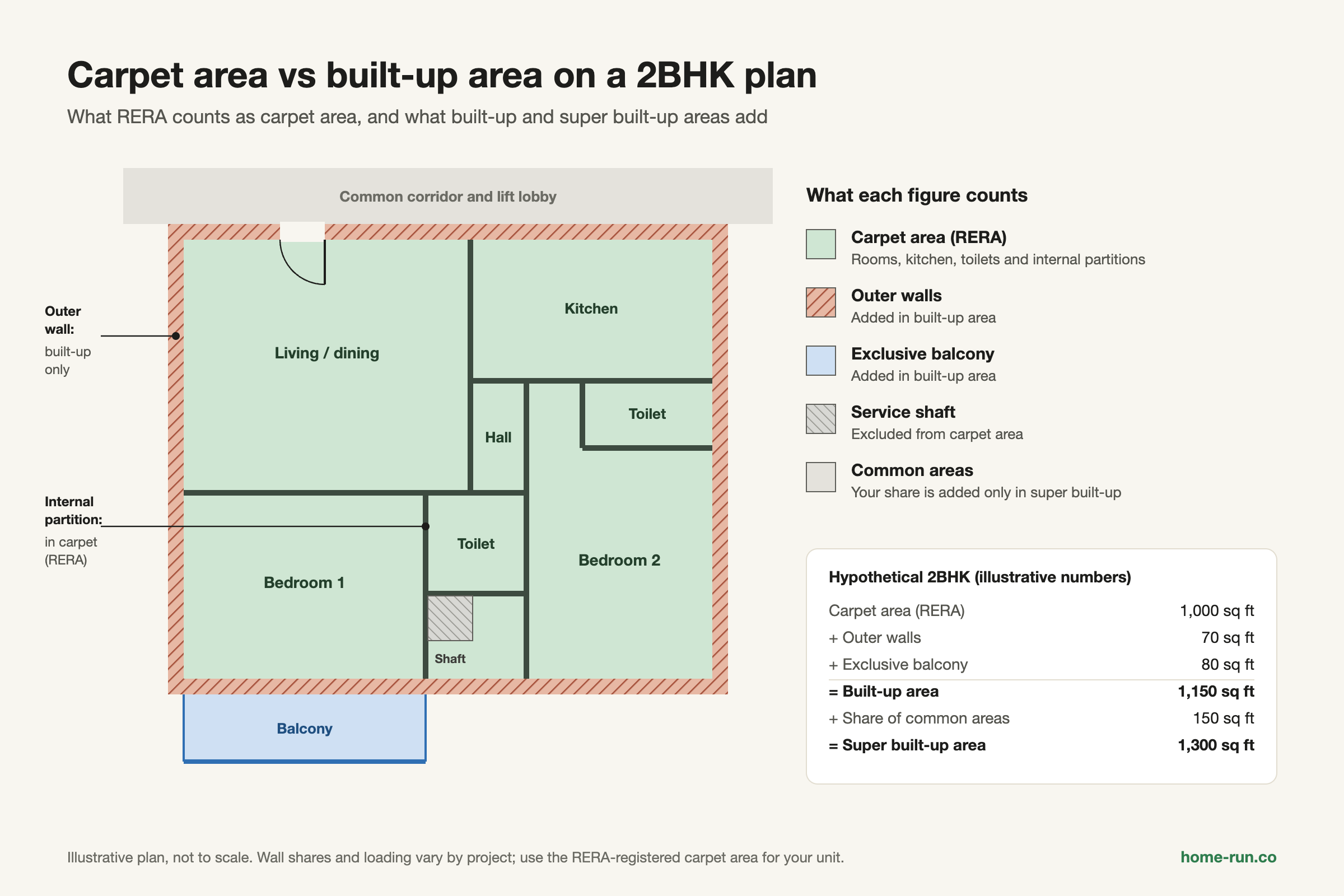
In plain words, the RERA carpet area:
- Excludes the area under external walls.
- Excludes service shafts, the exclusive balcony or verandah and the exclusive open terrace.
- Includes the area under the internal partition walls of the flat.
The Act's explanation calls a balcony or terrace "exclusive" when it is attached to your flat and meant only for your use.
IS 3861:2002, the Bureau of Indian Standards method for measuring plinth, carpet and rentable areas, also leaves out kitchens, toilets and corridors from carpet area. RERA counts them. So a "carpet area" on an old valuation can be smaller than the RERA figure for the same flat.
What Is Built-Up Area and How Is It Measured?
Built-up area is the carpet area plus the thickness of the outer walls plus any balcony or terrace reserved for your flat. It does not include shared spaces such as the lobby or stairs.
To measure built-up area, take the flat's outline at the outer face of its external walls, then add exclusive balconies. Where two flats share a wall, measurement practice usually splits that wall between them.
Plinth area is the IS 3861 term for the covered floor area including walls, close to built-up area. Covered area means the roofed part. Builders use both terms loosely, so ask what a listing includes.
What Do RERA and Karnataka RERA Require on Carpet Area?
RERA requires builders to disclose and sell flats on carpet area. Three provisions matter most to you:
- Section 4(2)(h): project registration must list the number, type and carpet area of the apartments for sale.
- Section 13(1): a builder cannot take more than 10% of the flat's cost before a registered agreement for sale.
- Section 13(2): the agreement follows the format each state prescribes.
In Karnataka, the Karnataka Real Estate Regulatory Authority (K-RERA) registers projects. The state notified its standard agreement-for-sale format in June 2020.
Model agreements under RERA rules typically let the builder charge extra only if carpet area grows by up to 3%. If the area shrinks, you get a refund for the shortfall. Check the exact clause in your own agreement.
Before you pay, look up the project on the K-RERA portal at rera.karnataka.gov.in and match the carpet area of your unit type.
Where Does Super Built-Up Area Fit In?
Super built-up area is built-up area plus your proportionate share of common spaces such as the lobby, lifts, staircases, corridors and clubhouse. Builders also call it saleable area or super area.
Carpet Area vs Built-Up Area vs Super Built-Up Area: Side by Side
RERA carpet area is the only one of the three figures with a fixed legal meaning.
The three area figures compared
Smallest to largest| Area | Includes | Excludes | Usable space? |
|---|---|---|---|
| Carpet area RERA basis | Rooms, kitchen, toilets, internal walls | Outer walls, shafts, exclusive balcony and terrace | Yes |
| Built-up area | Carpet area, outer walls, exclusive balcony | Common areas | Mostly |
| Super built-up area Marketing figure | Built-up area plus share of lobby, lifts, stairs, amenities | Nothing inside the project boundary you share | No |
How Do You Calculate Carpet Area From Built-Up Area?
You calculate carpet area by subtracting outer walls and exclusive balconies from built-up area. A ratio gives only an estimate, because wall thickness and balcony size vary by layout.
Developer guides put built-up area at about 10–20% above carpet area. Some bank guides cite a wider gap, with carpet area near 70% of built-up. Use the RERA-registered figure, not a ratio.
RERA documents often state area in square metres. Multiply by 10.764 to get square feet: 92.9 sq m is about 1,000 sq ft.
To check on site, measure each room wall to wall with a tape and add them up. Leave out balconies and shafts, then compare with the agreement. Remember that wall plaster and masonry thickness explain small gaps.
How Does Carpet Area vs Built-Up Area Change the Price You Pay?
The area a rate is quoted on changes the real cost per usable square foot. Divide the total price by the carpet area to compare fairly.
Three hypothetical quotes, recalculated on carpet area
Illustrative numbers, not market rates| Listing | Quoted rate | Total price | Carpet area | ₹ per carpet sq ft |
|---|---|---|---|---|
| Flat A, on super built-up 1,300 sq ft Looks cheap, isn't | ₹8,000 | ₹1,04,00,000 | 1,000 sq ft | ₹10,400 |
| Flat B, on built-up 1,200 sq ft | ₹8,800 | ₹1,05,60,000 | 1,020 sq ft | ₹10,353 |
| Flat C, on carpet 1,050 sq ft Best value | ₹9,800 | ₹1,02,90,000 | 1,050 sq ft | ₹9,800 |
A lower rate on a bigger, loaded area often works out dearer per square foot you can use. Never compare rates quoted on different area bases.
Carpet area also drives your fit-out budget. Floor tiles, paint for the ceiling and wardrobes are all sized to rooms, not to the super area.
What Mistakes Do Buyers Make When Comparing Areas?
Most area mistakes come from mixing up which figure a number refers to.
- Comparing a flat quoted on super built-up area with one quoted on carpet area
- Assuming the brochure figure is the RERA carpet area
- Counting the balcony as carpet area, or paying carpet rates for it
- Trusting a verbal area claim that the agreement does not state
Which Area Should You Compare, and What Should You Check Before Booking?
Compare flats on RERA carpet area and the price per carpet square foot. Take this checklist to the site visit:
- Ask for the RERA carpet area of your unit in writing.
- Confirm the project and unit type on the K-RERA portal.
- Get balcony and terrace areas listed separately.
- Ask what loading the builder applied to reach the super area.
- Check the agreement for sale states carpet area and the area-change clause.
- Work out the rate per carpet sq ft for every shortlisted flat.
At handover, re-measure and keep the occupancy certificate with your agreement. Keep copies of any indemnity bond you sign too.
Planning the interiors of your new flat?
Order by carpet area, room by room, with a GST invoice and delivery across Bengaluru.