On this page
- What Is Water Leakage in a House and Why Should You Act Fast?
- What Are the Common Sources of Leaks in Homes?
- What Are the Symptoms of Water Leakage in a House?
- How Do You Detect Water Leakage in a House?
- What Damage Does a Water Leak Cause Over Time?
- What Are the Repair Options for Each Type of Leak?
- Should You Fix a Water Leak Yourself or Hire a Professional?
- Who Should You Call for a Water Leak in Your House?
- How Can You Prevent Water Leakage After Repairs?
- Water leakage in a house comes from five main places: supply pipes, drain pipes, tanks, wet areas and the building shell (roof, walls, windows).
- When the leak appears tells you the source: only in rain, all the time, or only when a tap or shower runs.
- A 2-hour water meter test and a 10-minute toilet dye test rule plumbing in or out at no cost.
- Never paint or putty over a damp patch. Fix the source first, let the wall dry, then repair the finish.
- Plumbing leaks need a plumber; roof, wall and bathroom leaks need a waterproofing applicator; spreading cracks need a civil engineer.
Water leakage in a house is water escaping from a pipe, tank or fitting, or entering through the roof, walls or windows, and reaching places it should not.
This guide is the starting point: it helps you find which kind of leak you have. For deeper fixes, it links to our guides on water seepage in walls, leaking roof repair and bathroom waterproofing.
What Is Water Leakage in a House and Why Should You Act Fast?
Water leakage in a house is any uncontrolled flow of water into the structure or out of the plumbing. You should act fast because water keeps spreading inside walls and slabs even when the surface looks dry.
A leak left alone leads to:
- Structural damage: wet concrete lets steel bars rust and swell, which cracks and spalls plaster and concrete.
- Finish damage: blistering paint, salt deposits (efflorescence), loose tiles and swollen wooden doors and wardrobes.
- Health risks: damp walls grow mould. The World Health Organization (WHO) links damp and mouldy homes to more respiratory symptoms, respiratory infections and asthma attacks.
Leakage is water escaping from a defined point, such as a pipe joint or a crack in the terrace. Seepage is water slowly soaking through porous materials such as brick and plaster. One often causes the other, so trace the source before choosing a fix.
What Are the Common Sources of Leaks in Homes?
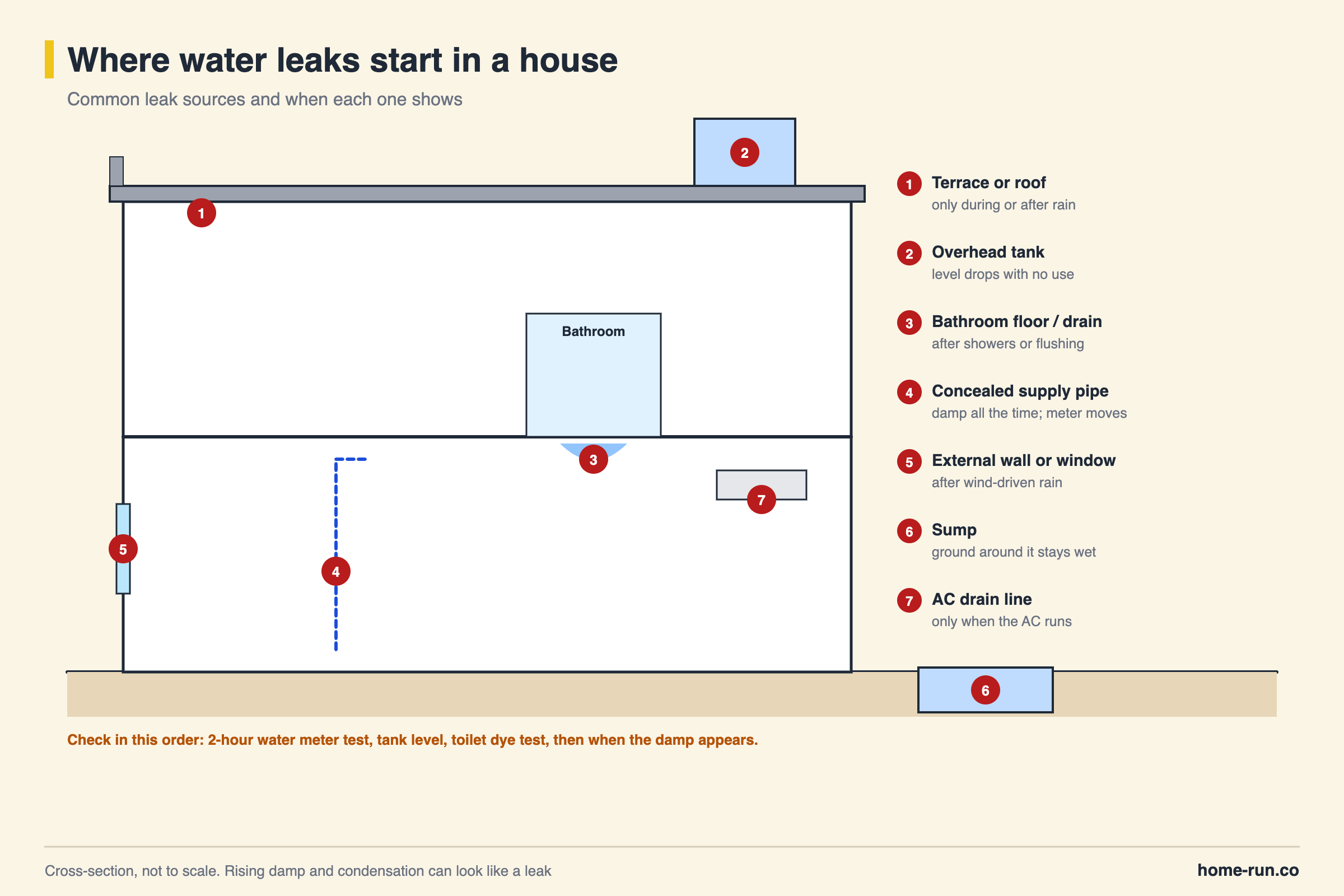
The common sources of leaks in Indian homes are supply pipes, drain pipes, tanks and sumps, wet areas and the building shell. Each leaves a different pattern.
Leak sources and the clue each one leaves
Match the pattern you see to the likely source| Source | Where the damp shows | Timing clue |
|---|---|---|
| Concealed supply pipe Runs 24/7 | Patch along a pipe route, behind a tap or mixer | Damp all the time; water meter moves with taps closed |
| Drain or waste pipe | Ceiling below a toilet or kitchen; stain near a stack | Worse after flushing, bathing or washing |
| Bathroom floor and walls | Ceiling below the bathroom; wall behind the shower | Appears after showers; grout or waterproofing has failed |
| Overhead tank or sump | Slab under the tank; ground around the sump | Water level drops with no use; overflow pipe running |
| Terrace or roof | Top-floor ceiling, often near outlets and parapet edges | Only during or after rain |
| External wall, window or sunshade | Inner face of outer walls, around window frames | After wind-driven rain |
| AC drain or washing machine line | Wall below the indoor AC unit; utility area | Only when the appliance runs |
Water leakage in a new house usually comes from workmanship, not wear. Watch for these signs in the first year:
- Untested concealed lines: pipes closed into walls before a pressure test.
- Skipped waterproofing: bathroom or terrace coating missing, thin or not taken up the walls.
- Poor terrace slope: water ponding for days after rain instead of reaching the outlets.
- Open joints: gaps around window frames, pipe sleeves and slab-to-wall junctions.
What Are the Symptoms of Water Leakage in a House?
The symptoms of water leakage in a house are damp spots, stains, peeling paint, a musty smell and a water bill or tank that empties faster than usual. Check your home against this list:
- Damp or darker patches on walls or ceilings, often with a brown ring at the edge
- Bubbling, flaking or peeling paint and white powdery salt deposits
- A musty smell or black and green mould spots in corners and behind furniture
- Loose or hollow-sounding floor tiles, or grout that stays wet
- The sound of running water when every tap is closed
- The overhead tank emptying sooner, or the pump running more often
How Do You Detect Water Leakage in a House?
You detect water leakage in a house by ruling sources out one at a time: plumbing tests first, then the timing of the damp, then detection tools.
- Do the water meter test. Close every tap and stop all water use. Note the meter reading, wait 2 hours, and read it again. Any change means a leak on the supply side.
- Split mains from tank. Many Bengaluru homes fill a sump and an overhead tank. Close the tank outlet valve and mark the water level. If the level falls with no use, the tank or its pipes leak.
- Dye-test every toilet. Add a few drops of food colouring to the cistern and do not flush. Colour in the bowl after 10 minutes means a leaking flush valve.
- Note when the damp appears. Rain only points to the roof, walls or windows. Constant damp points to supply pipes. Damp after use points to drains or the bathroom.
- Run one fixture at a time. Run the shower for 10 to 15 minutes, or fill the floor near the drain, and watch the ceiling below.
- Map the wet area. A moisture meter shows how far the dampness has spread and where it is wettest. That point is usually closest to the source.
- Call in leak detection for hidden lines. Specialists use thermal cameras, acoustic listening devices and pressure tests to find a concealed leak without breaking tiles.
A water meter only tells you water is being lost. A moisture meter measures how wet a wall or floor is, not where the water enters. A water leak detector (thermal camera or acoustic device) helps pinpoint the leak itself.
What Damage Does a Water Leak Cause Over Time?
A water leak damages finishes within weeks and the structure within months to years. The longer water sits in concrete and brick, the costlier the repair.
How leak damage progresses
Typical sequence; speed depends on the volume of water| Stage | What you see | What it means |
|---|---|---|
| Early Cheapest fix | Faint patch, slight discolouration | Fix the source; the finish usually recovers after drying |
| Spreading | Peeling paint, salt deposits, musty smell | Plaster and putty are soaked and need scraping and redoing |
| Biological | Mould spots, swollen woodwork | Health risk for children, elderly and anyone with asthma |
| Structural Urgent | Rust stains, cracks along bars, concrete falling off | Steel is corroding; get a civil engineer to assess |
What Are the Repair Options for Each Type of Leak?
The right repair depends on the source: replace or rejoin the pipe for plumbing leaks, re-grout or re-waterproof for wet areas, and seal or re-coat the shell for rain leaks.
Water leakage repair options by source
Start with the least invasive fix that removes the source| Source | Repair option | Who does it |
|---|---|---|
| Dripping tap or mixer | Replace washer, cartridge or spindle | DIY or plumber |
| Toilet flush valve | Replace flapper, seal or flush valve | DIY or plumber |
| Concealed supply pipe Find first | Locate, open a small section, replace the joint or length, pressure-test, close | Plumber, with leak detection |
| Drain or waste joint | Reseal or replace the fitting; clear chokes | Plumber |
| Bathroom tile joints | Re-grout with epoxy grout; seal around drains and pipes | Applicator |
| Bathroom waterproofing failed Major | Remove tiles, apply membrane, ponding test, retile | Waterproofing applicator |
| Terrace cracks or failed coating | Fill cracks; recoat with liquid membrane, or relay the slope | Waterproofing applicator |
| External wall and window gaps | Fill cracks, seal frames with sealant, apply exterior waterproof coating | Painter or applicator |
After the source is fixed, repair the damage in this order:
- Let the area dry fully. Keep it ventilated; a soaked wall can take weeks.
- Scrape off loose paint, putty and salt, and treat any mould with a fungicidal wash.
- Repair the plaster where it sounds hollow or crumbles.
- Prime and repaint once the surface is dry.
Painting, putty or "waterproof paint" on the inside face of a damp wall only hides the leak. The water stays in the wall, and the patch returns, often bigger.
Should You Fix a Water Leak Yourself or Hire a Professional?
Fix a leak yourself only when the source is visible and the fix is a part swap. Hire a professional for anything inside a wall, slab or waterproofing layer.
DIY fix
Visible, simple- Dripping tap, loose connection hose
- Toilet flapper or cistern seal
- Small grout gaps in a wall tile joint
- Blocked terrace outlet or rainwater pipe
Professional repair
Hidden or recurring- Meter test shows loss, source not visible
- Ceiling leak below a bathroom or terrace
- Damp returns after a previous repair
- Cracks, rust stains or fallen concrete
Who Should You Call for a Water Leak in Your House?
Call the professional who matches the source: a plumber for pipes and fittings, a waterproofing applicator for roofs, walls and bathrooms, and a civil engineer for structural signs.
- Plumber: taps, flush valves, supply and drain pipes, tank connections.
- Leak detection service: concealed pipe leaks that a meter test confirms but you cannot see.
- Waterproofing applicator: terrace, bathroom, sump, external wall and window leaks.
- Civil or structural engineer: rust stains, wide or growing cracks, spalling concrete.
- Apartment association: leaks from a shared stack, the terrace or the flat above.
Ask any contractor what they think the source is and how they confirmed it. Get the scope, materials, test method and warranty in writing before work starts.
In a flat, a leak from the unit above is usually the upper owner's repair, but agreements differ. Record photos and dates, and raise it with the owner and the association in writing.
How Can You Prevent Water Leakage After Repairs?
You prevent water leakage by checking the roof, wet areas and plumbing on a fixed calendar. Bengaluru gets the southwest monsoon from June to September and the northeast monsoon in October and November, with heavy storms often from April and May.
Dry-season check
Inspect the terrace coating, parapet tops and external walls for cracks.
Pre-monsoon prep
Clear terrace outlets, rainwater pipes and gutters. Reseal window frames and pipe sleeves.
During the rains
Check top-floor ceilings and outer walls after each heavy spell. Clear outlets again after storms.
Post-monsoon review
Note any new stains, re-grout wet areas, run the water meter test, and record what needs fixing.
Most roof and wall leaks start where water stands. Keep terrace outlets clear, keep slopes towards drains, and never let soil or pots block a rainwater pipe.
Waterproofing also needs upkeep. Recoat or repair it when you see these signs:
- Chalking, cracking or peeling of the terrace coating
- Water ponding on the terrace for more than a day after rain
- Grout lines in the bathroom staying dark long after a shower
Fixing a leak this week?
Waterproofing chemicals, pipes, fittings and plumbing supplies delivered across Bengaluru.