On this page
- What Is Concrete Mix Design?
- What Factors Influence Concrete Mix Design?
- Nominal Mix vs Design Mix: Which Does Your Project Need?
- How Do You Calculate Target Mean Strength?
- What Are the Steps in Concrete Mix Design as per IS 10262?
- Worked Example: M30 Concrete Mix Design Calculation
- What Are the Methods of Concrete Mix Design?
- How Are Trial Mixes Produced and Tested?
- How Does an Optimised Mix Design Save Money?
- What Should You Check Before and During Mix Design?
- What Should You Do After the Mix Design Is Approved?
- Concrete mix design sets the quantity of each ingredient per m³ so concrete reaches its grade, workability and durability.
- In India, follow IS 10262:2019 and check the result against IS 456:2000 Table 5.
- Design for a target mean strength: 38.25 N/mm² for M30 with an assumed standard deviation of 5.0.
- Nominal mixes (fixed ratios like 1:1.5:3) are allowed only up to M20.
- No calculation is final until trial mixes and 28-day cube tests confirm it in a lab.
Concrete mix design is the process of selecting concrete ingredients and working out their proportions so the mix meets a specified strength, workability and durability at the lowest practical cost. In India, the method is set by IS 10262:2019, the Bureau of Indian Standards (BIS) guideline for concrete mix proportioning.
This guide covers the design-mix process. For fixed ratios such as 1:2:4, see our concrete mix ratio guide.
What Is Concrete Mix Design?
Concrete mix design is the calculation that fixes how much cement, water, fine aggregate, coarse aggregate and admixture go into one cubic metre (m³) of concrete. The output is a set of weights in kg/m³ and a water-cement ratio.
A design mix is built from tests on the actual materials. That is the key difference from a nominal mix, which uses a fixed volume ratio for every site.
What are the objectives of concrete mix design?
- Strength: reach the specified characteristic compressive strength (fck) at 28 days.
- Workability: place and compact the concrete without segregation, measured by slump in mm.
- Durability: meet the maximum water-cement ratio and minimum cement content for the exposure.
- Economy: use the least cement that still meets the three goals above.
What are the basic components?
- Cement: the binder, such as OPC (IS 269) or PPC (IS 1489 Part 1).
- Water: reacts with cement; free water sets strength and workability.
- Fine aggregate: river sand or manufactured sand (M-sand), graded into Zones I to IV under IS 383.
- Coarse aggregate: crushed stone, usually 20 mm nominal maximum size for building work.
- Admixtures: chemicals such as superplasticisers (IS 9103) that cut water or change setting time.
- Mineral additions: fly ash or ground granulated blast furnace slag (GGBS), where used.
In a design mix you fix the water-cement ratio for strength and the water content for workability. Cement content is then just water ÷ w/c. Adding water on site raises the ratio and lowers strength. Our water-cement ratio guide explains why.
What Factors Influence Concrete Mix Design?
The main factors in concrete mix design are the grade, the exposure condition, the workability needed, the cement type and the size, shape and grading of the aggregates. Each one changes a specific step of the calculation.
- Grade of concrete: sets the target mean strength and the water-cement ratio.
- Exposure condition: IS 456 classes it as mild, moderate, severe, very severe or extreme.
- Workability and placing method: pumping or congested steel needs a higher slump.
- Cement type and strength: OPC 43, OPC 53 or PPC read off different strength curves.
- Aggregate size and shape: bigger and rounder aggregate needs less water.
- Sand grading zone: finer sand (Zone III or IV) allows a larger share of coarse aggregate.
- Site quality control: poor control means a higher standard deviation and a richer mix.
Durability limits for reinforced concrete, IS 456:2000 Table 5
20 mm nominal maximum aggregate| Exposure | Min cement (kg/m³) | Max free w/c | Min grade |
|---|---|---|---|
| Mild | 300 | 0.55 | M20 |
| Moderate Most house work | 300 | 0.50 | M25 |
| Severe | 320 | 0.45 | M30 |
| Very severe | 340 | 0.45 | M35 |
| Extreme | 360 | 0.40 | M40 |
IS 456 Table 3 classes concrete buried in non-aggressive soil, or exposed to rain, as moderate. Bengaluru is inland, so most house elements fall in the mild or moderate class. Coastal Karnataka sites often sit higher.
IS 10262:2019 tells you how to proportion a mix. IS 456:2000, the code for plain and reinforced concrete, sets the durability limits the mix must pass. For roads and bridges, the Ministry of Road Transport & Highways (MORT&H) Specifications for Road and Bridge Works and IRC:44 apply instead of house-building practice.
In Karnataka, M-sand is widely used, and the state PWD has required it on larger public projects. M-sand grading and fines content vary by quarry. Always design with a sieve analysis of the sand you will actually buy.
Nominal Mix vs Design Mix: Which Does Your Project Need?
A nominal mix uses fixed volume proportions for a grade, while a design mix is calculated and lab-tested for your materials. IS 456:2000 Clause 9.1 says design mix concrete is preferred, and nominal mix may be used only for M20 or lower.
Nominal mix
Small worksPoints
- Fixed ratios such as 1:2:4 or 1:1.5:3
- Allowed only for M5 to M20
- No lab design; uses more cement as a margin
- Strength varies with local sand and stone
Design mix
Required above M20Points
- Weights per m³ from IS 10262:2019
- Any grade, including M25, M30 and above
- Trial mixes and cube tests confirm it
- Often less cement for the same strength
Nominal mix proportions, IS 456:2000 Table 9
Cement : sand : coarse aggregate| Grade | Typical proportion | Typical use |
|---|---|---|
| M5 | 1:5:10 | Lean levelling course |
| M7.5 | 1:4:8 | Bedding under footings |
| M10 | 1:3:6 | PCC below footings |
| M15 | 1:2:4 | PCC flooring, plain work |
| M20 Upper limit | 1:1.5:3 | Small RCC works |
Grades M25, M30 and above must be designed. Our M30 concrete ratio explainer covers that grade's typical numbers.
How Do You Calculate Target Mean Strength?
Target mean strength is the average cube strength the mix must reach so that very few results fall below the grade. IS 10262:2019 Clause 4.2 takes the higher of two formulas.
Assumed standard deviation and factor X, IS 10262:2019
Good site control| Grade | Assumed s (N/mm²) | X (N/mm²) | Target f′ck (lower grade) |
|---|---|---|---|
| M10–M15 | 3.5 | 5.0 | 15.78 (M10) |
| M20–M25 | 4.0 | 5.5 | 26.60 (M20) |
| M30–M60 Example grade | 5.0 | 6.5 | 38.25 (M30) |
| M65 and above | 6.0 | 8.0 | 74.90 (M65) |
What Are the Steps in Concrete Mix Design as per IS 10262?
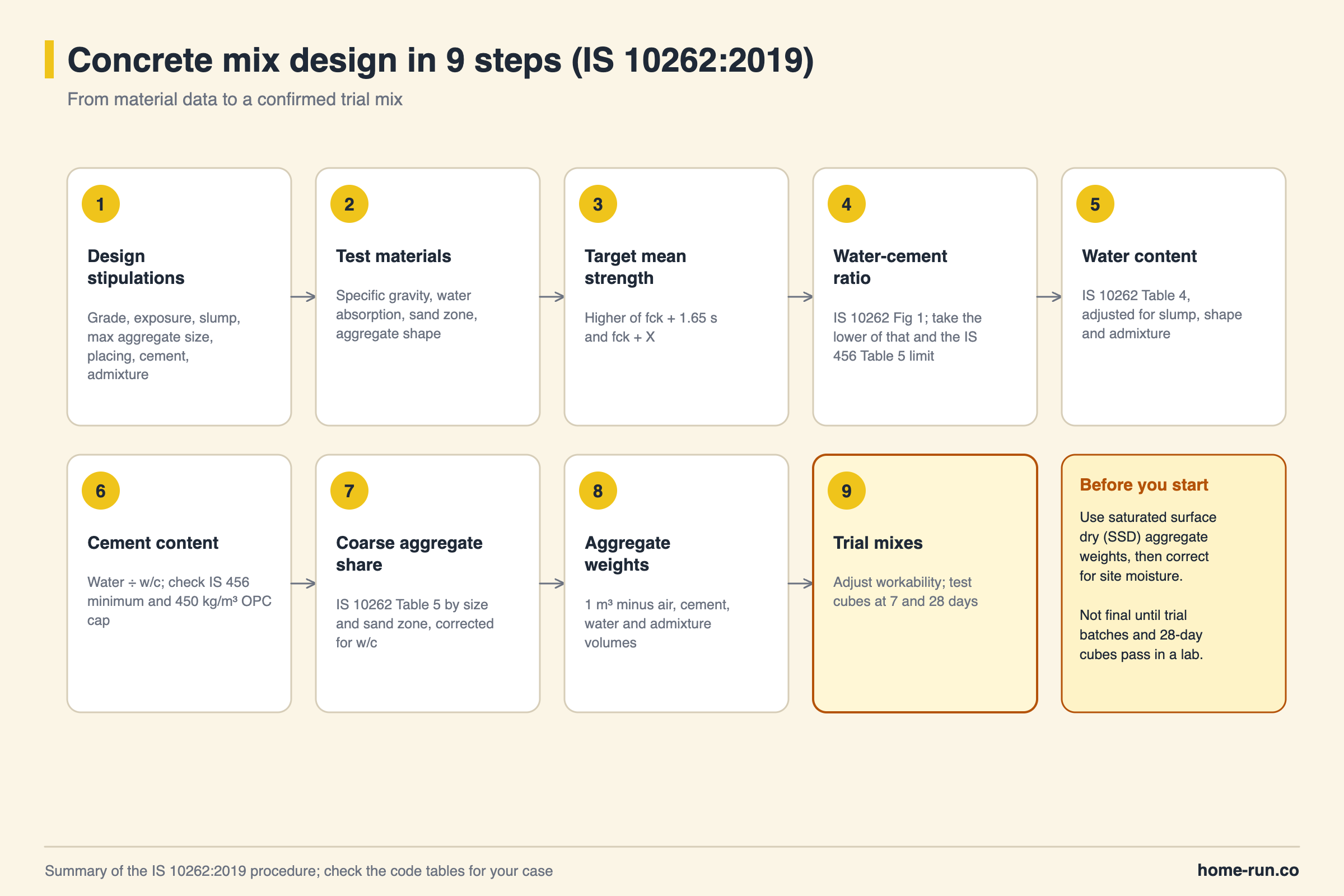
Concrete mix design under IS 10262:2019 runs in nine steps, from collecting material data to adjusting trial mixes. Work on saturated surface dry (SSD) aggregate weights, then correct for site moisture.
- Collect the design stipulations: grade, exposure, slump, maximum aggregate size, placing method, cement type and any admixture.
- Test the materials: specific gravity of cement and aggregates, water absorption, sand grading zone and aggregate shape.
- Calculate the target mean strength: the higher of fck + 1.65 s and fck + X.
- Select the water-cement ratio: read it from IS 10262 Figure 1 for your cement, then take the lower of that and the IS 456 Table 5 limit.
- Estimate the water content: start from IS 10262 Table 4, adjust for slump, aggregate shape and admixture.
- Calculate the cement content: water ÷ w/c, then check it against the IS 456 minimum and the 450 kg/m³ OPC cap.
- Fix the coarse aggregate share: from IS 10262 Table 5 by aggregate size and sand zone, corrected for w/c.
- Calculate aggregate weights: subtract air, cement, water and admixture volumes from 1 m³ and split the rest.
- Run trial mixes: adjust for workability, test cubes at 7 and 28 days, then fix the final mix.
How is the water content chosen?
Water content comes from IS 10262:2019 Table 4, then gets adjusted. The base values assume angular aggregate in SSD condition at 50 mm slump.
Base water content and entrapped air, IS 10262:2019
Per m³, angular aggregate, 50 mm slump| Nominal max aggregate size | Water (kg/m³) | Entrapped air | Coarse aggregate share, Zone II at w/c 0.50 |
|---|---|---|---|
| 10 mm | 208 | 1.5% | 0.50 |
| 20 mm Common | 186 | 1.0% | 0.62 |
| 40 mm | 165 | 0.8% | 0.71 |
- Slump: add about 3% water for every 25 mm above 50 mm.
- Aggregate shape: reduce by about 10 kg for sub-angular, 15 kg for gravel with some crushed particles, 20 kg for rounded gravel.
- Admixture: water reducers cut water by about 5–10%; superplasticisers by about 20–30% or more.
How is the coarse aggregate share corrected?
The Table 5 share applies at w/c 0.50. Add 0.01 for every 0.05 drop in w/c, and subtract 0.01 for every 0.05 rise. For pumped concrete, IS 10262 allows up to 10% less coarse aggregate.
All design weights assume SSD aggregate. Wet M-sand in the monsoon can carry several percent surface water. Deduct that from mixing water and add it to the sand weight, or the real w/c will be higher than designed.
Worked Example: M30 Concrete Mix Design Calculation
This M30 concrete mix design follows IS 10262:2019 for a reinforced slab in severe exposure. The inputs are assumptions for illustration; your lab must use measured values.
- Grade and exposure: M30, severe (IS 456 limit: w/c 0.45, cement 320 kg/m³ minimum).
- Cement: OPC 53 grade (IS 269), specific gravity 3.15.
- Aggregates: 20 mm crushed angular stone, SG 2.74; Zone II sand, SG 2.65; both SSD.
- Workability: 75 mm slump, placed by hand, good site control.
- Admixture: PCE superplasticiser, SG 1.145, dosage 0.8% by cement weight, 20% water reduction.
The total comes to about 2,466 kg/m³, a normal density for structural concrete. At 365 kg, the mix needs about 7.3 bags of 50 kg cement per m³.
The w/c of 0.42 and the 20% water reduction are illustrative. A qualified structural engineer or NABL-accredited lab must design the actual mix, read Figure 1 for your cement and run trial mixes before any pour.
What Are the Methods of Concrete Mix Design?
The main methods of concrete mix design are the Indian Standard (IS) method, the ACI method, the British DOE method and older empirical methods such as maximum density and fineness modulus. Indian building projects use the IS method.
Common concrete mix design methods compared
Conceptual comparison| Method | Basis | Where it is used |
|---|---|---|
| IS method India | IS 10262:2019; w/c from strength curves, water from tables, absolute volume | Buildings and most Indian structural work |
| ACI method | ACI 211.1 tables of water and dry-rodded coarse aggregate volume | USA and projects specified to ACI codes |
| DOE method | UK Department of the Environment charts for free w/c and water | UK and British-specified projects |
| IRC:44 method | Flexural strength based design for pavement quality concrete | Concrete roads under MORT&H and IRC specifications |
| Maximum density method | Grades aggregates to an ideal curve for the fewest voids | Teaching and aggregate blending |
| Fineness modulus method | Combines aggregates to a target fineness modulus | Older practice; now mostly academic |
Concrete mix design software and online calculators automate the same IS 10262 steps. They speed up the arithmetic but cannot replace material tests or trial cubes.
IS 10262:2019 also adds guidance for self-compacting concrete, high strength concrete and mass concrete, and for mixes with fly ash or GGBS.
How Are Trial Mixes Produced and Tested?
Trial mixes are small lab or site batches that check whether the calculated mix actually reaches its slump and strength. IS 10262:2019 Clause 5.8 sets out a sequence of trials.
Calculated mix
Batch the calculated weights and measure slump and cohesion.
Workability fixed
Adjust water or admixture until the slump is right; recalculate the mix.
w/c bracket
Keep Trial 2 water and vary w/c by about ±10% of the selected value.
Cube tests
Crush 150 mm cubes (IS 516) and plot strength against w/c.
From the plot of the three w/c values, pick the ratio that meets the target mean strength. That becomes the approved mix for site batching.
- Use site materials: the same cement brand, sand source and stone as the job.
- Weigh, do not measure by volume: use calibrated scales for every ingredient.
- Record everything: batch time, temperature, slump, cube IDs and curing.
- Cure cubes properly: keep them in water at the standard temperature until testing.
- Cement is alkaline and causes skin burns: wear gloves, boots and eye protection.
- Wear a dust mask when tipping cement or dry-sieving aggregates.
- Keep hands out of a running mixer and switch it off before cleaning.
Slump is the workability check at every trial. Our slump value guide covers the test and typical ranges.
How Does an Optimised Mix Design Save Money?
An optimised concrete mix design saves money mainly by using the least cement that still meets strength and durability. Cement is usually the costliest ingredient per m³.
- Less cement: a tested design avoids the extra margin built into nominal ratios.
- Admixtures: a superplasticiser cuts water, so the same w/c needs less cement.
- Mineral additions: fly ash or GGBS can replace part of the OPC where approved.
- Fewer failures: a verified mix lowers the risk of failed cubes, core tests and rework.
- Longer life: a correct w/c reduces cracking, corrosion and repair later.
Each 25 mm of extra slump adds about 3% water under IS 10262. At a fixed w/c, cement rises by the same 3%. Ask for only the slump your placing method needs, and use admixture rather than water to get more.
What Should You Check Before and During Mix Design?
Check that the design inputs and material test data are complete before any calculation starts. Missing data is the most common reason a design mix fails on site.
Pre-mix design readiness checklist
- Grade, exposure class and slump are written in the structural drawings or specification.
- Cement test certificate is available (grade, 28-day strength, specific gravity).
- Sand sieve analysis gives the grading zone under IS 383.
- Coarse aggregate size, shape, specific gravity and water absorption are tested.
- Admixture data sheet gives dosage, specific gravity and water reduction.
- Lab has a mixer, slump cone, cube moulds and a curing tank ready.
Red flags in concrete mix design
- The w/c in the design is higher than the IS 456 Table 5 limit for the exposure.
- Cement content is below the IS 456 minimum or above 450 kg/m³ OPC.
- The design uses textbook specific gravities instead of tested values.
- No trial mix or cube results are attached to the design report.
- Water is added at site to "loosen" the mix without engineer approval.
What Should You Do After the Mix Design Is Approved?
After approval, convert the SSD weights into field batch weights and control every batch against the approved design. The work shifts from the lab to site quality control.
- Adjust for moisture: correct water and aggregate weights daily for surface moisture and absorption.
- Batch by weight: use a weigh batcher or a ready-mix plant for design-mix grades.
- Sample on site: make cubes at the frequency set in IS 456 and test at 28 days.
- Track results: once 30 results exist, recalculate s and refine the mix.
- Stay current: use IS 10262:2019 (second revision), not the 2009 edition.
For grades up to M20 on small works, a nominal mix may still apply. Check IS 456 Table 9 for those proportions and water limits.
Sourcing materials for a design mix?
Cement, sand, aggregates and steel delivered across Bengaluru.