On this page
- What Is a Transit Mixer?
- How Does the Drum Rotate to Mix, Agitate and Discharge?
- How Much Concrete Does a Transit Mixer Carry?
- What Does IS 4926 Say About Ready-Mix Delivery Time?
- What Specifications Should a Buyer Compare?
- How Do You Maintain and Operate the Truck Safely?
- Should You Buy a Truck or Order Ready-Mix?
- A transit mixer is a truck-mounted rotating drum that carries plant-made concrete to site.
- Nominal capacity runs 6–12 m³, about 52–63% of the drum's volume.
- IS 4926:2003 asks for discharge within 2 hours of loading.
- No water may go into the drum at site unless you ask for it and sign the delivery ticket.
A transit mixer is a truck with a rotating drum that carries fresh concrete from a batching plant to a construction site. The turning drum keeps the concrete uniform and workable until it is poured.
Sites also call it an RMC truck or a concrete truck mixer.
What Is a Transit Mixer?
A transit mixer is a mobile concrete carrier: a truck chassis with an inclined drum, spiral blades, a water tank and a chute. A batching plant weighs and loads the materials. Battery-electric 7 m³ models, shown by Schwing Stetter India and Qucev at EXCON 2025 in Bengaluru, are now arriving.
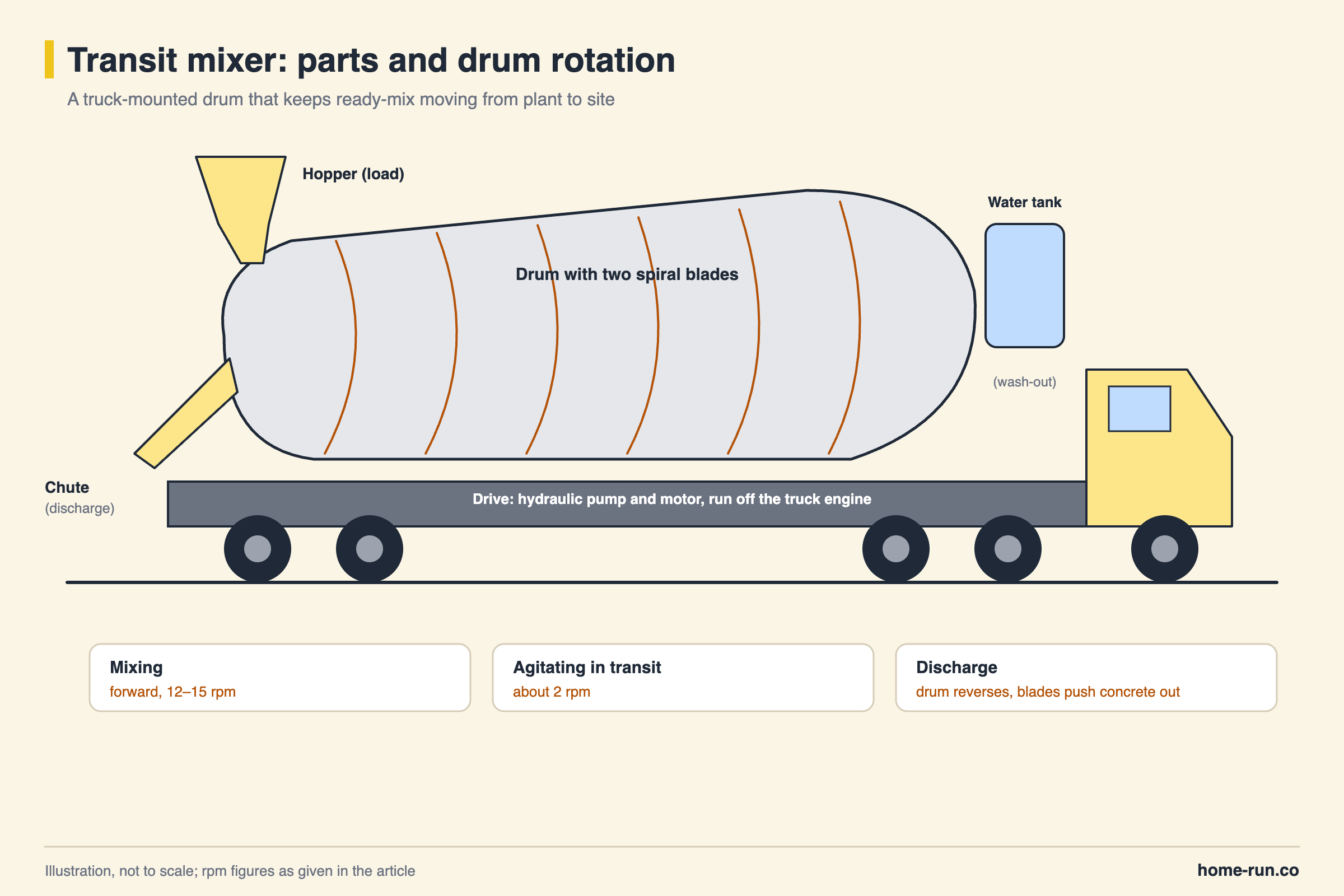
- Drum: an inclined steel vessel with two spiral blades inside.
- Drive: a hydraulic pump and motor, run off the truck engine.
- Hopper, chute and water tank: to load, discharge and wash out.
A concrete mixer mixes small batches on site. A transit mixer carries ready-mix from a plant. A concrete pump lifts it from the truck to the slab.
How Does the Drum Rotate to Mix, Agitate and Discharge?
The transit mixer drum turns forward to mix and carry concrete, and in reverse to push it out. The spiral blades fold the concrete inward, then lift it to the chute.
Transit mixer drum speeds by stage
Typical values; check the maker's data plate| Stage | Drum direction | Typical speed |
|---|---|---|
| Mixing Truck-mixed | Forward | 12–15 rpm |
| Agitating in transit | Forward | About 2 rpm |
| Remixing at site | Forward | At least 2 min |
| Discharge | Reverse | Varied to control flow |
Mixing typically takes 50–100 drum revolutions. Long churning beyond about 300 revolutions heats the mix and cuts slump.
IS 5892:2004 is the BIS specification for concrete transit mixers. Its original 1970 edition set mixing at 4–18 rev/min and agitating at 2 rev/min or more.
How Much Concrete Does a Transit Mixer Carry?
A transit mixer carries its nominal capacity in cubic metres (m³) of compacted fresh concrete, usually 6–10 m³ in India. The drum itself is much larger, since it needs space to fold the concrete.
Nominal capacity vs drum volume, Schwing Stetter AM series
Manufacturer data| Model | Nominal (m³) | Drum volume (litres) | Fill ratio |
|---|---|---|---|
| AM 6 C | 6 | 11,530 | 52% |
| AM 7 C City size | 7 | 12,710 | 55.1% |
| AM 10 C | 10 | 17,040 | 58.7% |
| AM 12 C | 12 | 19,170 | 62.6% |
6 m³ and 7 m³ trucks suit narrow city lanes.
For the mix itself, see our M20 concrete ratio guide.
What Does IS 4926 Say About Ready-Mix Delivery Time?
IS 4926:2003, the Indian code of practice for ready-mixed concrete, says concrete should be discharged from the truck mixer within 2 hours of loading. Loading time starts when water meets the cement and aggregate.
- Longer periods: allowed with retarders, in cool humid weather or for chilled concrete.
- At site: empty a full load within 30 minutes of arrival; after that, responsibility shifts to the buyer.
- Remixing: at least 2 minutes at site.
- Slump tolerance: ±25 mm or ±one-third of the specified slump, whichever is less.
- Delivery ticket: shows grade, quantity in m³, truck number and loading time.
IS 4926:2003 bars extra water unless the buyer requests and signs for it. Check the ticket's loading time, then run a slump test before the chute swings over the formwork.
What Specifications Should a Buyer Compare?
The specifications that matter most are drum capacity, chassis power, drum drive and build quality. Indian trucks pair an Ashok Leyland, Tata, Mahindra or BharatBenz chassis with a drum from Schwing Stetter, AJAX, Putzmeister, Conmat or Macons.
- Drum capacity: sets the trips per pour and which roads the truck can use.
- Chassis and engine: decide laden hill climbing and fuel use.
- Drum drive and blades: worn blades or a weak pump slow discharge and mix poorly.
- Water system: a metered feed, since IS 4926 wants added water measured.
Transit mixers are special-purpose vehicles: concrete-mixer lorries sit under HS code 8705 40.
Price depends on chassis, drum size, emission norm and body maker, and portal prices vary widely. Get a written on-road quote from the dealer before comparing.
How Do You Maintain and Operate the Truck Safely?
You maintain a transit mixer by washing the drum after every load, checking blades and hydraulics, and fitting genuine spare parts. Hardened build-up cuts capacity.
- Check tyres, brakes, lights, chute locks and hydraulic hoses.
- Wash the drum, hopper and chute after each discharge.
- Never enter the drum unless the engine is off and locked out.
- Take turns slowly when loaded.
Should You Buy a Truck or Order Ready-Mix?
Buy a transit mixer only if you run a batching plant or pour concrete most weeks. For a house, ordering ready-mixed concrete (RMC) or renting trucks costs less and leaves upkeep to the supplier.
Buy a transit mixer
Fleet ownersPoints
- Fits plants and contractors pouring daily
- Full control of truck scheduling
- You carry loan, driver, insurance and upkeep
Order RMC or rent
Home buildersPoints
- Fits one-off slabs, footings and columns
- Pay per m³ delivered
- Supplier handles drivers, washing and repairs
Plan RMC deliveries around Bengaluru Traffic Police curbs on heavy goods vehicles, reported in 2024 as 7–11 am and 4–10 pm on weekdays. Confirm current timings with your plant.
Preparing for a concrete pour?
Cement, steel and site hardware delivered across Bengaluru.