On this page
- What Is the Water Cement Ratio in Concrete?
- Why Does Extra Water Weaken Concrete?
- How Do You Calculate the Water Cement Ratio?
- What Is the Maximum Water Cement Ratio as per IS 456?
- Which Ratio Suits M20, M25 and M30 Concrete?
- How Does a Slump Test Show Extra Water?
- Which Site Mistakes Add Too Much Water?
- How Can You Cut Water Without Losing Workability?
- What Should You Check Before the Pour?
- The water cement ratio is the weight of free water divided by the weight of cement in a mix.
- A lower ratio gives stronger, less porous concrete, but a very low ratio needs an admixture to stay workable.
- IS 456 caps RCC at 0.55 (mild) down to 0.40 (extreme) exposure.
- At 0.50, one 50 kg bag takes 25 litres of water, counting the water already in wet sand.
- When the mix is too stiff, use a superplasticiser, not extra water.
The water cement ratio (w/c ratio) is the weight of water in a concrete mix divided by the weight of cement. A ratio of 0.50 means 0.5 kg, or half a litre, of water for every 1 kg of cement.
It is the biggest single control you have over concrete strength and durability on site. IS 456:2000, the Indian code of practice for plain and reinforced concrete, sets a maximum ratio for every exposure condition.
What Is the Water Cement Ratio in Concrete?
The water cement ratio is free water divided by cement, both by weight. Free water is the water left to react with cement and lubricate the mix, after the aggregates have absorbed their share.
When water meets cement, hydration starts. The cement forms a gel, mainly calcium silicate hydrate, that binds sand and stone into solid concrete.
Cement needs only about 0.23 to 0.25 of its weight in water to react chemically, and about 0.38 for full hydration including water held in the gel pores. Some sources quote 0.35. Water beyond that only helps the mix flow, then dries out and leaves pores.
The 1:1.5:3 or 1:2:4 you hear on site is a volume ratio of cement, sand and stone. The water cement ratio is a separate weight ratio that every mix still needs. For proportions by grade, see our concrete mix ratio guide.
Why Does Extra Water Weaken Concrete?
The water cement ratio matters because extra water turns into pores, and pores cut both strength and durability. Duff Abrams showed this in 1918: with the same materials, concrete strength falls as the ratio rises.
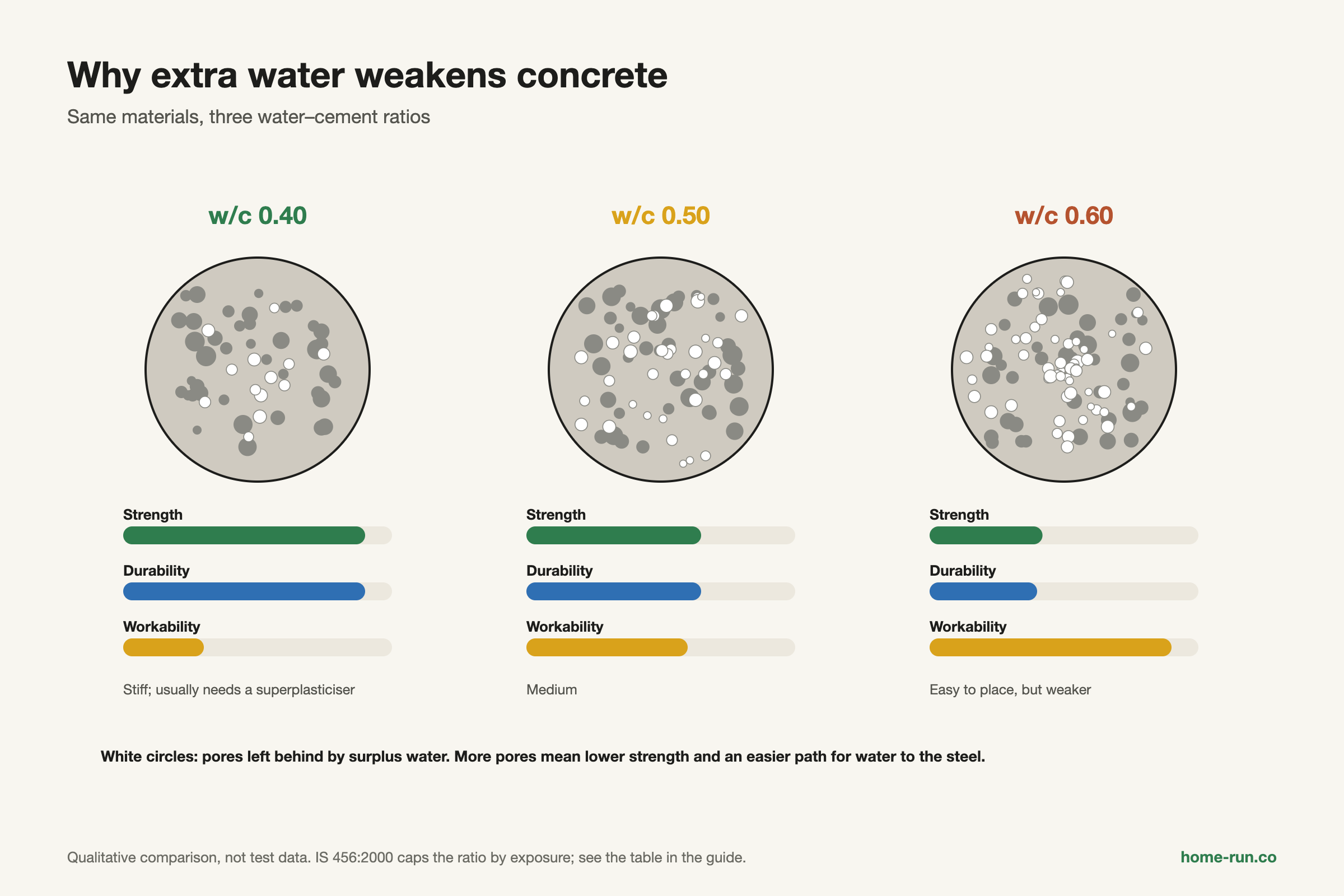
- Strength: a lower ratio gives a denser paste and higher 28-day compressive strength.
- Durability: fewer linked pores let less water, chloride and carbon dioxide reach the steel, so rebars rust more slowly.
- Cracking: more water means more drying shrinkage and more surface cracks.
- Workability: more water makes the mix easier to place, which is why crews are tempted to add it.
Common water cement ratios and where they fit
Caps from IS 456:2000| Ratio | Workability without admixture | Where the code allows it |
|---|---|---|
| 0.40 | Stiff; usually needs a superplasticiser | RCC and PCC in extreme exposure |
| 0.45 | Low to medium | RCC in severe and very severe exposure |
| 0.50 Common pick | Medium | RCC in moderate exposure; PCC in severe |
| 0.55 | Medium to high | RCC in mild exposure only |
| 0.60 Not for RCC | High | PCC in mild and moderate exposure |
Fix workability with the mix design or an admixture, never with the hose. One extra bucket raises the ratio of the whole batch.
How Do You Calculate the Water Cement Ratio?
Calculate the water cement ratio by dividing the weight of free water by the weight of cement. One litre of water weighs about 1 kg, so litres and kilograms swap directly.
For a single bag, multiply 50 kg by the ratio. At 0.45 that is 50 × 0.45 = 22.5 litres.
Water per 50 kg bag of cement
Free water, in litres| Water cement ratio | Water per bag | Typical use |
|---|---|---|
| 0.40 | 20.0 L | High-strength or extreme-exposure concrete |
| 0.45 | 22.5 L | Water tanks, sumps, severe exposure |
| 0.50 | 25.0 L | Footings, columns, slabs in moderate exposure |
| 0.55 | 27.5 L | Indoor RCC protected from weather |
| 0.60 | 30.0 L | PCC bed concrete, levelling courses |
Correct for moisture before you add water. For example, 100 kg of sand with 4% surface moisture brings 4 litres of water into the drum. Very dry, absorbent stone works the other way and soaks up mix water.
How do you find water and cement per cubic metre?
For a designed mix, IS 10262:2019, the Indian guideline for concrete mix proportioning, fixes the water first, then the ratio, then the cement.
- Target mean strength: f'ck = fck + 1.65 s, or fck + X, whichever is higher. For M20 and M25, s = 4.0 N/mm² and X = 5.5 (good site control).
- Water cement ratio: read it from the code's strength curves (Fig. 1) or trial mixes, then cap it at the IS 456 Table 5 limit.
- Water: 186 kg/m³ for 20 mm angular aggregate at 50 mm slump (208 kg for 10 mm, 165 kg for 40 mm). Add about 3% for each extra 25 mm of slump.
- Cement: water ÷ ratio. Check it against the IS 456 Table 5 minimum for the exposure.
We used the 0.50 cap to show the arithmetic. Your engineer may adopt a lower ratio from Fig. 1 or trial batches, and cube tests must prove the 31.6 N/mm² target.
Mixing concrete this week?
Cement, aggregates and admixtures delivered across Bengaluru.
What Is the Maximum Water Cement Ratio as per IS 456?
IS 456:2000 Table 5 sets the maximum free water cement ratio between 0.60 and 0.40. The limit depends on exposure and on whether the concrete is plain (PCC) or reinforced (RCC).
IS 456 Table 5: limits by exposure
20 mm aggregate| Exposure (IS 456 Table 3) | PCC max w/c | PCC min cement | RCC max w/c | RCC min cement | RCC min grade |
|---|---|---|---|---|---|
| Mild: protected from weather, not coastal | 0.60 | 220 kg/m³ | 0.55 | 300 kg/m³ | M20 |
| Moderate: sheltered from severe rain, in non-aggressive soil, under water Most Bengaluru homes | 0.60 | 240 kg/m³ | 0.50 | 300 kg/m³ | M25 |
| Severe: alternate wetting and drying, coastal | 0.50 | 250 kg/m³ | 0.45 | 320 kg/m³ | M30 |
| Very severe: sea-water spray, aggressive soil or groundwater | 0.45 | 260 kg/m³ | 0.45 | 340 kg/m³ | M35 |
| Extreme: tidal zone, aggressive chemicals | 0.40 | 280 kg/m³ | 0.40 | 360 kg/m³ | M40 |
Bengaluru is inland, so most house concrete is mild or moderate exposure. Treat footings in soil, roof slabs and sunshades as moderate: 0.50 maximum and M25 minimum for RCC. Sumps and tanks that wet and dry may count as severe (0.45). Confirm the class with your structural engineer.
For comparison, ACI 318, the American Concrete Institute building code, also caps the ratio at 0.45 for severe sulfate exposure. The logic is the same worldwide: harsher exposure, less water.
Which Ratio Suits M20, M25 and M30 Concrete?
No grade has one fixed water cement ratio; the mix design sets it and the exposure caps it. For RCC, the lower of the two limits always governs.
Water cement ratio by concrete grade
RCC, IS 456:2000| Grade | Harshest RCC exposure allowed | Max w/c for that use | Water per 50 kg bag |
|---|---|---|---|
| M20 | Mild only | 0.55 | 27.5 L |
| M25 Typical house RCC | Up to moderate | 0.50 | 25.0 L |
| M30 | Up to severe | 0.45 | 22.5 L |
IS 456 Table 9 allows up to 30 litres of water per 50 kg bag for an M20 nominal mix, a ratio of 0.60. For reinforced work in mild exposure, Table 5 still caps it at 0.55, so use 27.5 litres. See our guides to the M20 concrete ratio and the M30 concrete ratio for full proportions.
How Does a Slump Test Show Extra Water?
The slump test checks workability, which tells you on site whether extra water has gone into the mix. It does not measure the ratio directly, so compare the result with the slump in the mix design.
IS 1199 (Part 2):2018, the Indian method for testing fresh concrete, sets the procedure:
- Set up the cone. Dampen the mould (200 mm base, 100 mm top, 300 mm high) and stand it on a flat, non-absorbent base.
- Fill in three layers. Tamp each layer 25 times with a 16 mm steel rod, 600 mm long.
- Strike off. Level the top and clean spilled concrete from around the base.
- Lift the cone. Raise it straight up in 5 ± 2 seconds. Finish the test within 180 seconds of starting to fill.
- Measure the drop. Record the height from the mould top to the highest point of the concrete, to the nearest 5 mm.
IS 456 guides workability at 25–75 mm slump for lightly reinforced slabs, beams, walls and footings, and 75–100 mm for heavily reinforced or pumped work. If the concrete shears or collapses, retest with a fresh sample. Two failures in a row make the test invalid and point to a wet or poorly graded mix.
For ready-mixed concrete, order a slump within the supplier's ±25 mm tolerance and test every truck before it discharges.
Which Site Mistakes Add Too Much Water?
Most site errors raise the water cement ratio, because extra water is the quickest way to make a stiff mix easy to place.
- Water by guesswork: buckets of unknown size, or a running hose. Fix: mark a measure for the exact litres per bag.
- Ignoring wet sand: sand stockpiled through Bengaluru's monsoon can hold a lot of extra water. Fix: squeeze-test or weigh a sample and cut the added water.
- Water added to ready-mix: IS 4926, the Indian code for ready-mixed concrete, allows no extra water in the drum unless the buyer requests and signs for it. Fix: refuse it; ask the supplier to restore slump with an agreed admixture.
- Retempering: adding water to concrete that has begun to stiffen. Fix: mix smaller batches and place within the working time.
- Too little water: a dry, stony mix that cannot be compacted leaves honeycombs. Fix: keep the design water and add a plasticiser instead.
- Hot afternoon pours: in Bengaluru's March to May heat the surface dries fast and crews add water. Fix: pour early and start curing on time.
How Can You Cut Water Without Losing Workability?
Lower the water cement ratio by using admixtures and better materials, not by simply cutting water. IS 9103 is the Indian specification for concrete admixtures.
- Plasticiser (water reducer): typically cuts water by 5–10% at the same slump.
- Superplasticiser: cuts water by 20–30% or more at the right dose, as in the worked example above.
- Aggregate shape: rounded stone needs less water. IS 10262 lowers base water by 10 kg/m³ for sub-angular and 20 kg/m³ for rounded gravel.
- Fly ash or slag: PPC and slag cements count as cementitious material in the ratio, within IS 456 limits.
- Curing: keep low-ratio concrete moist for the full IS 456 curing period, longer for blended cements, so it can hydrate.
Extra water
AvoidPoint
- Raises the ratio for the whole batch
- Lowers strength and adds pores
- Increases shrinkage cracks and bleeding
Superplasticiser
Better choicePoint
- Keeps the design ratio unchanged
- Restores slump for pumping or dense steel
- Needs the dose agreed with the supplier
What Should You Check Before the Pour?
Check that the water cement ratio is written down, measurable and testable before any concrete is mixed.
- Exposure class and maximum ratio noted on the drawing or mix design
- Litres of water per bag marked on the site measure
- Sand and stone moisture checked, with added water reduced to suit
- Slump cone, 16 mm rod and base plate on site
- Admixture type and dose agreed in writing
- Cube moulds ready for 7- and 28-day strength tests
- Curing water, hessian or plastic sheet ready
The ratio only works with consistent cement. Compare grades in our guide to OPC cement before you place the order.