


On this page
- What Is the M20 Concrete Ratio and What Does 1:1.5:3 Mean?
- Is the M20 Ratio by Volume or by Weight?
- How Much Cement, Sand and Aggregate Do You Need for 1 m³ of M20?
- How Do You Calculate M20 Materials for Your Own Slab?
- What Is the Water-Cement Ratio for M20 Concrete?
- Nominal Mix or Design Mix: Which M20 Do You Need?
- How Does M20 Compare With M15, M25 and M30?
- Where Is M20 Concrete Used, and Is It Enough for Your House?
- How Do You Mix, Place and Cure M20 Concrete?
- How Do You Test M20 Concrete?
- Site-Mixed or Ready-Mix M20: Which Costs Less?
- What Mistakes Weaken M20 Concrete?
- How Should You Plan Your M20 Pour?
- The M20 concrete ratio is 1:1.5:3 (cement : sand : aggregate) by volume.
- 1 m³ of M20 needs about 8.06 bags of cement, 0.42 m³ of sand and 0.84 m³ of 20 mm aggregate.
- Keep the water-cement ratio at 0.55 or lower for RCC in mild exposure; 0.50 means 25 litres per bag.
- IS 456 allows nominal mixes up to M20. M25 and above need a design mix.
- Cure for at least 7 days with OPC and 10 days with PPC, longer in hot, dry weather.
The M20 concrete ratio is 1:1.5:3, meaning 1 part cement, 1.5 parts sand and 3 parts coarse aggregate by volume. One cubic metre of M20 concrete needs about 8 bags of cement, 0.42 m³ of sand and 0.84 m³ of aggregate. M20 reaches a characteristic strength of 20 N/mm² at 28 days.
This guide shows how those quantities are calculated, how much water to add, how to mix and cure M20, and when you should switch to a design mix or ready-mix concrete.
What Is the M20 Concrete Ratio and What Does 1:1.5:3 Mean?
M20 is a grade of concrete defined in IS 456:2000, the Indian code for plain and reinforced concrete. "M" stands for mix, and "20" is the characteristic compressive strength in N/mm² (MPa) of 150 mm cubes tested at 28 days.
Characteristic strength is the strength below which no more than 5% of test results are expected to fall. So most M20 cubes test well above 20 N/mm².
The ratio 1:1.5:3 tells you the proportions:
- 1 part cement, usually OPC 43/53 grade or PPC
- 1.5 parts fine aggregate, which is river sand or M-sand
- 3 parts coarse aggregate, usually 20 mm crushed stone
M20 is the lowest grade IS 456 allows for reinforced concrete in mild exposure, which is why it is the default for most house slabs, beams and columns.
Is the M20 Ratio by Volume or by Weight?
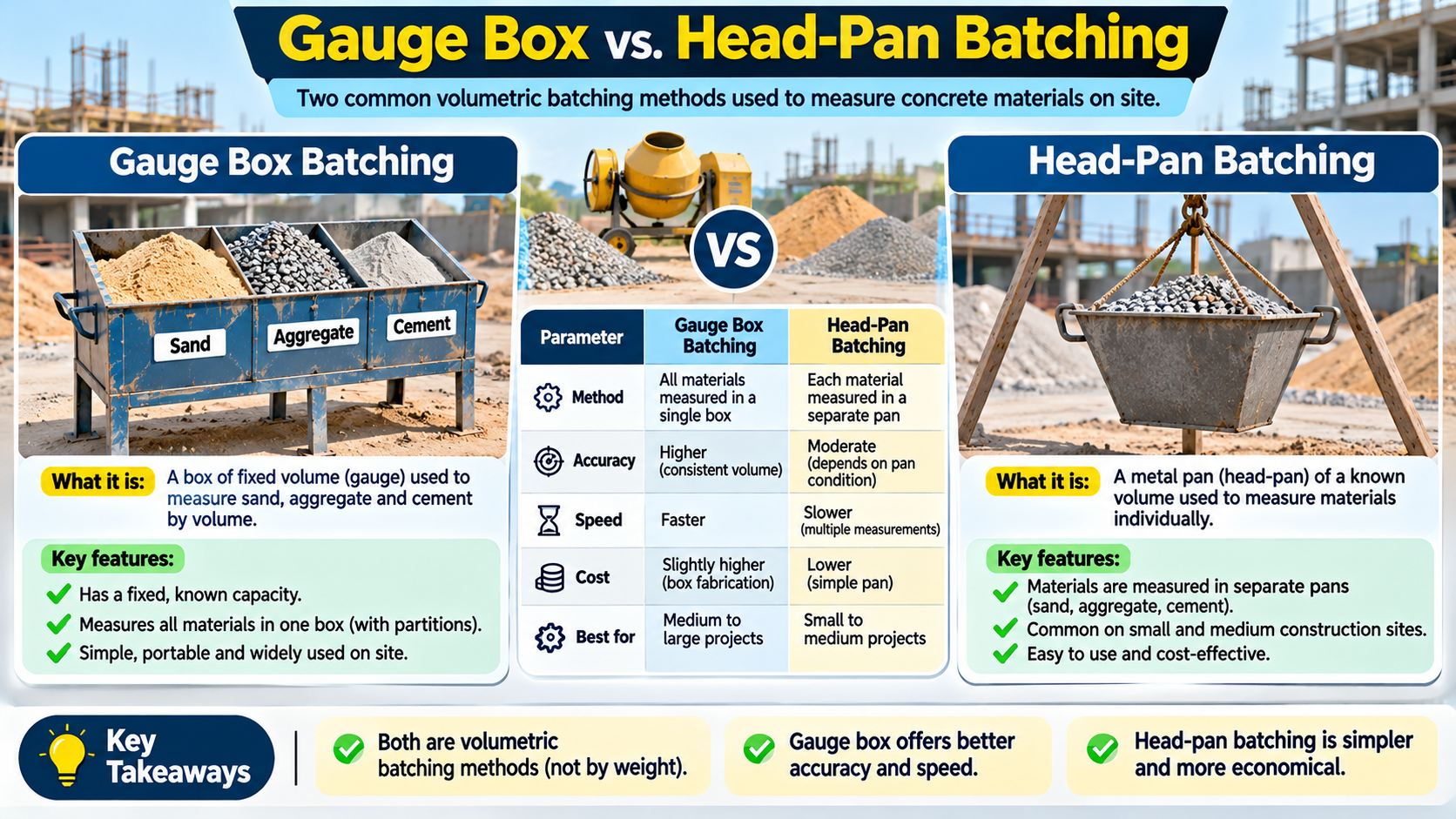
The 1:1.5:3 ratio is by volume. Site crews measure it with gauge boxes, while bag and kilogram figures come from converting volume using material densities.
- Volume batching: use a wooden or steel gauge box that holds exactly one 50 kg bag of cement (about 0.035 m³). Fill it 1.5 times with sand and 3 times with aggregate per bag.
- Weight batching: weighs every ingredient. It is more accurate and is how ready-mix plants work.
- Bulking of sand: damp sand swells, so a box of wet sand holds less sand than a box of dry sand. Add extra sand when it is moist, or the mix becomes cement-rich and sand-poor.
Counting head pans or shovels is the most common batching error on Indian sites. Pans are filled unevenly, so the real ratio drifts. Use a gauge box for every batch.
How Much Cement, Sand and Aggregate Do You Need for 1 m³ of M20?
For 1 m³ of M20 concrete you need about 403 kg of cement (8.06 bags), 0.42 m³ of sand and 0.84 m³ of coarse aggregate. Here is how to calculate it.
M20 concrete quantities for common volumes
Before wastage| Concrete volume | Cement (bags) | Sand (m³) | Aggregate (m³) |
|---|---|---|---|
| 0.5 m³ | 4.03 | 0.21 | 0.42 |
| 1 m³ | 8.06 | 0.42 | 0.84 |
| 5 m³ | 40.3 | 2.10 | 4.20 |
Multiply your concrete volume in m³ by 8 to get cement bags, then add a wastage allowance agreed with your site engineer. Round up to whole bags.
How Do You Calculate M20 Materials for Your Own Slab?
You calculate M20 materials by finding the concrete volume (length × width × thickness), adding wastage, then multiplying by the per-m³ quantities above.
Beams, columns and footings work the same way. Add up each element's volume first. Do not deduct the steel; reinforcement takes up very little volume.
What Is the Water-Cement Ratio for M20 Concrete?
The water-cement ratio for M20 concrete is usually 0.45–0.55. IS 456 Table 5 caps it at 0.55 for reinforced concrete in mild exposure and 0.50 in moderate exposure.
- At 0.50: 25 litres of water per 50 kg bag of cement.
- At 0.55 (maximum for mild exposure): 27.5 litres per bag.
- Moisture in sand counts: wet sand already carries water, so reduce the added water.
Workability is checked with the slump test. Extra water makes concrete easier to pour but weaker, and it causes bleeding, segregation and shrinkage cracks. If you need a more flowable mix, ask for a plasticiser admixture instead of more water.
Nominal Mix or Design Mix: Which M20 Do You Need?
A nominal mix like 1:1.5:3 is a fixed recipe and suits small residential pours. A design mix is proportioned in a lab from your actual materials to hit a target strength, and it usually saves cement on larger jobs.
Nominal mix M20
Small jobsFixed 1:1.5:3 proportions from IS 456.
- No lab testing needed to start
- Easy to batch with gauge boxes
- Allowed up to M20 under IS 456
- Uses more cement than needed
Design mix M20
Larger poursProportioned to IS 10262 from tested materials.
- Targets a mean strength of about 26.6 N/mm²
- Often lower cement content and cost
- Needs trial mixes and quality control
- Required for M25 and above
The target mean strength comes from IS 10262: 20 + 1.65 × 4 (the assumed standard deviation for M20) = 26.6 N/mm².
How Does M20 Compare With M15, M25 and M30?
M20 sits in the middle of the common residential grades. Lower grades suit plain concrete; higher grades suit heavier loads, harsher exposure or taller buildings.
Concrete grades compared
Nominal ratios as commonly used in India| Grade | Ratio (C:S:A) | Strength (N/mm²) | Typical use |
|---|---|---|---|
| M10 | 1:3:6 | 10 | PCC levelling, bed concrete |
| M15 | 1:2:4 | 15 | PCC under footings, floors |
| M20 Default pick | 1:1.5:3 | 20 | House slabs, beams, columns, footings |
| M25 | Design mix (1:1:2 often quoted) | 25 | Moderate exposure, multi-storey RCC |
| M30 | Design mix | 30 | Severe exposure, heavy loads |
Use M20 for most low-rise house RCC. Move to M25 or higher where the structural drawing says so, or where the building faces moderate or severe exposure such as coastal air. The engineer's drawing always overrides a rule of thumb.
Where Is M20 Concrete Used, and Is It Enough for Your House?
M20 concrete is enough for the slabs, beams, columns and footings of most low-rise Indian homes in mild exposure. Common uses include:
- Roof and floor slabs, beams and columns in G+1 and G+2 homes
- Isolated and strip footings
- Driveways, pavements and compound wall beams
- Small retaining walls
Water tanks and sumps are different. Liquid-retaining structures follow IS 3370, which has its own grade and crack-width rules, so follow the structural design rather than defaulting to M20. Reinforcement size and spacing also come from the engineer, not from the grade.
How Do You Mix, Place and Cure M20 Concrete?
Mix M20 by batching with gauge boxes, mixing dry, adding water gradually, then placing, compacting and curing. Follow this order:
- Batch one bag of cement, 1.5 boxes of sand and 3 boxes of aggregate.
- Mix dry until the colour is even. A drum mixer gives a more uniform mix than hand mixing.
- Add water gradually to the measured quantity, then mix for about two minutes.
- Place within about 30 minutes of mixing, without dropping it from a height.
- Compact with a needle vibrator to remove air and avoid honeycombing.
- Finish the surface, then start curing once it has set.
- Cure for at least 7 days with OPC, and at least 10 days with PPC or other blended cements, as IS 456 recommends. Extend both in hot, dry weather.
Before the pour: check you have these on site
- Gauge box sized to one 50 kg cement bag
- Cement, sand and aggregate for the full pour, plus wastage
- Clean water and a measuring bucket
- Mixer and needle vibrator, with fuel or power
- Slump cone and three 150 mm cube moulds
- Hessian, water and a curing plan for the next 7–10 days
How Do You Test M20 Concrete?
You test M20 concrete with a slump test for workability on site and a cube test for strength at 7 and 28 days.
- Slump test: fill a standard cone in three layers, lift it and measure how far the concrete drops. IS 456 suggests about 25–75 mm for lightly reinforced slabs, beams and footings, and 50–100 mm for heavily reinforced sections.
- Cube test: cast 150 mm cubes from the same batch and crush them at a lab as per IS 516. The 28-day result is the one that counts.
- 7-day check: cubes commonly reach about two-thirds of their 28-day strength at 7 days. A very low 7-day result is an early warning.
IS 456 Table 11 sets the acceptance rules for a group of cube results. Ask your engineer or the lab to apply it, rather than judging from a single cube.
Site-Mixed or Ready-Mix M20: Which Costs Less?
Site-mixed M20 usually costs less in materials for small pours, while ready-mix concrete (RMC) gives more consistent quality and saves labour on larger slabs.
M20 cost signals in Bengaluru
Market data, April–May 2026| Item | Price |
|---|---|
| Ready-mix M20, per m³ | ₹5,000–6,160 |
| Pumping, extra per m³ | ₹200–400 |
| OPC 43 cement, per 50 kg bag | ₹385–425 |
| PPC cement, per 50 kg bag | ₹365–405 |
| Cement for 1 m³ site-mixed M20 (8.06 bags of OPC 43) | ₹3,103–3,426 |
Ready-mix makes sense when the pour is large (a full roof slab), access is good for the truck and the pump, and you want a test certificate with the delivery. Site mixing suits small or scattered pours such as footings, lintels and repairs.
Order M20 materials in the right quantities
Cement, M-sand, 20 mm aggregate and TMT steel for slabs, footings and columns, delivered across Bengaluru. Genuine stock, GST invoice.
What Mistakes Weaken M20 Concrete?
Excess water, eyeballed proportions and missed curing are the mistakes that weaken M20 concrete most often. Watch for these signs:
- Segregation: stones settle and slurry floats, usually from too much water or dropping concrete from a height
- Bleeding: water collects on top, leaving a weak, dusty surface
- Honeycombing: voids at the formwork face from poor compaction
- Dusting and surface cracks: the slab dried out before it was cured
- Low cube results: wrong proportions, damp sand not adjusted for, or dirty aggregate
The cheapest way to lose a grade of concrete is a bucket of extra water. The cheapest way to keep it is a week of curing.
HomeRun Editorial Desk
How Should You Plan Your M20 Pour?
Plan an M20 pour in four steps:
- Confirm the grade and exposure class on the structural drawing
- Calculate volume, then cement bags, sand and aggregate with the method above
- Source clean, graded sand and aggregate, and fresh cement
- Book labour, the mixer or RMC truck, and plan 7–10 days of curing