On this page
- What Is White Cement and Why Use It on Walls?
- What Materials and Tools Do You Need?
- How Do You Prepare a Wall Before Applying White Cement?
- How Do You Mix White Cement With Water?
- How to Apply White Cement on a Wall: Step by Step
- How Much White Cement Do You Need for a Room?
- Should You Apply White Cement Yourself or Hire a Painter?
- Can You Paint Over White Cement?
- What Problems Can Occur, and How Do You Fix Them?
- Clean the wall, then soak it with water before you start.
- Add powder to water and use each batch within 1.5–2 hours.
- Brush on two thin coats, at least 24 hours apart, out of direct sun.
- Water-cure the final coat for 3–5 days; use a thick paste for cracks.
To apply white cement on a wall, you clean and wet the surface, mix the white cement with water into a smooth slurry, brush on two thin coats 24 hours apart, and keep the wall damp for 3–5 days.
What Is White Cement and Why Use It on Walls?
White cement is a Portland cement made from raw materials low in iron and manganese, so it sets bright white instead of grey. On walls, it works as a thin wash and as a white crack filler.
A wash suits compound walls, parapets and utility areas. For tile joints and decorative work, see our guide to white cement uses, and for the chemistry, white cement composition and properties.
What Materials and Tools Do You Need?
You need white cement, water, a bucket and a brush for a wash, plus sand and a trowel for patches.
- White cement, or a ready white cement wash product
- Clean water and clean fine sand (sand for patches only)
- Bucket, stirrer and a measuring mug
- 4–5 inch painting brush or roller
- Steel trowel and putty knife
- Wire brush, sandpaper and a hose
- Gloves, goggles and a dust mask
How Do You Prepare a Wall Before Applying White Cement?
You prepare a wall by cleaning it, repairing cracks and soaking it with water.
- Clean the wall. Wire-brush off dust, oil, loose paint and salt deposits.
- Scrape old finishes. Scrape or brush down walls finished with lime, oil paint or varnish so the wash can bond.
- Repair cracks. Rake out cracks, fill them with white cement paste and let the patch set.
- Dampen the wall. Wet it until water starts to run down, and keep it moist while you work.
How Do You Mix White Cement With Water?
You mix white cement by adding the powder to the water and stirring until the slurry is creamy and lump-free. Birla White's Ever White Cement Wash datasheet gives 1 kg of powder to 1.2 litres of water.
Stir 3–5 minutes with a mechanical stirrer or 10–12 minutes by hand, and use the slurry within 1.5–2 hours. Other published ratios run from 1:1 to 2:1 water to cement, so follow your bag.
White cement mixes for wall work
Always check the ratio on your bag first| Job | Mix | Consistency | Apply with |
|---|---|---|---|
| Wall wash Most common | 1 kg powder : 1.2 L water | Creamy slurry | 4–5 inch brush or roller |
| Crack filling | White cement + a little water | Thick paste that holds its shape | Putty knife |
| Thin patch or plaster coat | 1 part white cement : 2–3 parts sand | Thick, spreadable mortar | Steel trowel, 2–3 mm layer |
How to Apply White Cement on a Wall: Step by Step
To apply white cement on a wall, brush thin coats onto the damp wall, 24 hours apart, and cure each coat with water.
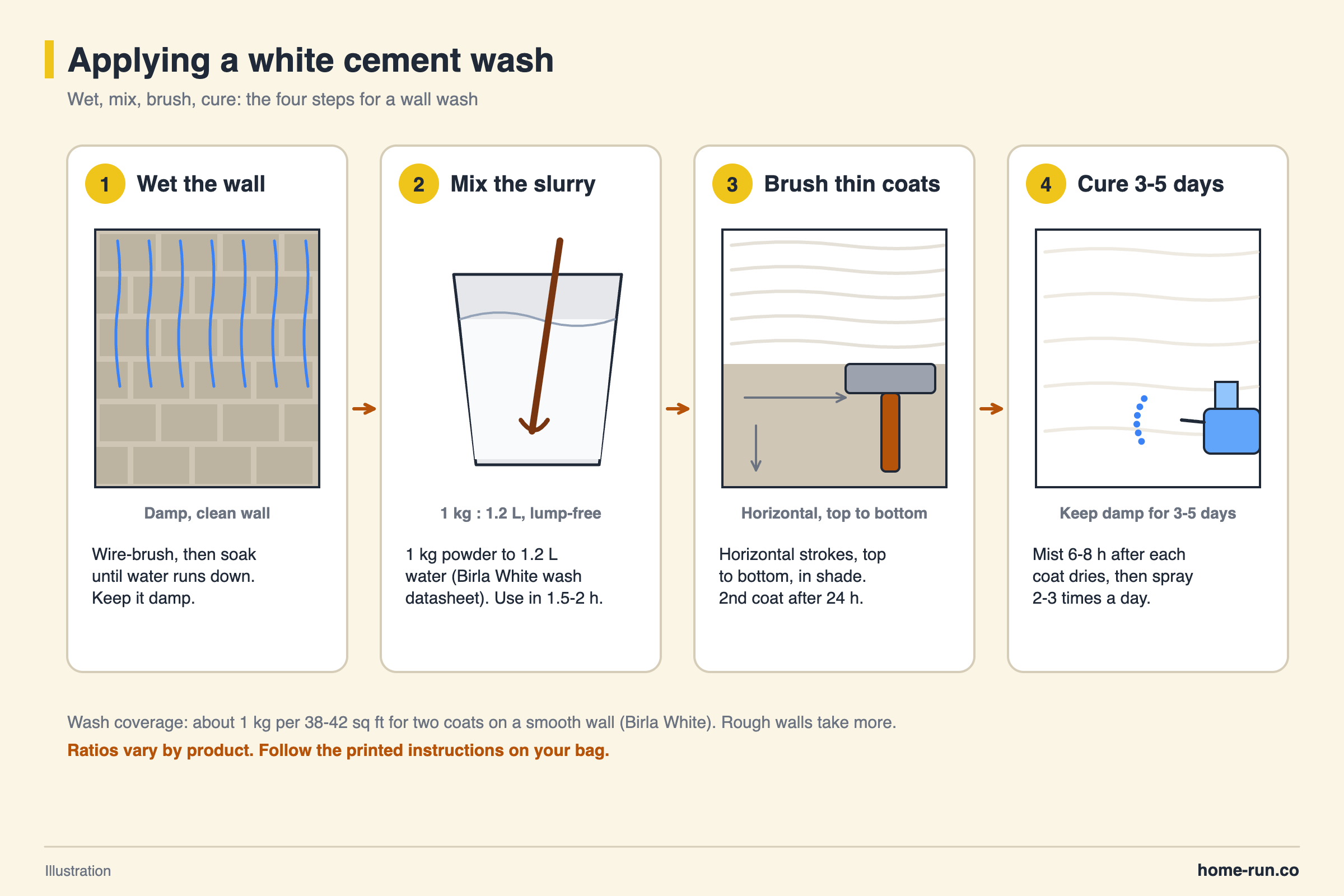
- Work in shade. Direct sun sets the cement fast and leaves brush marks.
- Re-wet the wall. The surface must stay damp while you apply.
- Apply the first coat. Brush horizontally, working top to bottom.
- Mist the coat. Spray it with water 6–8 hours after it dries.
- Apply the second coat. After at least 24 hours, wet the wall and repeat.
- Cure the wall. Spray water 2–3 times a day for 3–5 days.
How Much White Cement Do You Need for a Room?
You need about 1 kg of white cement wash per 38–42 sq ft of wall for two coats, per Birla White's test on a smooth surface. Rough walls take more.
At HomeRun's May 2026 Bengaluru price for Birla White cement (₹140 per 5 kg, ₹40 per 1 kg), 11 kg costs ₹320.
Starting a white cement wall this week?
Delivered across Bengaluru.
Should You Apply White Cement Yourself or Hire a Painter?
A white cement wash on a small, sound wall is a fair DIY job. Hire a painter for large, high or damaged walls.
DIY
Small, sound wallsPoints
- Compound walls, parapets, utility areas
- Brush, bucket and hose only
- Material cost only
- You handle 3–5 days of curing
Professional painter
Large or damaged wallsPoints
- Whole houses, ceilings, high walls
- Brings scaffolding and safety gear
- More even finish on large areas
- Spots damp or cracks needing repair
Can You Paint Over White Cement?
Yes, you can paint over white cement once it has cured and dried. Sand bumps, wipe off powder, apply a cement-surface primer, then paint. For a textured base, see our wall putty design ideas.
What Problems Can Occur, and How Do You Fix Them?
The common problems are brush marks, cracks, powdering and peeling, mostly from sun, thick coats or skipped curing.
- Brush marks: the coat set too fast in sun. Work in shade.
- Cracks: the coat went on too thick. Keep patch coats to 2–3 mm.
- Powdering: a dry wall or skipped curing. Wet first, cure 3–5 days.
- Peeling: the wash went over dust, oil or old paint. Scrape and redo.
Wet cement has a pH of 11 to 13.5 in cement safety data sheets, and long contact can cause painless burns. Wear gloves, goggles and long sleeves. If cement enters an eye, flush with clean water for at least 20 minutes and see a doctor.