On this page
- What Is VDF Flooring and What Does the Full Form Mean?
- How Does Vacuum Dewatering Work?
- How Is VDF Flooring Laid, Step by Step?
- What Role Do Steel Fibres and Floor Hardener Play?
- VDF vs IPS Flooring: Which Should You Choose?
- What Are the Disadvantages of a Vacuum Dewatered Floor?
- How Much Does VDF Flooring Cost?
- How Do You Choose a Contractor and Check the Work?
- VDF flooring is a concrete slab with surplus water vacuumed out after levelling.
- Removing 15–25% of the mixing water gives a denser, harder surface with less shrinkage.
- It suits warehouses, factories and parking; IPS suits homes.
- Plain VDF costs about ₹60–110 per sq ft (2026 indicative), with hardeners adding more.
- Most cracks come from late joint cutting or short curing.
VDF flooring is a concrete floor from which a vacuum pump draws excess water soon after pouring, leaving a dense, hard slab that is power-trowelled smooth. This guide covers its benefits, the laying process, cost drivers and how it compares with IPS flooring.
What Is VDF Flooring and What Does the Full Form Mean?
VDF stands for Vacuum Dewatered Flooring. VDF is a way of placing and finishing concrete, not a separate material or a coating.
The slab is normal structural concrete, usually M20 to M30. Indian sellers also call it "Tremix" or "trimix" flooring, after an equipment brand.
Concrete needs extra water to flow, and that water later leaves pores. Pulling it out while the concrete is fresh lowers the water-cement ratio near the surface, so the top layer packs tighter.
How Does Vacuum Dewatering Work?
Vacuum dewatering works by laying a filter mat and airtight cover over the levelled concrete and connecting them to a pump that sucks water out.
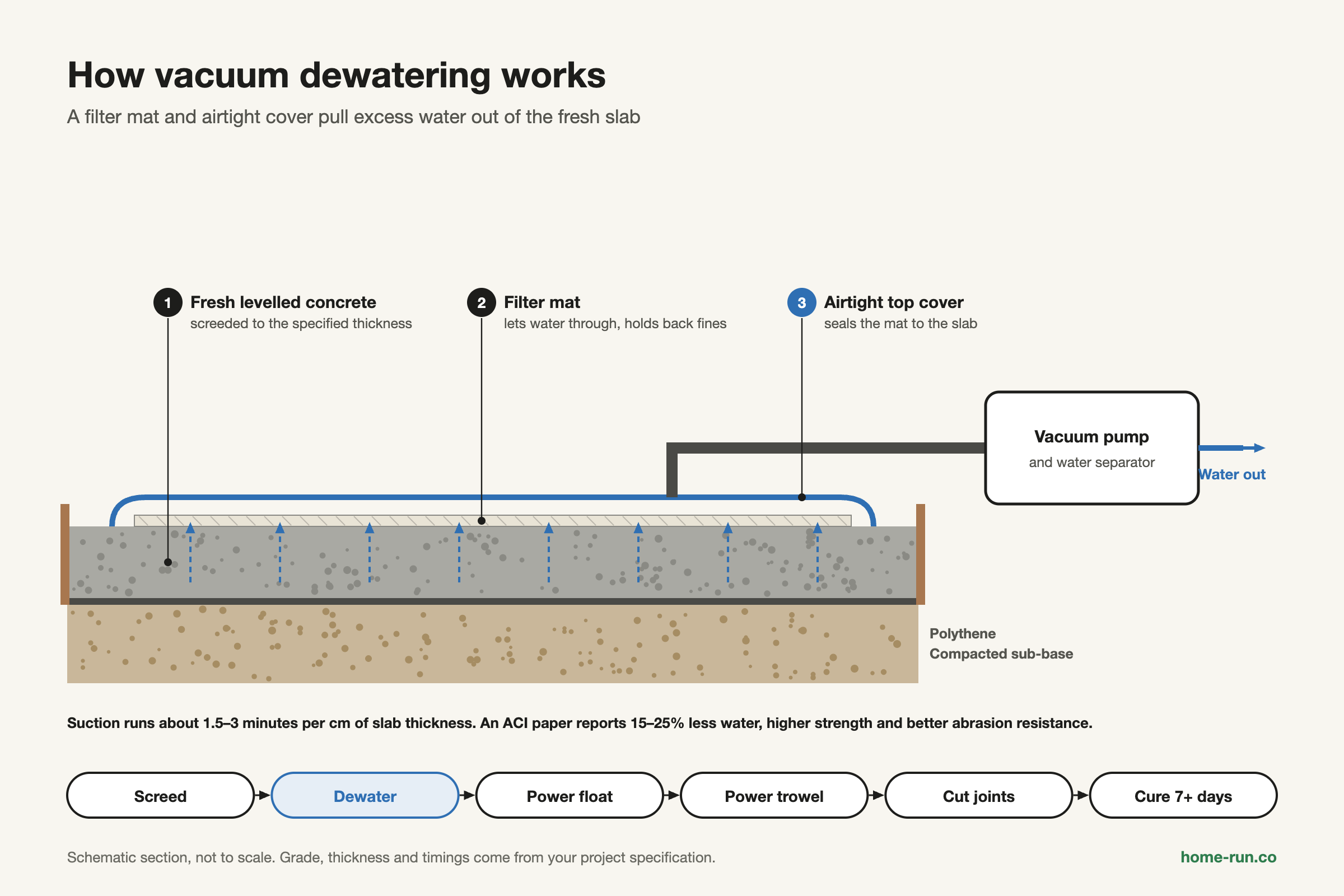
A 1981 paper in Concrete International, the American Concrete Institute (ACI) journal, reports 15–25% less water, higher strength, better abrasion resistance and lower shrinkage.
Suction runs about 1.5–3 minutes per cm of slab thickness (Studio Matrx).
How Is VDF Flooring Laid, Step by Step?
VDF flooring is laid in eight steps. Grade, thickness and timings come from your project specification.
- Prepare the base. Compact the sub-base, lay polythene, fix edge forms.
- Reinforce. Fix mesh or plan steel fibres.
- Pour and screed. Level with a vibrating double-beam screed.
- Dewater. Run the vacuum mats until the surface firms up.
- Power float. Close the surface; spread any dry-shake hardener.
- Power trowel. Blades give the final dense finish.
- Cut joints. Saw-cut within hours, to a quarter to a third of slab depth.
- Cure and seal. Moist-cure at least 7 days; seal trafficked joints.
A VDF surface looks hard early, so crews skip curing. Random cracks usually come from late sawing or fast drying.
What Role Do Steel Fibres and Floor Hardener Play?
Steel fibres and dry-shake hardener are optional VDF upgrades. Fibres control cracking; hardener toughens the surface.
- Steel fibres can reduce or replace mesh.
- Non-metallic hardener (quartz or emery) is the standard warehouse choice.
- Metallic hardener (iron particles) suits the heaviest traffic but can rust-stain in wet areas.
Let your flooring consultant set fibre dosage and hardener rate from the manufacturer's data sheet.
VDF vs IPS Flooring: Which Should You Choose?
Choose VDF flooring for large, heavily trafficked industrial floors. Choose IPS flooring for homes and light-traffic areas.
IPS (Indian Patent Stone) is a thin cement topping laid on site in small panels, the grey cousin of red oxide flooring.
VDF flooring
Heavy dutyPoint
- Full slab, 100–200 mm thick
- Panels about 3–4.5 m each way
- Machine-trowelled, flat finish
- Needs vacuum and trowel machines
IPS flooring
BudgetPoint
- Topping about 20–40 mm thick
- Panels about 1 m × 1 m
- Hand-finished, can be polished
- Needs only a skilled mason
VDF vs conventional concrete vs IPS flooring
Indicative, India| Factor | VDF | Conventional concrete | IPS |
|---|---|---|---|
| What it is | Slab dewatered, then power-trowelled | Slab finished without dewatering | Thin in-situ cement topping |
| Best for VDF pick | Warehouses, factories, parking | Utility and low-traffic areas | Homes, balconies, verandas |
| Rate, ₹/sq ft | 60–110 | 40–90 | 40–80 |
IPS follows IS 2571, the Bureau of Indian Standards code for laying in-situ cement concrete flooring. VDF has no dedicated IS code.
What Are the Disadvantages of a Vacuum Dewatered Floor?
The main disadvantages of VDF flooring are cost, equipment dependence and tight timing:
- Uneconomic for small areas
- Depends on crew skill and a short finishing window
- Heat, wind and rain during the pour affect the finish
- Plain VDF does not resist chemicals; wet or chemical areas need an epoxy floor coating on top
- Few colour or design options compared with tiles
How Much Does VDF Flooring Cost?
VDF flooring costs about ₹60–110 per sq ft for a plain 100–150 mm floor (Studio Matrx, June 2026). Thickness, hardener and site size move the rate most.
VDF flooring rate by specification
₹ per sq ft, applied, before GST| Specification | Rate |
|---|---|
| Plain VDF, 100–150 mm | 60–110 |
| VDF + non-metallic hardener Common | 90–150 |
| VDF + metallic hardener | 130–200 |
| Heavy VDF, 150–200 mm | 120–200+ |
For grade choice, see our guide to the M20 concrete ratio.
Planning a concrete floor?
Get cement, steel and sand delivered across Bengaluru with a GST invoice.
How Do You Choose a Contractor and Check the Work?
Choose a contractor on proof of similar work. Confirm:
- Past warehouse or factory floors you can visit
- Own vacuum pump, mats, screed and power trowels
- Mix design and cube-test records for the grade
- A written joint layout and sawing timeline
- Flatness check on handover and written warranty